







Question: Exercise 3.3. (Estimator #1: non-parametric) The simplest way to estimate the net premium II( R) is to use an empirical estimator of (6) given by
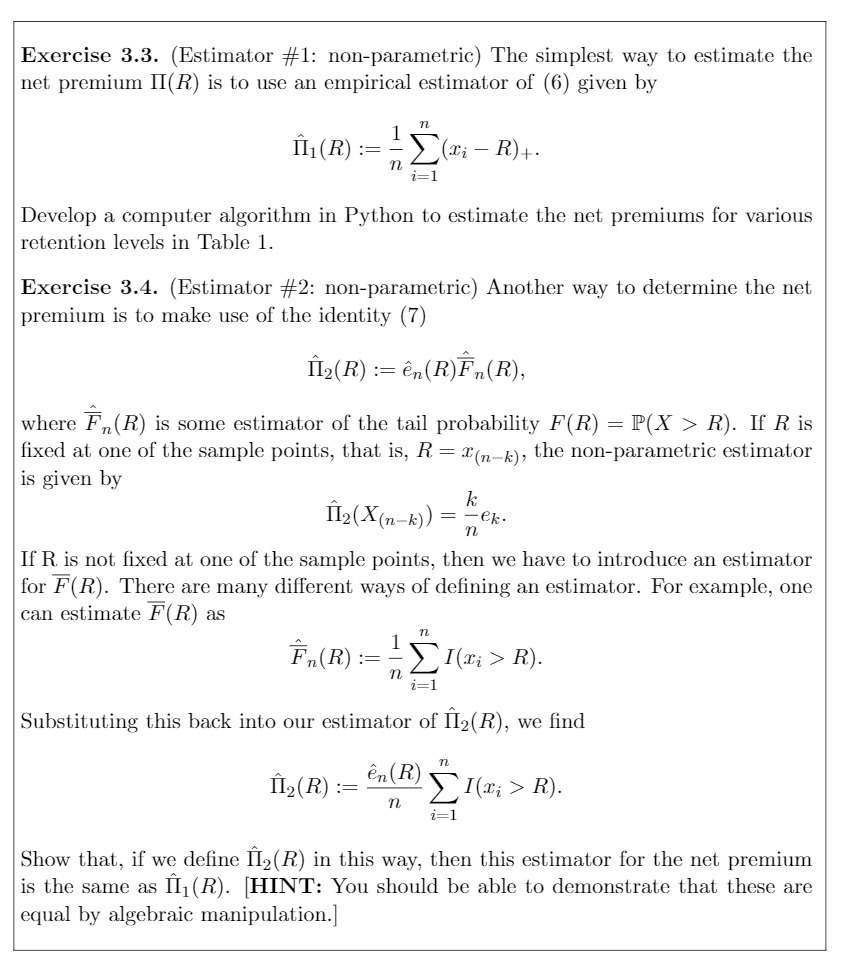
Exercise 3.3. (Estimator #1: non-parametric) The simplest way to estimate the net premium II( R) is to use an empirical estimator of (6) given by I(R) := (x - R)+. n i= 1 Develop a computer algorithm in Python to estimate the net premiums for various retention levels in Table 1. Exercise 3.4. (Estimator #2: non-parametric) Another way to determine the net premium is to make use of the identity (7) I12 ( R) : = en( R ) Fn ( R ), where Fn(R) is some estimator of the tail probability F(R) = P(X > R). If R is fixed at one of the sample points, that is, R = (n-k), the non-parametric estimator is given by I12 ( X ( n k ) ) = -ek k If R. is not fixed at one of the sample points, then we have to introduce an estimator for F(R). There are many different ways of defining an estimator. For example, one can estimate F(R) as Fn ( R ) : = ! _ I( xi > R). i=1 Substituting this back into our estimator of II2(R), we find II2 (R) : en (R) I(I; > R). n i= 1 Show that, if we define II2(R) in this way, then this estimator for the net premium is the same as II, (R). [HINT: You should be able to demonstrate that these are equal by algebraic manipulation.]
Step by Step Solution
There are 3 Steps involved in it

Get step-by-step solutions from verified subject matter experts
 Study Help