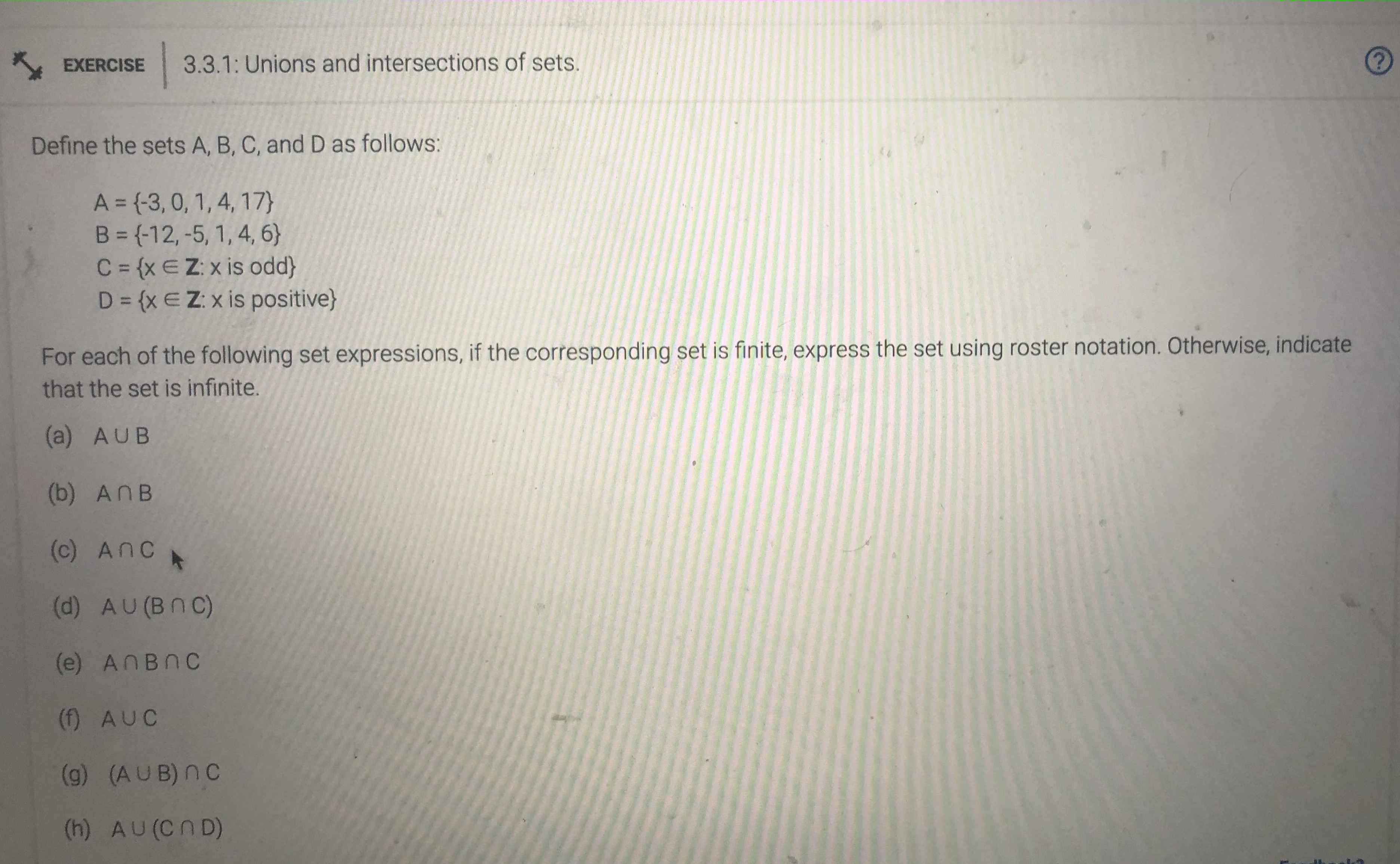
Question: EXERCISE 3.3.1: Unions and intersections of sets. Define the sets A, B, C, and D as follows: A = {-3, 0, 1, 4, 17} B
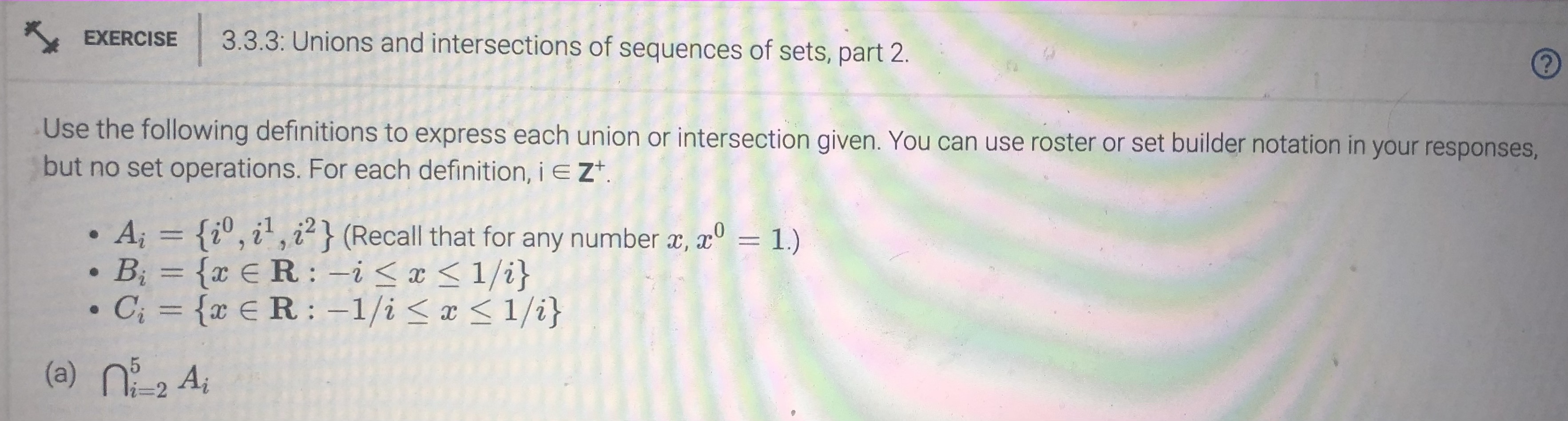
EXERCISE 3.3.1: Unions and intersections of sets. Define the sets A, B, C, and D as follows: A = {-3, 0, 1, 4, 17} B = {-12, -5, 1, 4, 6} C = {X E Z: x is odd} D = {X E Z: x is positive} For each of the following set expressions, if the corresponding set is finite, express the set using roster notation. Otherwise, indicate that the set is infinite. (a) AUB (b) AnB (c) AnCA (d) AU(Bnc) (e) AnBNC (f) AUC (g) (A UB)nc (h) AU (CND)EXERCISE 3.3.3: Unions and intersections of sequences of sets, part 2. ? Use the following definitions to express each union or intersection given. You can use roster or set builder notation in your responses, but no set operations. For each definition, i E Zt. . Ai = {i, it, i2} (Recall that for any number a, a = 1.) . Bi = {xER : -i
Step by Step Solution
There are 3 Steps involved in it
1 Expert Approved Answer
Step: 1 Unlock
Question Has Been Solved by an Expert!
Get step-by-step solutions from verified subject matter experts
Step: 2 Unlock
Step: 3 Unlock
Students Have Also Explored These Related Mathematics Questions!









 Study Help