







Question: Exercise 3.8 (Queue-length stability in wireless channels) Consider a simple model of a discrete-time wireless channel: the channel is ON with probability and OFF with
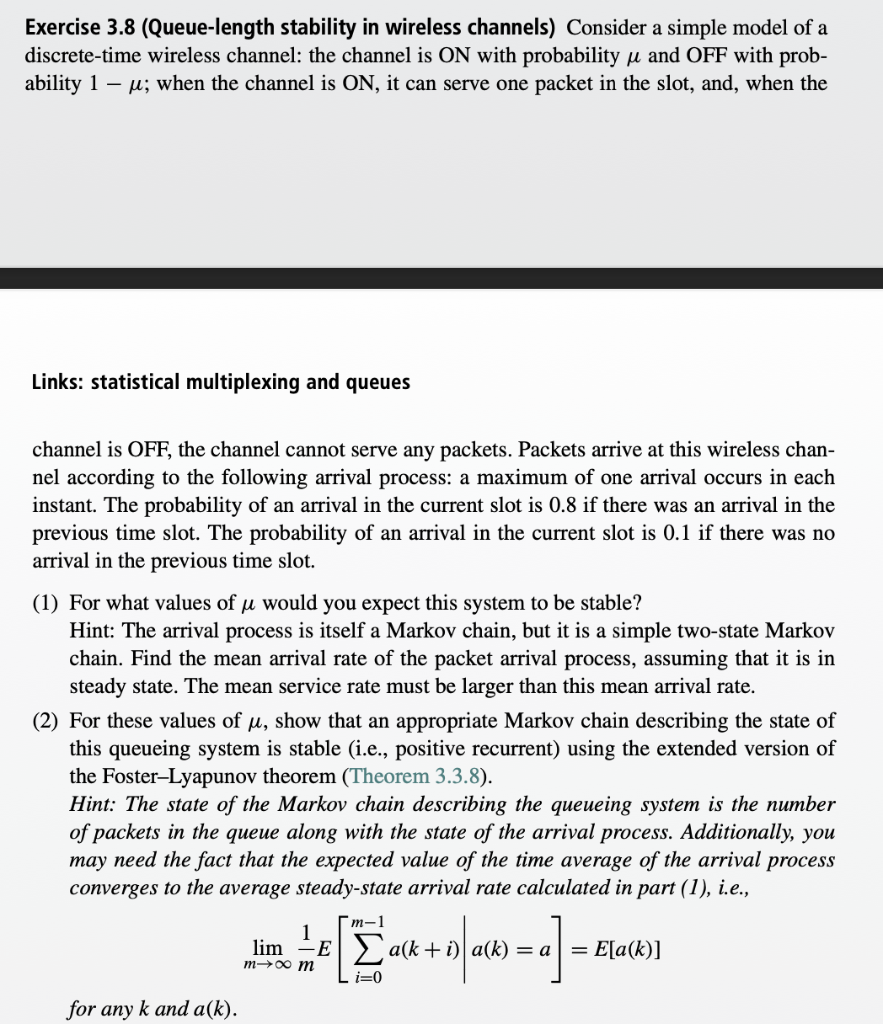
Exercise 3.8 (Queue-length stability in wireless channels) Consider a simple model of a discrete-time wireless channel: the channel is ON with probability and OFF with probability 1; when the channel is ON, it can serve one packet in the slot, and, when the Links: statistical multiplexing and queues channel is OFF, the channel cannot serve any packets. Packets arrive at this wireless channel according to the following arrival process: a maximum of one arrival occurs in each instant. The probability of an arrival in the current slot is 0.8 if there was an arrival in the previous time slot. The probability of an arrival in the current slot is 0.1 if there was no arrival in the previous time slot. (1) For what values of would you expect this system to be stable? Hint: The arrival process is itself a Markov chain, but it is a simple two-state Markov chain. Find the mean arrival rate of the packet arrival process, assuming that it is in steady state. The mean service rate must be larger than this mean arrival rate. (2) For these values of , show that an appropriate Markov chain describing the state of this queueing system is stable (i.e., positive recurrent) using the extended version of the Foster-Lyapunov theorem (Theorem 3.3.8). Hint: The state of the Markov chain describing the queueing system is the number of packets in the queue along with the state of the arrival process. Additionally, you may need the fact that the expected value of the time average of the arrival process converges to the average steady-state arrival rate calculated in part (1), i.e., limmm1E[i=0m1a(k+i)a(k)=a]=E[a(k)] for any k and a(k)
Step by Step Solution
There are 3 Steps involved in it

Get step-by-step solutions from verified subject matter experts
 Study Help