







Question: Exercise 4 B&K is a grocery store selling two types of soft drinks: Al and B1. The profit margin on the first drink is $5
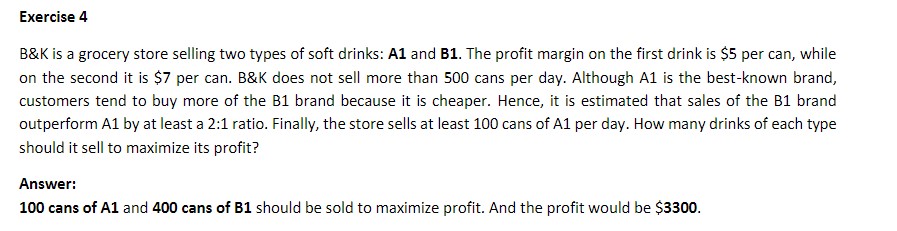
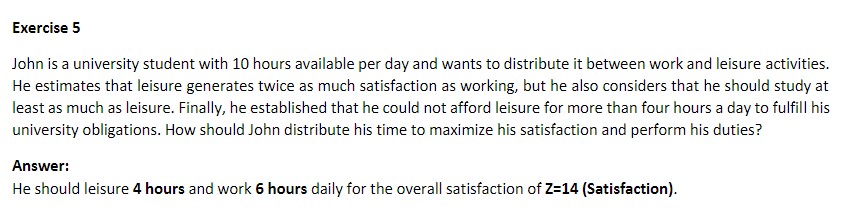
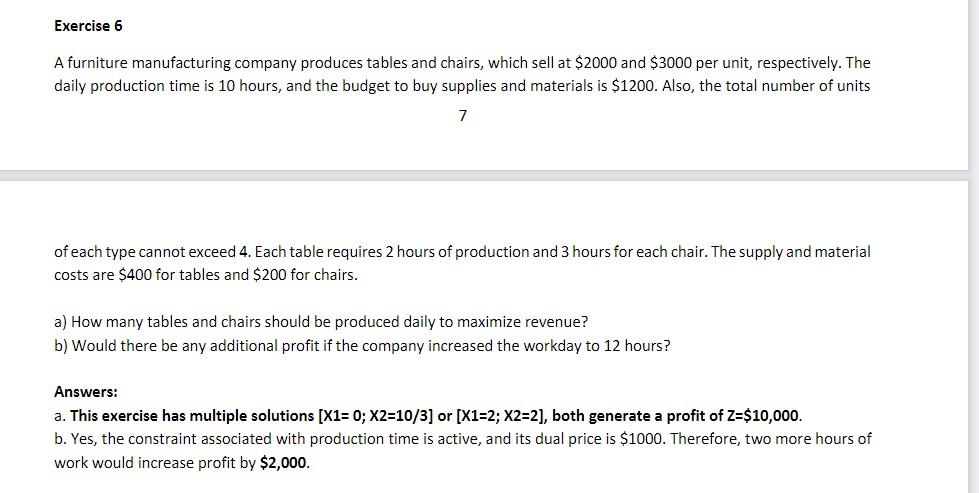
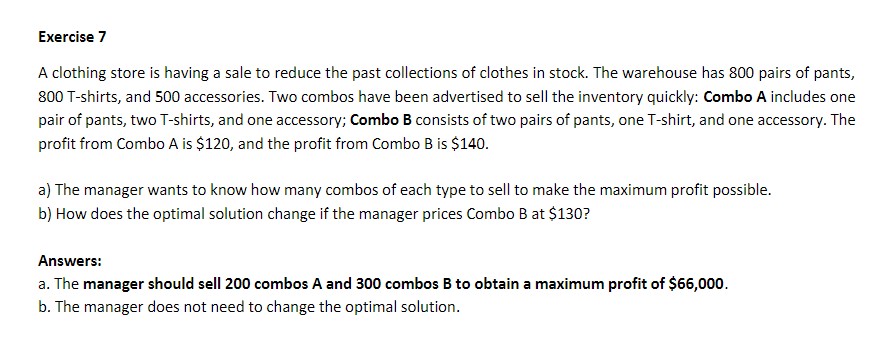
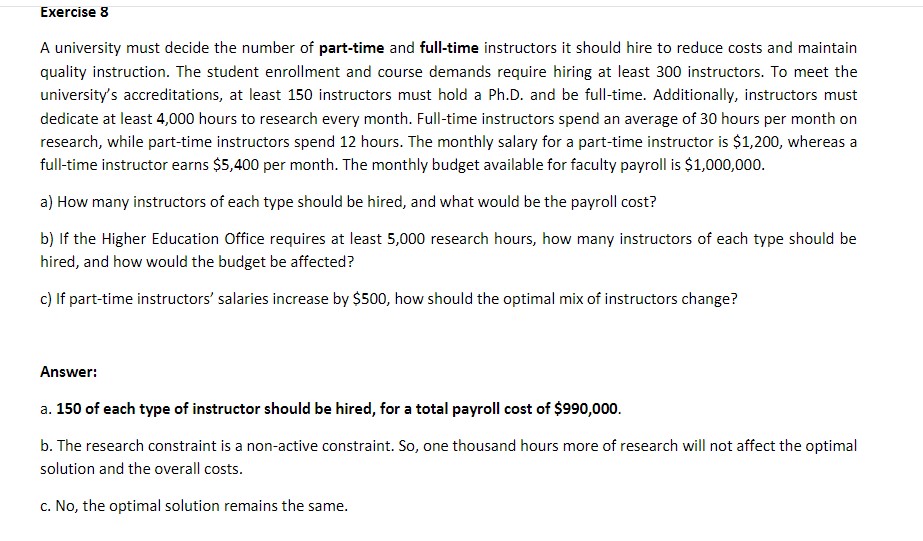
Exercise 4 B&K is a grocery store selling two types of soft drinks: Al and B1. The profit margin on the first drink is $5 per can, while on the second it is $7 per can. B&K does not sell more than 500 cans per day. Although Al is the best-known brand, customers tend to buy more of the B1 brand because it is cheaper. Hence, it is estimated that sales of the B1 brand outperform Al by at least a 2:1 ratio. Finally, the store sells at least 100 cans of Al per day. How many drinks of each type should it sell to maximize its profit? Answer: 100 cans of Al and 400 cans of B1 should be sold to maximize profit. And the profit would be $3300. Exercise 5 John is a university student with 10 hours available per day and wants to distribute it between work and leisure activities. He estimates that leisure generates twice as much satisfaction as working, but he also considers that he should study at least as much as leisure. Finally, he established that he could not afford leisure for more than four hours a day to fulfill his university obligations. How should John distribute his time to maximize his satisfaction and perform his duties? Answer: He should leisure 4 hours and work 6 hours daily for the overall satisfaction of Z=14 (Satisfaction). Exercise 6 A furniture manufacturing company produces tables and chairs, which sell at $2000 and $3000 per unit, respectively. The daily production time is 10 hours, and the budget to buy supplies and materials is $1200. Also, the total number of units 7 of each type cannot exceed 4. Each table requires 2 hours of production and 3 hours for each chair. The supply and material costs are 5400 for tables and $200 for chairs. a) How many tables and chairs should be produced daily to maximize revenue? b) Would there be any additional profit if the company increased the workday to 12 hours? Answers: a. This exercise has multiple solutions [X1= 0; X2=10/3] or [X1=2; X2=2], both generate a profit of Z=510,000. b. Yes, the constraint associated with production time is active, and its dual price is $1000. Therefore, two more hours of work would increase profit by $2,000. Exercise 7 A clothing store is having a sale to reduce the past collections of clothes in stock. The warehouse has 800 pairs of pants, 800 T-shirts, and 500 accessories. Two combos have been advertised to sell the inventory guickly: Combo A includes one pair of pants, two T-shirts, and one accessory; Combo B consists of two pairs of pants, one T-shirt, and one accessory. The profit from Combo A is $120, and the profit from Combo B is $140. a) The manager wants to know how many combos of each type to sell to make the maximum profit possible. b) How does the optimal solution change if the manager prices Combo B at $1307? Answers: a. The manager should sell 200 combos A and 300 combos B to obtain a maximum profit of $66,000. b. The manager does not need to change the optimal solution. Exercise 8 A university must decide the number of part-time and full-time instructors it should hire to reduce costs and maintain quality instruction. The student enrollment and course demands require hiring at least 300 instructors. To meet the university's accreditations, at least 150 instructors must hold a Ph.D. and be full-time. Additionally, instructors must dedicate at least 4,000 hours to research every manth. Full-time instructors spend an average of 30 hours per month on research, while part-time instructors spend 12 hours. The monthly salary for a part-time instructor is $1,200, whereas a full-time instructor earns $5,400 per month. The monthly budget available for faculty payroll is $1,000,000. a) How many instructors of each type should be hired, and what would be the payroll cost? b) If the Higher Education Office requires at least 5,000 research hours, how many instructors of each type should be hired, and how would the budget be affected? c) If part-time instructors' salaries increase by $500, how should the optimal mix of instructors change? Answer: a. 150 of each type of instructor should be hired, for a total payroll cost of $990,000. b. The research constraint is a non-active constraint. So, one thousand hours more of research will not affect the optimal solution and the overall costs. c. No, the optimal solution remains the same
Step by Step Solution
There are 3 Steps involved in it

Get step-by-step solutions from verified subject matter experts
 Study Help