







Question: Exercise 4: Minimum Permissions for common file operations In the table below, give in symbolic rwx form the minimum permissions an ordinary (non-root) user requires
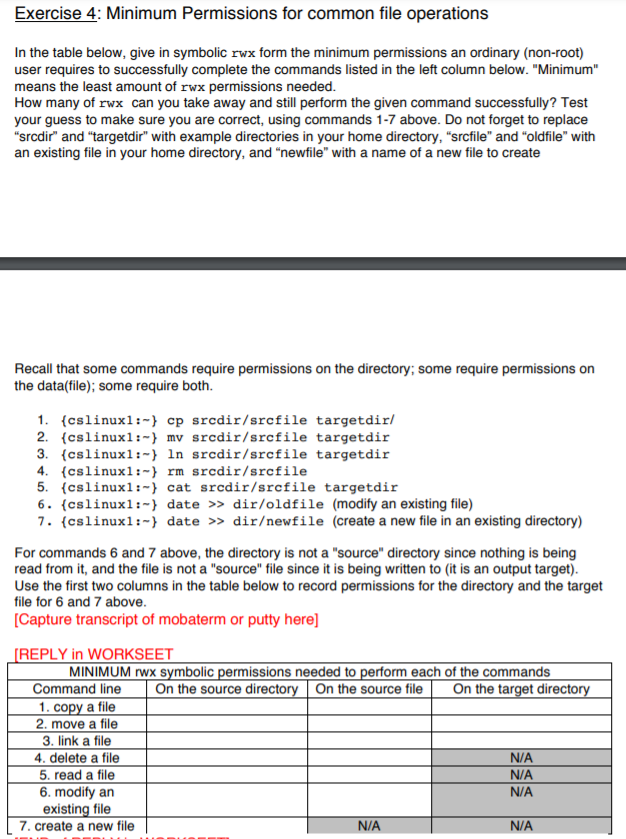
Exercise 4: Minimum Permissions for common file operations In the table below, give in symbolic rwx form the minimum permissions an ordinary (non-root) user requires to successfully complete the commands listed in the left column below. "Minimum" means the least amount of rwx permissions needed. How many of rwx can you take away and still perform the given command successfully? Test your guess to make sure you are correct, using commands 1-7 above. Do not forget to replace "srcdir" and "targetdir" with example directories in your home directory,"srcfile" and "oldfile" with an existing file in your home directory, and "newfile" with a name of a new file to create Recall that some commands require permissions on the directory; some require permissions on the data(file); some require both. 1. {cslinux1:-) cp srcdir/srcfile targetdir/ 2. {cslinuxl:-} mv srcdir/srcfile targetdir 3. {cslinuxl:-} In srcdir/srcfile targetdir 4. (cslinux1:-} rm srcdir/srcfile 5. {cslinux1:-} cat srcdir/srcfile targetdir 6. (cslinuxl:-} date >> dir/oldfile (modify an existing file) 7. (cslinux1 :-} date >> direwfile (create a new file in an existing directory) For commands 6 and 7 above, the directory is not a "source" directory since nothing is being read from it, and the file is not a "source" file since it is being written to (it is an output target). Use the first two columns in the table below to record permissions for the directory and the target file for 6 and 7 above. [Capture transcript of mobaterm or putty here] (REPLY in WORKSEET MINIMUM rwx symbolic permissions needed to perform each of the commands Command line On the source directory On the source file On the target directory 1. copy a file 2. move a file 3. link a file 4. delete a file N/A 5. read a file N/A 6. modify an N/A existing file 7. create a new file N/A N/A Exercise 4: Minimum Permissions for common file operations In the table below, give in symbolic rwx form the minimum permissions an ordinary (non-root) user requires to successfully complete the commands listed in the left column below. "Minimum" means the least amount of rwx permissions needed. How many of rwx can you take away and still perform the given command successfully? Test your guess to make sure you are correct, using commands 1-7 above. Do not forget to replace "srcdir" and "targetdir" with example directories in your home directory,"srcfile" and "oldfile" with an existing file in your home directory, and "newfile" with a name of a new file to create Recall that some commands require permissions on the directory; some require permissions on the data(file); some require both. 1. {cslinux1:-) cp srcdir/srcfile targetdir/ 2. {cslinuxl:-} mv srcdir/srcfile targetdir 3. {cslinuxl:-} In srcdir/srcfile targetdir 4. (cslinux1:-} rm srcdir/srcfile 5. {cslinux1:-} cat srcdir/srcfile targetdir 6. (cslinuxl:-} date >> dir/oldfile (modify an existing file) 7. (cslinux1 :-} date >> direwfile (create a new file in an existing directory) For commands 6 and 7 above, the directory is not a "source" directory since nothing is being read from it, and the file is not a "source" file since it is being written to (it is an output target). Use the first two columns in the table below to record permissions for the directory and the target file for 6 and 7 above. [Capture transcript of mobaterm or putty here] (REPLY in WORKSEET MINIMUM rwx symbolic permissions needed to perform each of the commands Command line On the source directory On the source file On the target directory 1. copy a file 2. move a file 3. link a file 4. delete a file N/A 5. read a file N/A 6. modify an N/A existing file 7. create a new file N/A N/A
Step by Step Solution
There are 3 Steps involved in it

Get step-by-step solutions from verified subject matter experts
 Study Help