



Question: Exercise 4. Roll control under periodic disturbance (10pt) Consider the feedback loop represented in Fig. 1 where 1 P(s) = S is the normalized transfer
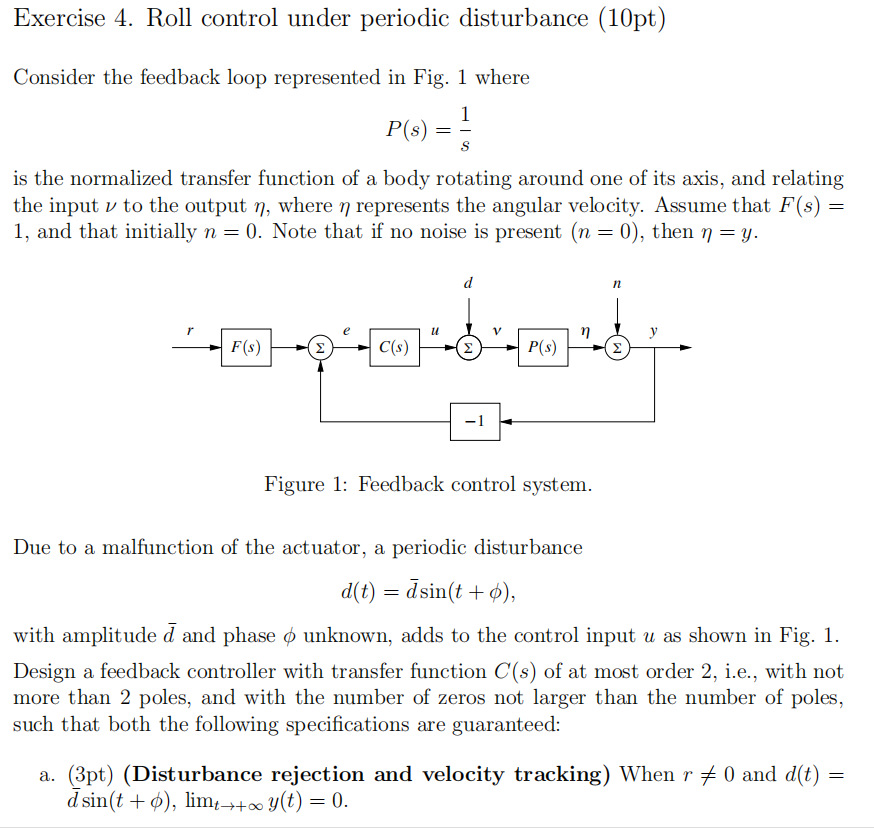
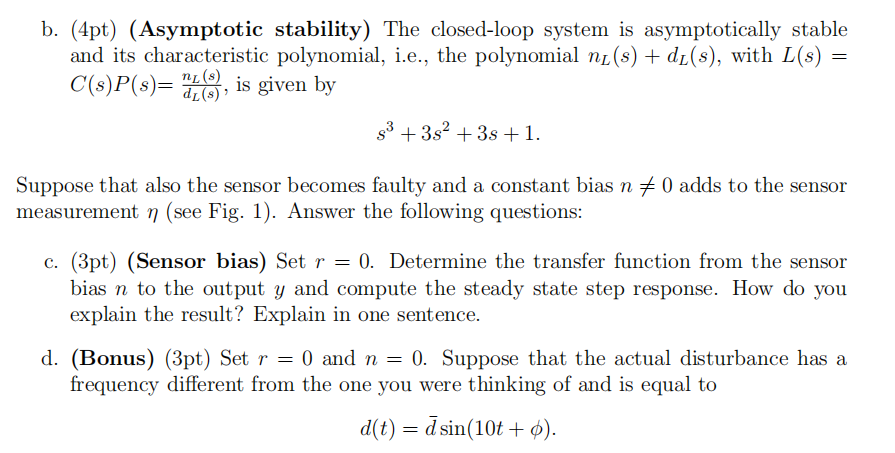

Exercise 4. Roll control under periodic disturbance (10pt) Consider the feedback loop represented in Fig. 1 where 1 P(s) = S is the normalized transfer function of a body rotating around one of its axis, and relating the input v to the output n, where n represents the angular velocity. Assume that F(s) = 1, and that initially n = 0. Note that if no noise is present (n = 0), then n = y. d n n F(s) C(s) P(s) ( -1 Figure 1: Feedback control system. Due to a malfunction of the actuator, a periodic disturbance d(t) = 2sin(t + ), with amplitude d and phase o unknown, adds to the control input u as shown in Fig. 1. Design a feedback controller with transfer function C(s) of at most order 2, i.e., with not more than 2 poles, and with the number of zeros not larger than the number of poles, such that both the following specifications are guaranteed: a. (3pt) (Disturbance rejection and velocity tracking) When r + 0 and d(t) = d sin(t +o), limt+too y(t) = 0. = b. (4pt) (Asymptotic stability) The closed-loop system is asymptotically stable and its characteristic polynomial, i.e., the polynomial ni(s) + d(s), with L(s) nl (8) C(s)P(s)= dl(s) is given by $3 +382 + 3s +1. Suppose that also the sensor becomes faulty and a constant bias n # 0 adds to the sensor measurement n (see Fig. 1). Answer the following questions: C. (3pt) (Sensor bias) Set r = 0. Determine the transfer function from the sensor bias n to the output y and compute the steady state step response. How do you explain the result? Explain in one sentence. d. (Bonus) (3pt) Set r = 0 and n = 0. Suppose that the actual disturbance has a frequency different from the one you were thinking of and is equal to d(t) = d sin(10t +o). Determine the transfer function from the disturbance d to the output y and de- termine the amplitude of the steady state harmonic response. Is the disturbance attenuated or amplified? Hint Bear in mind that s3 +382 + 3s +1 = (s + 1)3. Exercise 4. Roll control under periodic disturbance (10pt) Consider the feedback loop represented in Fig. 1 where 1 P(s) = S is the normalized transfer function of a body rotating around one of its axis, and relating the input v to the output n, where n represents the angular velocity. Assume that F(s) = 1, and that initially n = 0. Note that if no noise is present (n = 0), then n = y. d n n F(s) C(s) P(s) ( -1 Figure 1: Feedback control system. Due to a malfunction of the actuator, a periodic disturbance d(t) = 2sin(t + ), with amplitude d and phase o unknown, adds to the control input u as shown in Fig. 1. Design a feedback controller with transfer function C(s) of at most order 2, i.e., with not more than 2 poles, and with the number of zeros not larger than the number of poles, such that both the following specifications are guaranteed: a. (3pt) (Disturbance rejection and velocity tracking) When r + 0 and d(t) = d sin(t +o), limt+too y(t) = 0. = b. (4pt) (Asymptotic stability) The closed-loop system is asymptotically stable and its characteristic polynomial, i.e., the polynomial ni(s) + d(s), with L(s) nl (8) C(s)P(s)= dl(s) is given by $3 +382 + 3s +1. Suppose that also the sensor becomes faulty and a constant bias n # 0 adds to the sensor measurement n (see Fig. 1). Answer the following questions: C. (3pt) (Sensor bias) Set r = 0. Determine the transfer function from the sensor bias n to the output y and compute the steady state step response. How do you explain the result? Explain in one sentence. d. (Bonus) (3pt) Set r = 0 and n = 0. Suppose that the actual disturbance has a frequency different from the one you were thinking of and is equal to d(t) = d sin(10t +o). Determine the transfer function from the disturbance d to the output y and de- termine the amplitude of the steady state harmonic response. Is the disturbance attenuated or amplified? Hint Bear in mind that s3 +382 + 3s +1 = (s + 1)3
Step by Step Solution
There are 3 Steps involved in it

Get step-by-step solutions from verified subject matter experts