







Question: // Exercise 4.1.16 package algs41; import stdlib.*; // This is problem 4.1.16 from the textbook // // You need only change the constructor. // You
// Exercise 4.1.16
package algs41;
import stdlib.*;
// This is problem 4.1.16 from the textbook
//
// You need only change the constructor.
// You can also change the main method.
// But you should not change eccentricity(), diameter(), radius(), center() or isCenter()
// You can (and should!) add more private methods (such as bfs or dfs)
public class MyGraphProperties {
int[] eccentricity;
int diameter;
int radius;
int center;
// Constructor can be linear in G.V() * G.E()
public MyGraphProperties(Graph G) {
this.eccentricity = new int[G.V()];
int diameter = Integer.MIN_VALUE;
int radius = Integer.MAX_VALUE;
int center = -1;
// If G.V()==0, then these are the correct values.
// If G is not connected, you should throw a new IllegalArgumentException()
// I suggest that you first get it to work for a connected graph
// This will require that you traverse the graph starting from some node (say 0)
// You can then adjust your code so that it throws an exception in the case that all nodes are not visited
// TODO
// compute the eccentricity, diameter, radius and center
// The center of the graph is not unique, set center to SOME center --- it does not matter which one
this.diameter = diameter;
this.radius = radius;
this.center = center;
}
// Do not change the following constant time methods
public int eccentricity(int v) { return eccentricity[v]; }
public int diameter() { return diameter; }
public int radius() { return radius; }
public int center() { return center; }
public boolean isCenter(int v) { return eccentricity[v] == radius; }
HERE IS THE BREADTHFIRSTSEARCH CODE WE WERE REQUESTED TO USE:
public class BreadthFirstPaths {
private static final int INFINITY = Integer.MAX_VALUE;
private final boolean[] marked; // marked[v] = is there an s-v path
private final int[] edgeTo; // edgeTo[v] = previous edge on shortest s-v path
private final int[] distTo; // distTo[v] = number of edges shortest s-v path
// single source
public BreadthFirstPaths(Graph G, int s) {
marked = new boolean[G.V()];
distTo = new int[G.V()];
edgeTo = new int[G.V()];
bfs(G, s);
}
private void bfs(Graph G, int s) {
Queue q = new Queue();
for (int v = 0; v
distTo[s] = 0;
marked[s] = true;
q.enqueue(s);
while (!q.isEmpty()) {
int v = q.dequeue();
for (int w : G.adj(v)) {
if (!marked[w]) {
edgeTo[w] = v;
distTo[w] = distTo[v] + 1;
marked[w] = true;
q.enqueue(w);
}
}
}
}
}
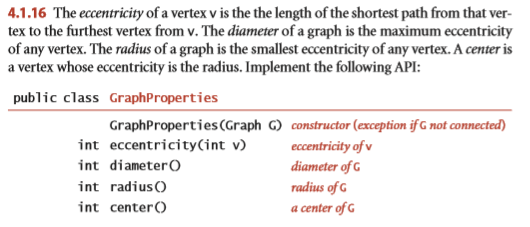
4.1.16 The eccentricity of a vertex v is the the length of the shortest path from that ver- tex to the furthest vertex from v. The diameter of a graph is the maximum eccentricity of any vertex. The radius of a graph is the smallest eccentricity of any vertex. A center is a vertex whose eccentricity is the radius. Implement the following API: public class GraphProperties GraphProperties(Graph G) constructor (exception ifG not connected int eccentricity(inteccentricity ofv int diameterO int radiusO int centerO diameter of G radius ofG a center of
Step by Step Solution
There are 3 Steps involved in it

Get step-by-step solutions from verified subject matter experts
 Study Help