





Question: Exercise 5 Write False if the Statement is true and True if the Statement is false beside the number for each item. EDP'JNP'P'JePJNL 10. 11.
Exercise 5 Write False if the Statement is true
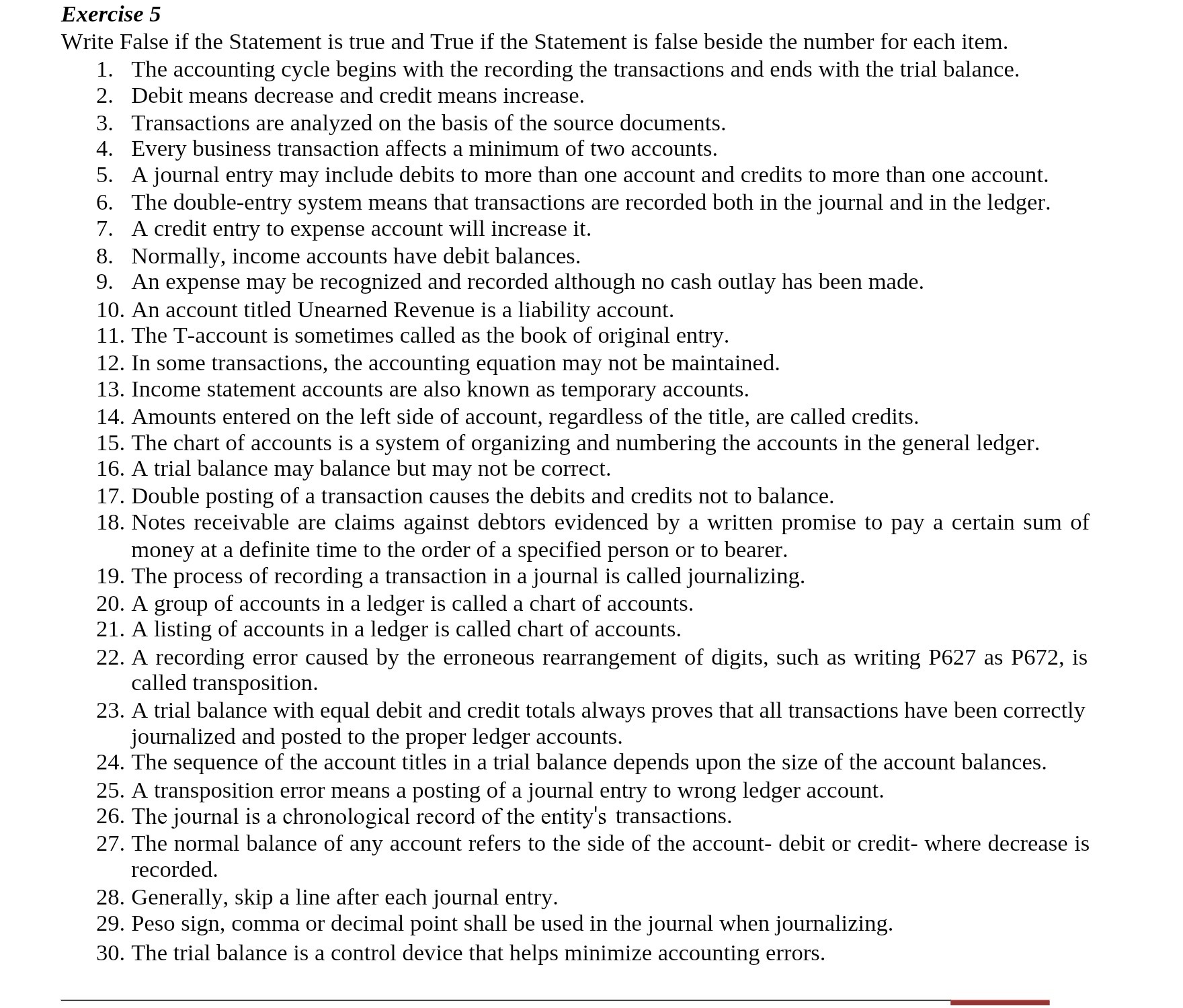
Exercise 5 Write False if the Statement is true and True if the Statement is false beside the number for each item. EDP'JNP'P'JePJNL\" 10. 11. 12. 13. 14. 15. 16. 17. 18. 19. 20. 21. 22. 23. 24. 25. 26. 27. 28. 29. 30. The accounting cycle begins with the recording the transactions and ends with the trial balance. Debit means decrease and credit means increase. Transactions are analyzed on the basis of the source documents. Every business transaction affects a minimum of two accounts. A journal entry may include debits to more than one account and credits to more than one account. The double-entry system means that transactions are recorded both in the journal and in the ledger. A credit entry to expense account will increase it. Normally, income accounts have debit balances. An expense may be recognized and recorded although no cash outlay has been made. An account titled Unearned Revenue is a liability account. The Taccount is sometimes called as the book of original entry. In some transactions, the accounting equation may not be maintained. Income statement accounts are also known as temporary accounts. Amounts entered on the left side of account, regardless of the title, are called credits. The chart of accounts is a system of organizing and numbering the accounts in the general ledger. A trial balance may balance but may not be correct. Double posting of a transaction causes the debits and credits not to balance. Notes receivable are claims against debtors evidenced by a written promise to pay a certain sum of money at a definite time to the order of a specified person or to bearer. The process of recording a transaction in a journal is called journalizing. A group of accounts in a ledger is called a chart of accounts. A listing of accounts in a ledger is called chart of accounts. A recording error caused by the erroneous rearrangement of digits, such as writing P627 as P672, is called transposition. A trial balance with equal debit and credit totals always proves that all transactions have been correctly journalized and posted to the proper ledger accounts. The sequence of the account titles in a trial balance depends upon the size of the account balances. A transposition error means a posting of a journal entry to wrong ledger account. The journal is a chronological record of the entity's transactions. The normal balance of any account refers to the side of the account debit or credit- where decrease is recorded. Generally, skip a line after each journal entry. Peso sign, comma or decimal point shall be used in the journal when journalizing. The trial balance is a control device that helps minimize accounting errors

Step by Step Solution

There are 3 Steps involved in it

1 Expert Approved Answer
Step: 1 Unlock blur-text-image

Question Has Been Solved by an Expert!

Get step-by-step solutions from verified subject matter experts

Step: 2 Unlock
Step: 3 Unlock

Students Have Also Explored These Related Accounting Questions!