







Question: EXERCISE 8. Present perfect vs. simple past. (Charts 2-9 and 3-1) Directions: Use the simple past or the present perfect. 1. What (you, learn) have
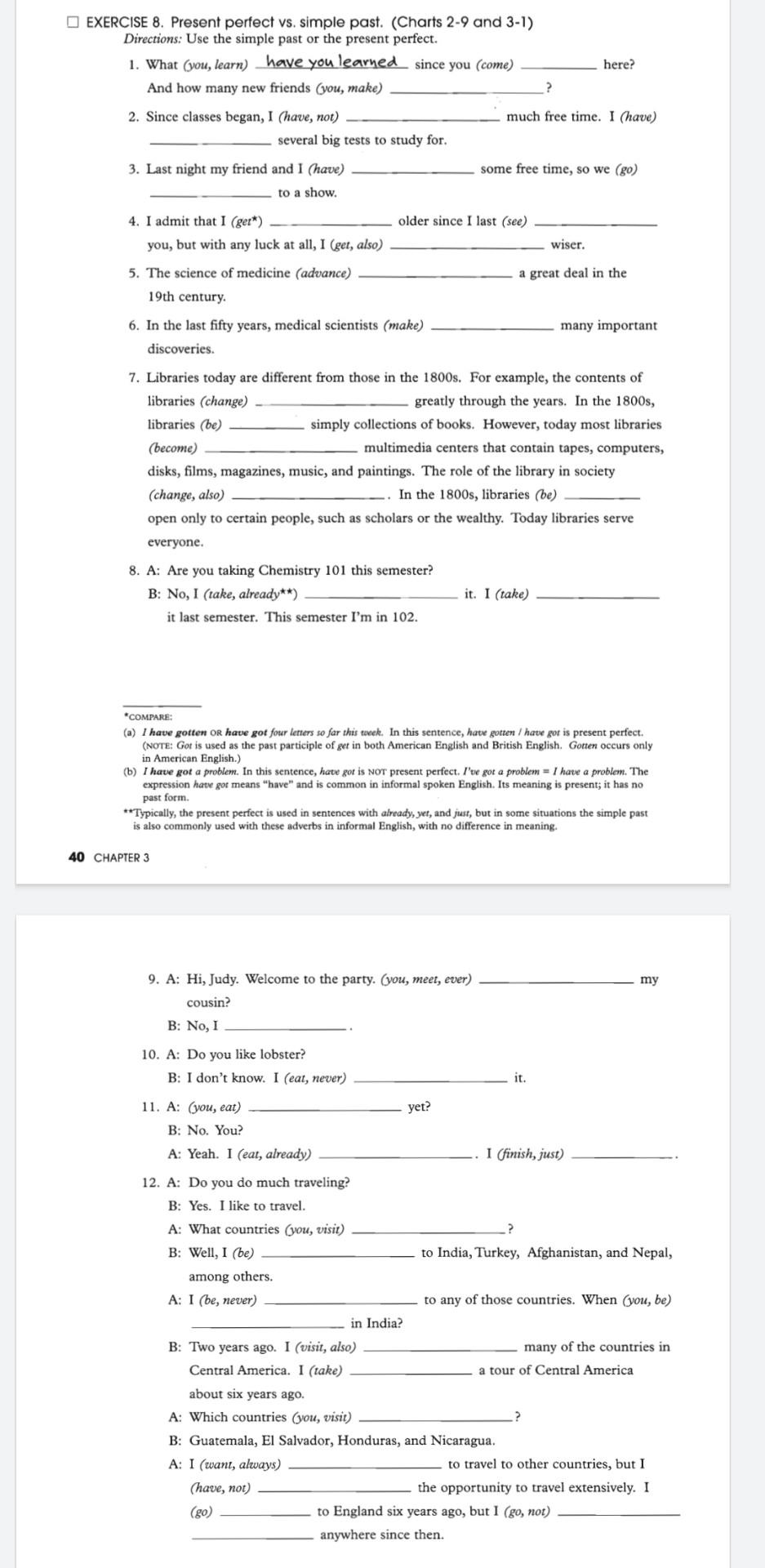
EXERCISE 8. Present perfect vs. simple past. (Charts 2-9 and 3-1) Directions: Use the simple past or the present perfect. 1. What (you, learn) have you learned since you (come) And how many new friends (you, make) here? ? much free time. I (have) 2. Since classes began, I have, not) several big tests to study for. some free time, so we (go) 3. Last night my friend and I (have) to a show. 4. I admit that I (ger*) older since I last (see) you, but with any luck at all, I (get, also) wiser. 5. The science of medicine (advance) a great deal in the 19th century. 6. In the last fifty years, medical scientists (make) many important discoveries. 7. Libraries today are different from those in the 1800s. For example, the contents of libraries (change) greatly through the years. In the 1800s, libraries (be) simply collections of books. However, today most libraries (become) multimedia centers that contain tapes, computers, disks, films, magazines, music, and paintings. The role of the library in society (change, also In the 1800s, libraries (be) open only to certain people, such as scholars or the wealthy. Today libraries serve everyone. 8. A: Are you taking Chemistry 101 this semester? B: No, I take, already**) it last semester. This semester I'm in 102. it. I (take) *COMPARE: (a) I have gotten OR have got four letters so far this week. In this sentence, hate gotten / have gor is present perfect. (NOTE: Got is used as the past participle of get in both American English and British English. Gotten occurs only in American English.) (b) I have got a problem. In this sentence, have got is not present perfect. I've got a problem = I have a problem. The expression have got means "have" and is common in informal spoken English. Its meaning is present; it has no past form. **Typically, the present perfect is used in sentences with already, yet, and just, but in some situations the simple past is also commonly used with these adverbs in informal English, with no difference in meaning. 40 CHAPTER 3 my 9. A: Hi, Judy. Welcome to the party. (you, meet, ever) cousin? B: No, I 10. A: Do you like lobster? B: I don't know. I eat, never) it. yet? 11. A: (you, eat) B: No. You? A: Yeah. I (eat, already) I (finish, just) 12. A: Do you do much traveling? B: Yes. I like to travel. A: What countries (you, visit) ? B: Well, I (be) to India, Turkey, Afghanistan, and Nepal, among others. A: I (be, never) to any of those countries. When (you, be) in India? B: Two years ago. I (visit, also) many of the countries in Central America. I take) a tour of Central America about six years ago. A: Which countries (you, visit) B: Guatemala, El Salvador, Honduras, and Nicaragua. A: I want, always) to travel to other countries, but I (have, not) the opportunity to travel extensively. I (go) to England six years ago, but I (go, not) anywhere since then
Step by Step Solution
There are 3 Steps involved in it
1 Expert Approved Answer
Step: 1 Unlock

Question Has Been Solved by an Expert!
Get step-by-step solutions from verified subject matter experts
Step: 2 Unlock
Step: 3 Unlock
 Study Help