







Question: Exercise 9-2 Current Liabilities Exercise 9-2 Current Liabilities he following items represent liabilities on a firm's balance sheet: a. An amount of money owed to
Exercise 9-2 Current Liabilities
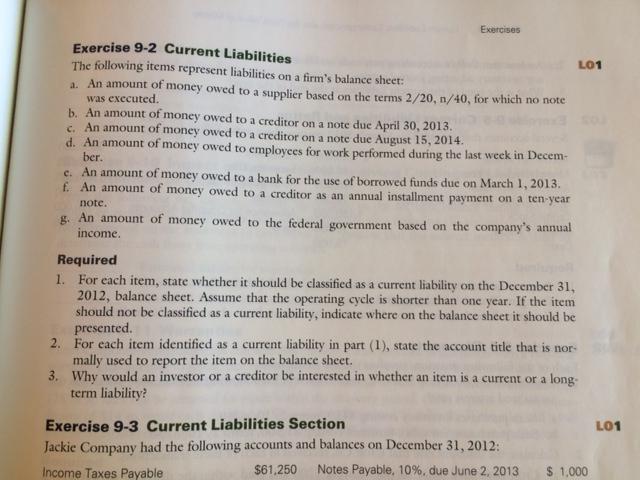
Exercise 9-2 Current Liabilities he following items represent liabilities on a firm's balance sheet: a. An amount of money owed to a supplier based on the terms 2/20, n/40, for which no note was executed. b. An amount of money owed to a creditor on a note due April 30, 2013. c. An amount of owed to on a due August 15, 2014. d. An amount of money to employees for work performed during the last week in Decem ber e. An amount of money owed to a bank for the use of borrowed funds due on March 1, 2013. f An amount of money owed to a creditor as an annual installment payment on a ten-year g. An amount of money owed to the federal government based on the company's annual ncome Required 1. For each item, state whether it should be classified as a current liability December 31, on the 2012, balance sheet. Assume that the operating cycle is shorter than one year. If the item should not be classified as a current liability, indicate where on the balance sheet it should be presented. 2. For each item identified as a current liability in part (i), state the account title that is nor- mally used to report the item on the balance sheet 3. Why would an investor or a creditor be interested in whether an item is a current or a long- term liability? Exercise 9-3 Current Liabilities Section LO1 Jackie Company had the following accounts and balances on December 31, 2012 $61,250 Notes Payable, 10%, due June 2, 2013 1,000 Income Taxes Payable
Step by Step Solution
There are 3 Steps involved in it

Get step-by-step solutions from verified subject matter experts
 Study Help