





Question: Exercise A. a) In the example of the falling object (pp. 72-75), we determined that the height of the ball as a function of time
Exercise A. a) In the example of the fallingExercise A. a) In the example of the falling
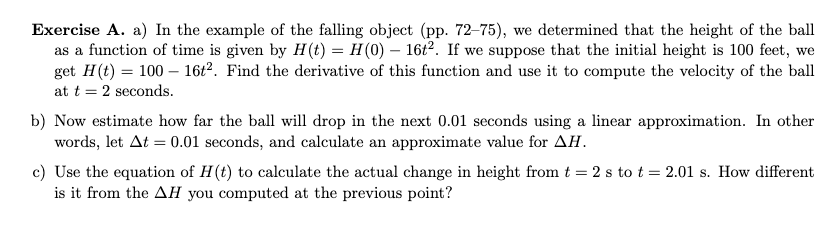
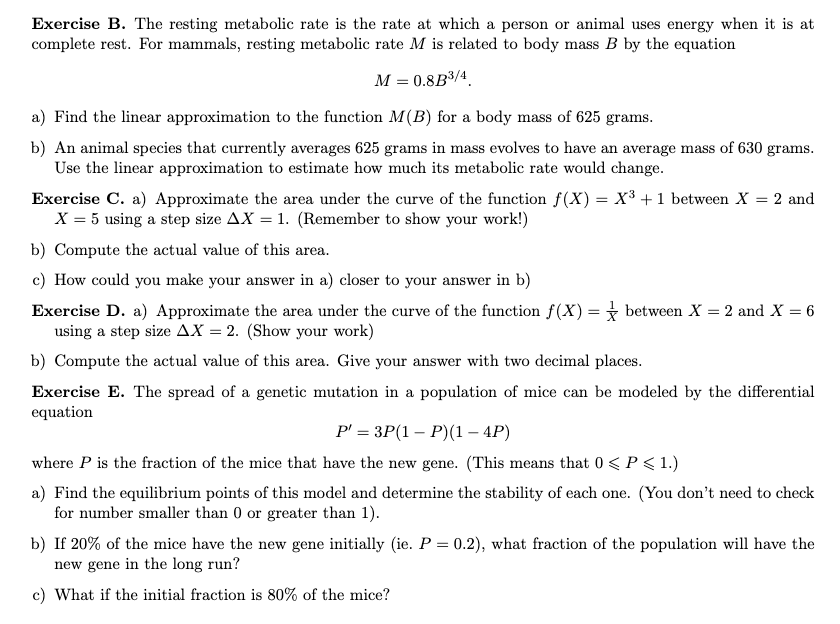
Exercise A. a) In the example of the falling object (pp. 72-75), we determined that the height of the ball as a function of time is given by H(t) = H(0) - 16t'. If we suppose that the initial height is 100 feet, we get H(t) = 100 - 16t2. Find the derivative of this function and use it to compute the velocity of the ball at t = 2 seconds. b) Now estimate how far the ball will drop in the next 0.01 seconds using a linear approximation. In other words, let At = 0.01 seconds, and calculate an approximate value for AH. c) Use the equation of H(t) to calculate the actual change in height from t = 2 s to t = 2.01 s. How different is it from the AH you computed at the previous point?Exercise B. The resting metabolic rate is the rate at which a person or animal uses energy when it is at complete rest. For mammals, resting metabolic rate M is related to body mass B by the equation M = 0.833\". a) Find the linear approximation to the function M(B} for a body mass of {525 grams. b} An animal species that currently,r averages (525 grams in mass evolves to have an average mass of 530 grams. Use the linear approximation to estimate how much its metabolic rate would change. Exercise C. a} Approximate the area under the curve of the mction ll") = X3 + 1 between X = 2 and X = 5 using a step size X = 1. (Remember to show your work!) b} Compute the actual value of this area. c) How could you make your answer in a} closer to your answer in b) Exercise D. a} Approximate the area under the curve of the mction f{X} = 3,1; between X = 2 and X = [i using a step size AX = 2. {Show your work] b) Compute the actual value of this area. Give your answer with two decimal places. Exercise E. The spread of a genetic mutation in a population of mice can be modeled by the di'erential equation F" = 3P(1 - PHI 4P} where P is the fraction of the mice that have the new gene. (This means that 0 a P s 1.] a} Find the equilibrium points of this model and determine the stability of each one. {You don't need to check for number smaller than I] or greater than 1]. b) If 20% of the mice have the new gene initially [ie. P = [12), what fraction of the population will have the new gene in the long run? :2} What if the initial fraction is 86% of the mice

Step by Step Solution

There are 3 Steps involved in it

1 Expert Approved Answer
Step: 1 Unlock blur-text-image

Question Has Been Solved by an Expert!

Get step-by-step solutions from verified subject matter experts

Step: 2 Unlock
Step: 3 Unlock

Students Have Also Explored These Related Mathematics Questions!