







Question: Exercise A. a) Suppose we build an SIR model for a disease such as measles. People get the disease by being in close contact to
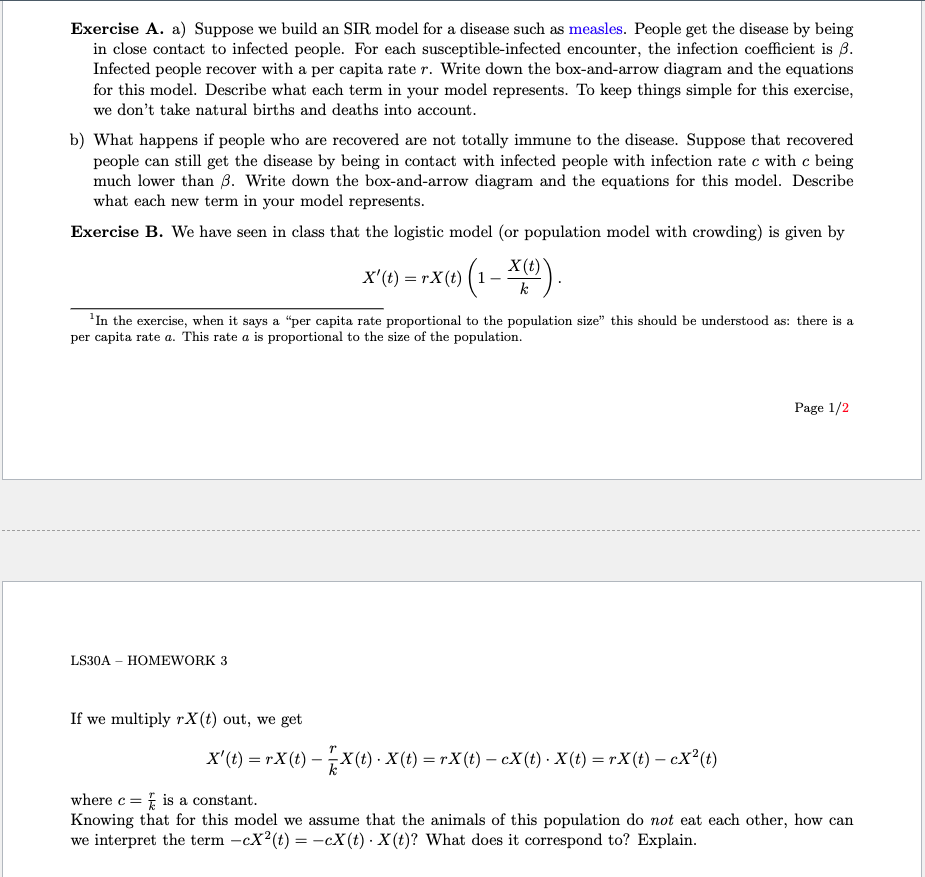
Exercise A. a) Suppose we build an SIR model for a disease such as measles. People get the disease by being in close contact to infected people. For each susceptible-infected encounter, the infection coefficient is B. Infected people recover with a per capita rate r. Write down the box-and-arrow diagram and the equations for this model. Describe what each term in your model represents. To keep things simple for this exercise, we don't take natural births and deaths into account. b) What happens if people who are recovered are not totally immune to the disease. Suppose that recovered people can still get the disease by being in contact with infected people with infection rate c with c being much lower than B. Write down the box-and-arrow diagram and the equations for this model. Describe what each new term in your model represents. Exercise B. We have seen in class that the logistic model (or population model with crowding) is given by X'(t) = rx(t) (1_*(8) In the exercise, when it says a "per capita rate proportional to the population size" this should be understood as: there is a per capita rate a. This rate a is proportional to the size of the population. Page 1/2 LS30A - HOMEWORK 3 If we multiply rX(t) out, we get X' (t ) = rx (t) - X(t) . X(t ) = rx(t) - ex(t) . x(t) = rx(t) - cx2(t) where c = = is a constant. Knowing that for this model we assume that the animals of this population do not eat each other, how can we interpret the term -cX2(t) = -cX(t) . X(t)? What does it correspond to? Explain
Step by Step Solution
There are 3 Steps involved in it

Get step-by-step solutions from verified subject matter experts
 Study Help