



Question: Exercise B (Two-Period Model: Asset Pricing) Consider a two-period model. A consumer is given current income, e>0, and future income, e>0. She would like to
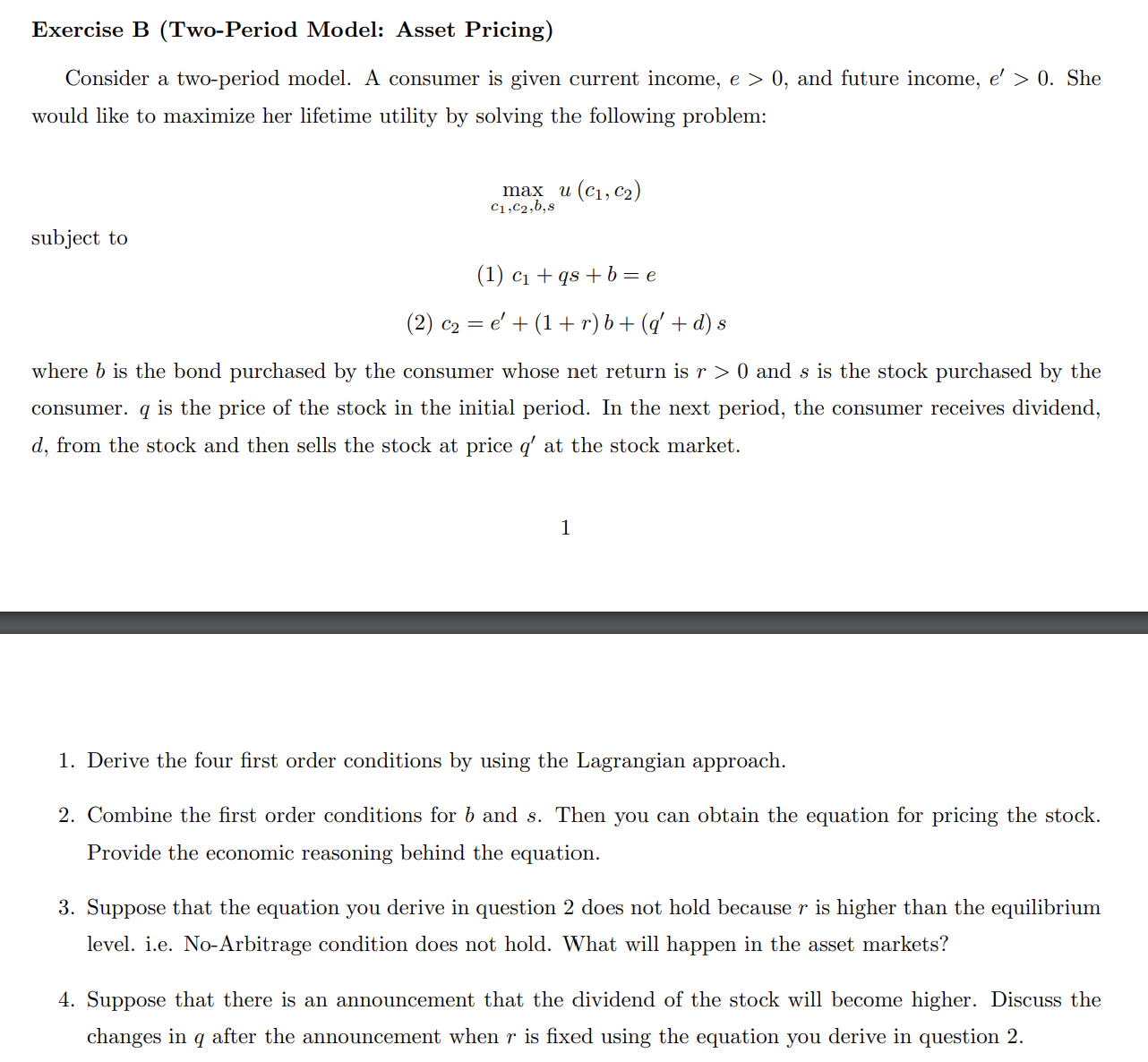
Exercise B (Two-Period Model: Asset Pricing) Consider a two-period model. A consumer is given current income, e>0, and future income, e>0. She would like to maximize her lifetime utility by solving the following problem: maxc1,c2,b,su(c1,c2) subject to (1) c1+qs+b=e (2) c2=e+(1+r)b+(q+d)s where b is the bond purchased by the consumer whose net return is r>0 and s is the stock purchased by the consumer. q is the price of the stock in the initial period. In the next period, the consumer receives dividend, d, from the stock and then sells the stock at price q at the stock market. 1 1. Derive the four first order conditions by using the Lagrangian approach. 2. Combine the first order conditions for b and s. Then you can obtain the equation for pricing the stock. Provide the economic reasoning behind the equation. 3. Suppose that the equation you derive in question 2 does not hold because r is higher than the equilibrium level. i.e. No-Arbitrage condition does not hold. What will happen in the asset markets? 4. Suppose that there is an announcement that the dividend of the stock will become higher. Discuss the changes in q after the announcement when r is fixed using the equation you derive in question 2
Step by Step Solution
There are 3 Steps involved in it

Get step-by-step solutions from verified subject matter experts