







Question: exercise b with explanation please Question 5. State Preference Theory. (during the exercise session and detailed solutions) An investor has initial wealth Wo = $
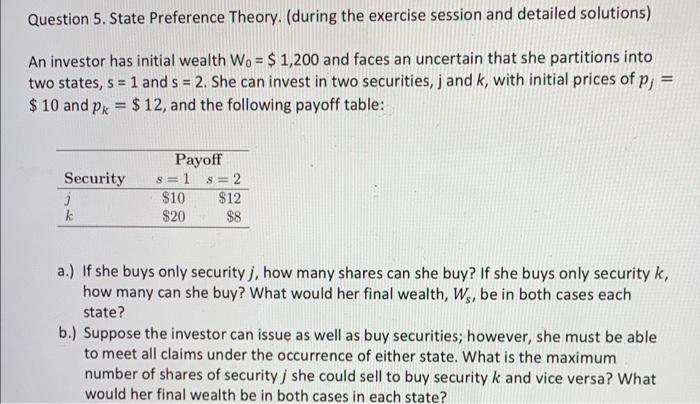
Question 5. State Preference Theory. (during the exercise session and detailed solutions) An investor has initial wealth Wo = $ 1,200 and faces an uncertain that she partitions into two states, s = 1 and s = 2. She can invest in two securities, j and k, with initial prices of p; = $ 10 and Pk = $ 12, and the following payoff table: Security Payoff s=1 S=2 $10 $12 $20 $8 k a.) If she buys only securityj, how many shares can she buy? If she buys only security k, how many can she buy? What would her final wealth, Ws, be in both cases each state? b.) Suppose the investor can issue as well as buy securities; however, she must be able to meet all claims under the occurrence of either state. What is the maximum number of shares of security j she could sell to buy security k and vice versa? What would her final wealth be in both cases in each state? Question 5. State Preference Theory. (during the exercise session and detailed solutions) An investor has initial wealth Wo = $ 1,200 and faces an uncertain that she partitions into two states, s = 1 and s = 2. She can invest in two securities, j and k, with initial prices of p; = $ 10 and Pk = $ 12, and the following payoff table: Security Payoff s=1 S=2 $10 $12 $20 $8 k a.) If she buys only securityj, how many shares can she buy? If she buys only security k, how many can she buy? What would her final wealth, Ws, be in both cases each state? b.) Suppose the investor can issue as well as buy securities; however, she must be able to meet all claims under the occurrence of either state. What is the maximum number of shares of security j she could sell to buy security k and vice versa? What would her final wealth be in both cases in each state
Step by Step Solution
There are 3 Steps involved in it

Get step-by-step solutions from verified subject matter experts
 Study Help