







Question: Exercise E4.14 Medical prosthetic implants, such as hip replacements, are, at present, made of metals such as stainless steel or titanium. These metals are much
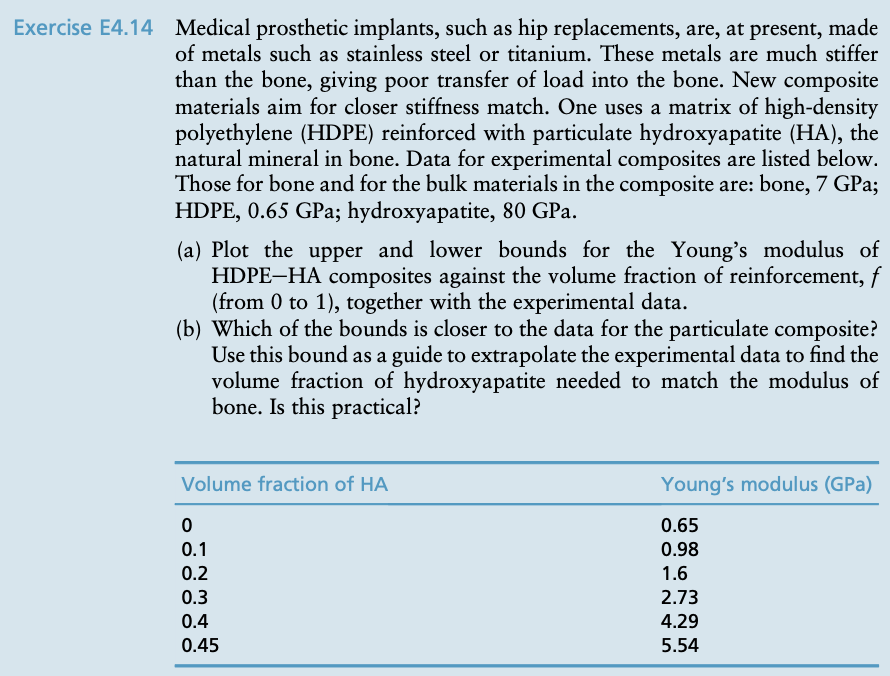
Exercise E4.14 Medical prosthetic implants, such as hip replacements, are, at present, made of metals such as stainless steel or titanium. These metals are much stiffer than the bone, giving poor transfer of load into the bone. New composite materials aim for closer stiffness match. One uses a matrix of high-density polyethylene (HDPE) reinforced with particulate hydroxyapatite (HA), the natural mineral in bone. Data for experimental composites are listed below. Those for bone and for the bulk materials in the composite are: bone, 7 GPa; HDPE, 0.65 GPa; hydroxyapatite, 80 GPa. (a) Plot the upper and lower bounds for the Young's modulus of HDPE-HA composites against the volume fraction of reinforcement, f (from 0 to 1), together with the experimental data. (b) Which of the bounds is closer to the data for the particulate composite? Use this bound as a guide to extrapolate the experimental data to find the volume fraction of hydroxyapatite needed to match the modulus of bone. Is this practical? Volume fraction of HA Young's modulus (GPa) 0 0.1 0.2 0.3 0.4 0.45 0.65 0.98 1.6 2.73 4.29 5.54
Step by Step Solution
There are 3 Steps involved in it

Get step-by-step solutions from verified subject matter experts
 Study Help