



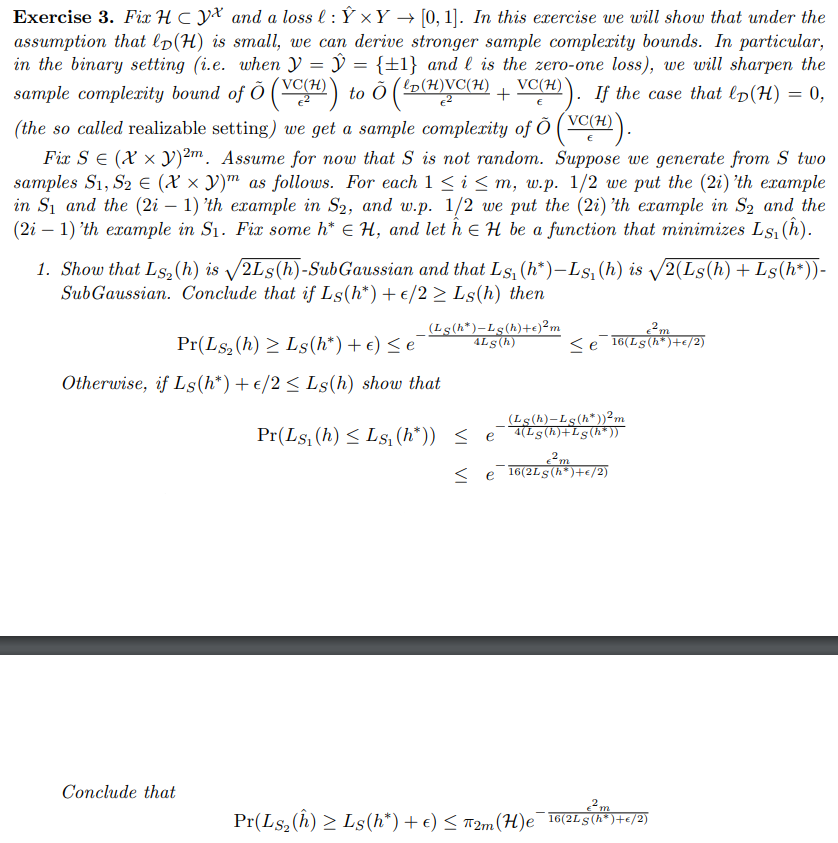
Question: Exercise : ( for correct symbols see the picture ) Fix H s u b Y x and a loss l :hat ( Y )
Exercise : for correct symbols see the picture Fix and a loss :hat In this exercise we will show that under the
assumption that is small, we can derive stronger sample complexity bounds. In particular,
in the binary setting ie when hat and is the zeroone loss we will sharpen the
sample complexity bound of tilde to tilde If the case that
the so called realizable setting we get a sample complexity of tilde
Fix Sin Assume for now that is not random. Suppose we generate from two
samples as follows. For each wp we put the th example
in and the th example in and wp we put the th example in and the
th example in Fix some inH, and let hat be a function that minimizes
Show that is SubGaussian and that is
SubGaussian. Conclude that if then
Otherwise, if show that
Conclude that
Step by Step Solution
There are 3 Steps involved in it
1 Expert Approved Answer
Step: 1 Unlock

Question Has Been Solved by an Expert!
Get step-by-step solutions from verified subject matter experts
Step: 2 Unlock
Step: 3 Unlock