



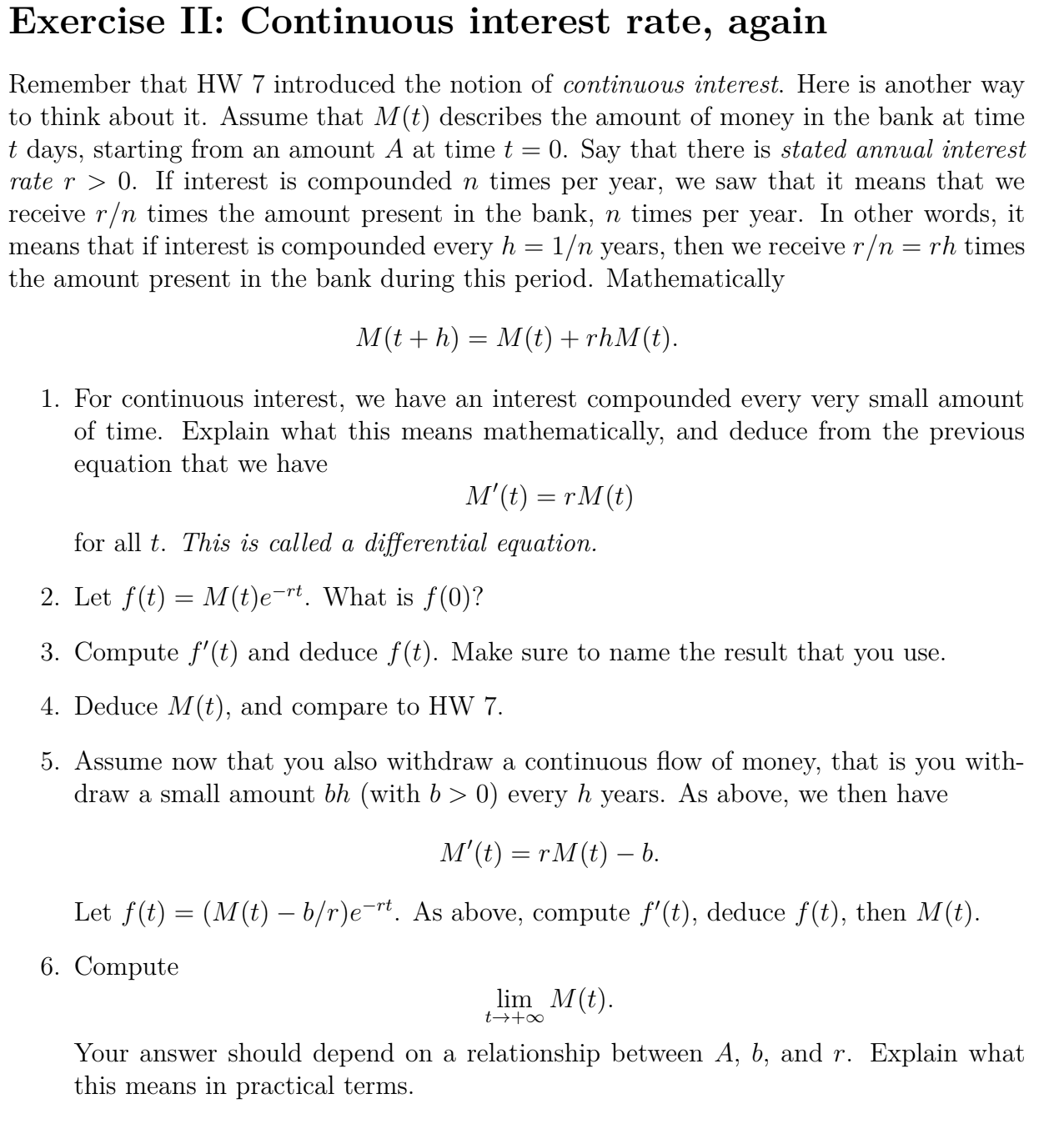
Question: Exercise II: Continuous interest rate, again Remember that HW 7 introduced the notion of continuous interest. Here is another way to think about it .
Exercise II: Continuous interest rate, again
Remember that HW introduced the notion of continuous interest. Here is another way
to think about it Assume that Mt describes the amount of money in the bank at time
t days, starting from an amount A at time t Say that there is stated annual interest
rate r If interest is compounded n times per year, we saw that it means that we
receive rn times the amount present in the bank, n times per year. In other words, it
means that if interest is compounded every hn years, then we receive rnrh times
the amount present in the bank during this period. Mathematically
MthMtrhMt
For continuous interest, we have an interest compounded every very small amount
of time. Explain what this means mathematically, and deduce from the previous
equation that we have
MtrMt
for all t This is called a differential equation.
Let ftMtert What is f
Compute ft and deduce ft Make sure to name the result that you use.
Deduce Mt and compare to HW
Assume now that you also withdraw a continuous flow of money, that is you with
draw a small amount bhb h years. As above, we then have
MtrMtb
Let ftMtbrert As above, compute ft deduce ft then Mt
Compute
limtinfty Mt
Your answer should depend on a relationship between Ab and r Explain what
this means in practical terms.
Step by Step Solution
There are 3 Steps involved in it
1 Expert Approved Answer
Step: 1 Unlock

Question Has Been Solved by an Expert!
Get step-by-step solutions from verified subject matter experts
Step: 2 Unlock
Step: 3 Unlock