





Question: EXERCISE Poco Exercise 13-1 SOT Com A to 2 dl bus Conflict-Resolution Survey bow For each of the 30 statements listed below, indicate how frequently
EXERCISE Poco Exercise 13-1 SOT Com A to 2 dl bus
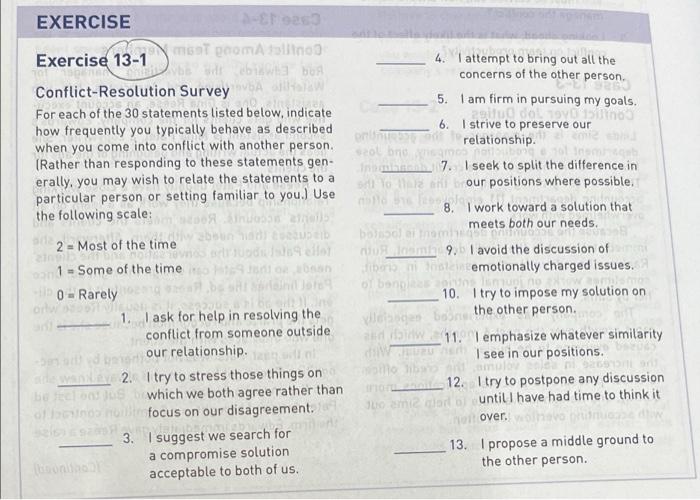
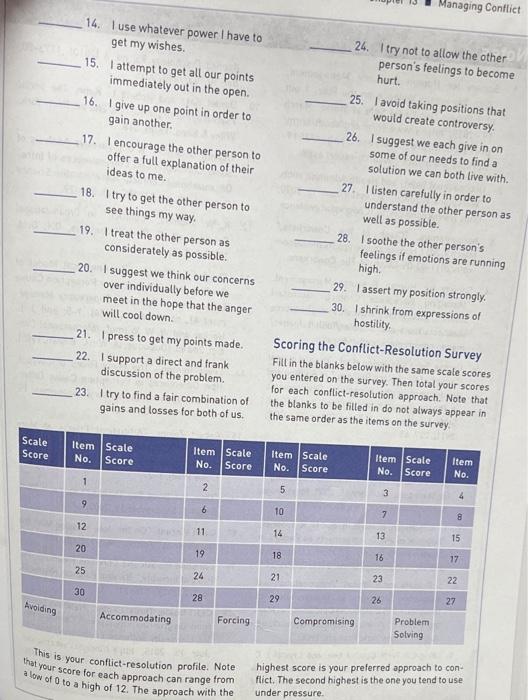
EXERCISE Poco Exercise 13-1 SOT Com A to 2 dl bus Conflict-Resolution Survey bow For each of the 30 statements listed below, indicate how frequently you typically behave as described when you come into conflict with another person. (Rather than responding to these statements gen- erally, you may wish to relate the statements to a particular person or setting familiar to you.) Use the following scale 4. I attempt to bring out all the concerns of the other person 5. I am firm in pursuing my goals. silu 1940 no 6. I strive to preserve our relationship sol brio in 7. I seek to split the difference in our positions where possible, 8. I work toward a solution that bonso meets both our needs. 9. I avoid the discussion of DO emotionally charged issues. obonne amino 10. I try to impose my solution on the other person ad 11. Temphasize whatever similarity I see in our positions. ob 12. I try to postpone any discussion Juo medias untill have had time to think it 2 - Most of the time 1 - Some of the time 0 - Rarely ht or I ask for help in resolving the conflict from someone outside to our relationship. 2. I try to stress those things on bo which we both agree rather than focus on our disagreement. 3. I suggest we search for a compromise solution acceptable to both of us. lover, 13. I propose a middle ground to the other person. Managing Conflict 14. I use whatever power I have to get my wishes. 15. I attempt to get all our points immediately out in the open. 16. I give up one point in order to gain another. 17. I encourage the other person to offer a full explanation of their ideas to me. 18. I try to get the other person to see things my way 19. I treat the other person as considerately as possible. 20. I suggest we think our concerns over individually before we meet in the hope that the anger will cool down 21. I press to get my points made. 22. I support a direct and frank discussion of the problem 23. I try to find a fair combination of gains and losses for both of us. 24. try not to allow the other person's feelings to become hurt. 25. Tavoid taking positions that would create controversy 26. I suggest we each give in on some of our needs to find a solution we can both live with 27. I listen carefully in order to understand the other personas well as possible. 28. I soothe the other person's feelings if emotions are running high 29. Tassert my position strongly. 30. Ishrink from expressions of hostility Scoring the Conflict-Resolution Survey Fill in the blanks below with the same scale scores you entered on the survey. Then total your scores for each conflict-resolution approach. Note that the blanks to be filled in do not always appear in the same order as the items on the survey Scale Score Item Scale No. Score Item Scale No. Score Item Scale No. Score Item Scale No. Score Item No. 1 2 D 5 3 9 6 10 7 8 12 11 14 13 15 20 19 18 16 17 25 24 21 23 22 30 28 29 26 27 Avoiding Accommodating Forcing Compromising Problem Solving This is your conflict-resolution profile. Note What your score for each approach can range from a low of O to a high of 12. The approach with the highest score is your preferred approach to con flict. The second highest is the one you tend to use under pressure Record and capture your scores, post the PDF or Jpeg of your scores into Canvas. Then, using a memo format (see below) place your 400-word evaluation of how you can best use the material in chapter 13 to improve your conflict management communication processes to be most successful in the workplace. And state how you will remind yourself of your plan in the workplace when you are in the stress of a conflict situation. EXERCISE Poco Exercise 13-1 SOT Com A to 2 dl bus Conflict-Resolution Survey bow For each of the 30 statements listed below, indicate how frequently you typically behave as described when you come into conflict with another person. (Rather than responding to these statements gen- erally, you may wish to relate the statements to a particular person or setting familiar to you.) Use the following scale 4. I attempt to bring out all the concerns of the other person 5. I am firm in pursuing my goals. silu 1940 no 6. I strive to preserve our relationship sol brio in 7. I seek to split the difference in our positions where possible, 8. I work toward a solution that bonso meets both our needs. 9. I avoid the discussion of DO emotionally charged issues. obonne amino 10. I try to impose my solution on the other person ad 11. Temphasize whatever similarity I see in our positions. ob 12. I try to postpone any discussion Juo medias untill have had time to think it 2 - Most of the time 1 - Some of the time 0 - Rarely ht or I ask for help in resolving the conflict from someone outside to our relationship. 2. I try to stress those things on bo which we both agree rather than focus on our disagreement. 3. I suggest we search for a compromise solution acceptable to both of us. lover, 13. I propose a middle ground to the other person. Managing Conflict 14. I use whatever power I have to get my wishes. 15. I attempt to get all our points immediately out in the open. 16. I give up one point in order to gain another. 17. I encourage the other person to offer a full explanation of their ideas to me. 18. I try to get the other person to see things my way 19. I treat the other person as considerately as possible. 20. I suggest we think our concerns over individually before we meet in the hope that the anger will cool down 21. I press to get my points made. 22. I support a direct and frank discussion of the problem 23. I try to find a fair combination of gains and losses for both of us. 24. try not to allow the other person's feelings to become hurt. 25. Tavoid taking positions that would create controversy 26. I suggest we each give in on some of our needs to find a solution we can both live with 27. I listen carefully in order to understand the other personas well as possible. 28. I soothe the other person's feelings if emotions are running high 29. Tassert my position strongly. 30. Ishrink from expressions of hostility Scoring the Conflict-Resolution Survey Fill in the blanks below with the same scale scores you entered on the survey. Then total your scores for each conflict-resolution approach. Note that the blanks to be filled in do not always appear in the same order as the items on the survey Scale Score Item Scale No. Score Item Scale No. Score Item Scale No. Score Item Scale No. Score Item No. 1 2 D 5 3 9 6 10 7 8 12 11 14 13 15 20 19 18 16 17 25 24 21 23 22 30 28 29 26 27 Avoiding Accommodating Forcing Compromising Problem Solving This is your conflict-resolution profile. Note What your score for each approach can range from a low of O to a high of 12. The approach with the highest score is your preferred approach to con flict. The second highest is the one you tend to use under pressure Record and capture your scores, post the PDF or Jpeg of your scores into Canvas. Then, using a memo format (see below) place your 400-word evaluation of how you can best use the material in chapter 13 to improve your conflict management communication processes to be most successful in the workplace. And state how you will remind yourself of your plan in the workplace when you are in the stress of a conflict situation

Step by Step Solution

There are 3 Steps involved in it

1 Expert Approved Answer
Step: 1 Unlock blur-text-image

Question Has Been Solved by an Expert!

Get step-by-step solutions from verified subject matter experts

Step: 2 Unlock
Step: 3 Unlock

Students Have Also Explored These Related General Management Questions!