







Question: Exercise: Stochastic Volatility and Local Volatility Models Consider the following stochastic volatility model for a stock S t where the dynamics are governed by the
Exercise: Stochastic Volatility and Local Volatility Models
Consider the following stochastic volatility model for a stock where the dynamics are governed by the following system of stochastic differential equations SDEs:
::
where:
is the stock price at time
is the instantaneous variance at time
and are correlated Wiener processes with correlation
is the drift rate of the stock,
is the speed of mean reversion of the variance,
is the longterm mean of the variance,
is the volatility of variance also known as "volatility of volatility"
Part : Basic Analysis and the BlackScholes Limit
Show that the model reduces to the BlackScholes model when
Derive the corresponding BlackScholes pricing formula for a European call option by setting and simplifying the SDEs. What does this imply about the volatility in the BlackScholes model?
Part : Derivation of the Option Pricing PDE
Derive the PDE for the option price under stochastic volatility.
Set up a riskfree portfolio using the option, the stock, and an additional derivative to hedge against changes in volatility. By requiring the portfolio to be riskfree, derive the partial differential equation PDE that the option price must satisfy under this stochastic volatility model.
Interpret the market price of volatility risk
In your derivation of the PDE, you will find a term involving known as the "market price of volatility risk." Discuss its role and significance in the option pricing framework.
Part : Local Volatility Model
Transition to a Local Volatility Model:
Assume that the stochastic volatility process is not explicitly modeled, but that the option prices reflect the implied volatility surface in the market. Using the Dupire equation for local volatility, express the local volatility in terms of the price of European call options where is the strike price and is the expiration time. Derive the following relationship for local volatility:
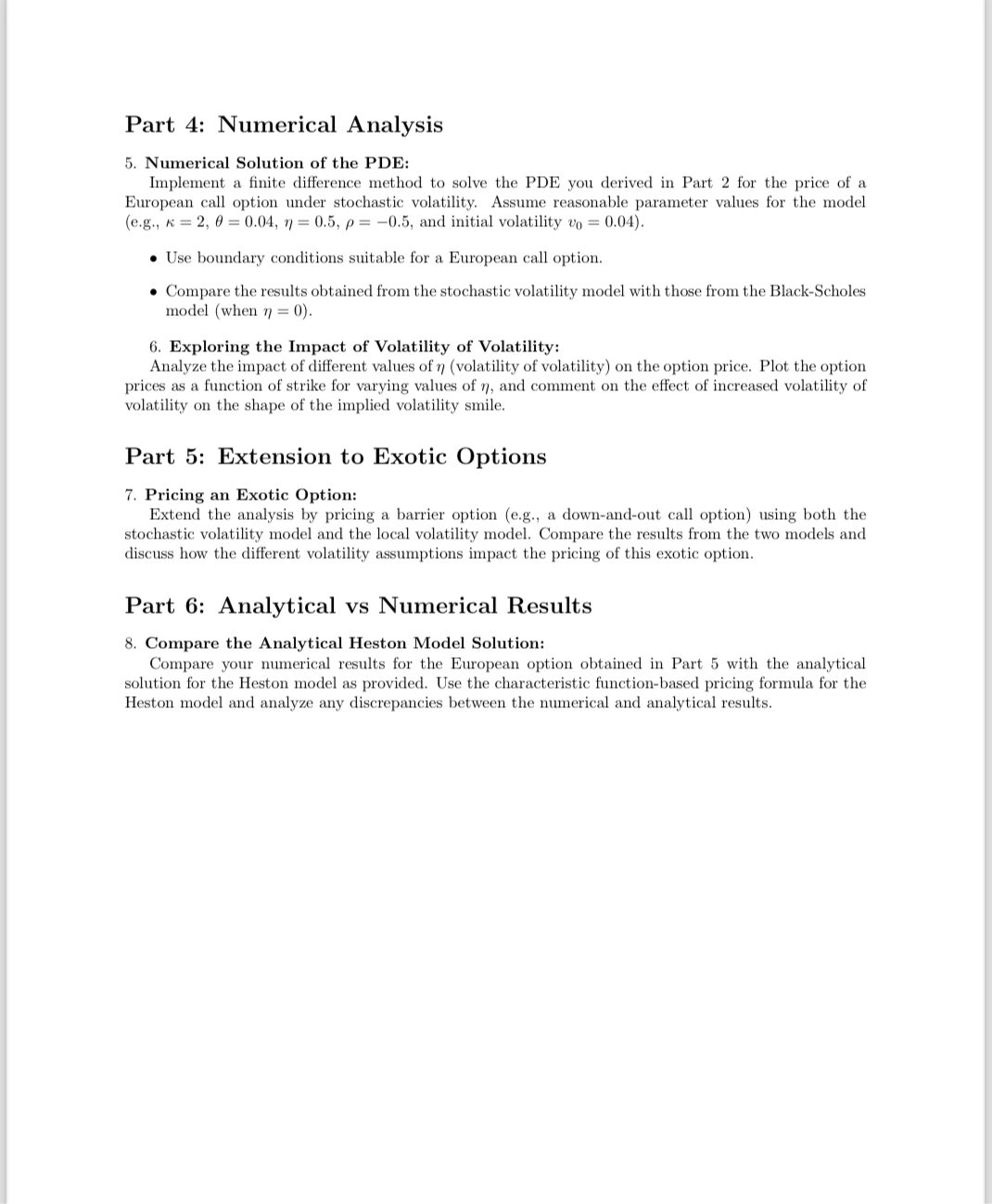
Part : Numerical Analysis
Numerical Solution of the PDE:
Implement a finite difference method to solve the PDE you derived in Part for the price of a European call option under stochastic volatility. Assume reasonable parameter values for the model eg and initial volatility
Use boundary conditions suitable for a European call option.
Compare the results obtained from the stochastic volatility model with those from the BlackScholes model when
Exploring the Impact of Volatility of Volatility:
Analyze the impact of different values of volatility of volatility on the option price. Plot the option prices as a function of strike for varying values of and comment on the effect of increased volatility of volatility on the shape of the implied volatility smile.
Part : Extension to Exotic Options
Pricing an Exotic Option:
Extend the analysis by pricing a barrier option eg a downandout call option using both the stochastic volatility model and the local volatility model. Compare the results from the two models and discuss how the different volatility assumptions impact the pricing of this exotic option.
Part : Analytical vs Numerical Results
Compare the Analytical Heston Model Solution:
Compare your numerical results for the European option obtained in Part with the analytical solution for the Heston model as provided. Use the characteristic functionbased pricing formula for the Heston model and analyze any discrepancies between the numerical and analytical results.
Step by Step Solution
There are 3 Steps involved in it
1 Expert Approved Answer
Step: 1 Unlock

Question Has Been Solved by an Expert!
Get step-by-step solutions from verified subject matter experts
Step: 2 Unlock
Step: 3 Unlock
 Study Help