







Question: exercise2 Now, consider the following three utility functions defined over a consumption set X c R2. 2/3 i) U(x, y) = max[2x,' 2y] (mind, this
exercise2
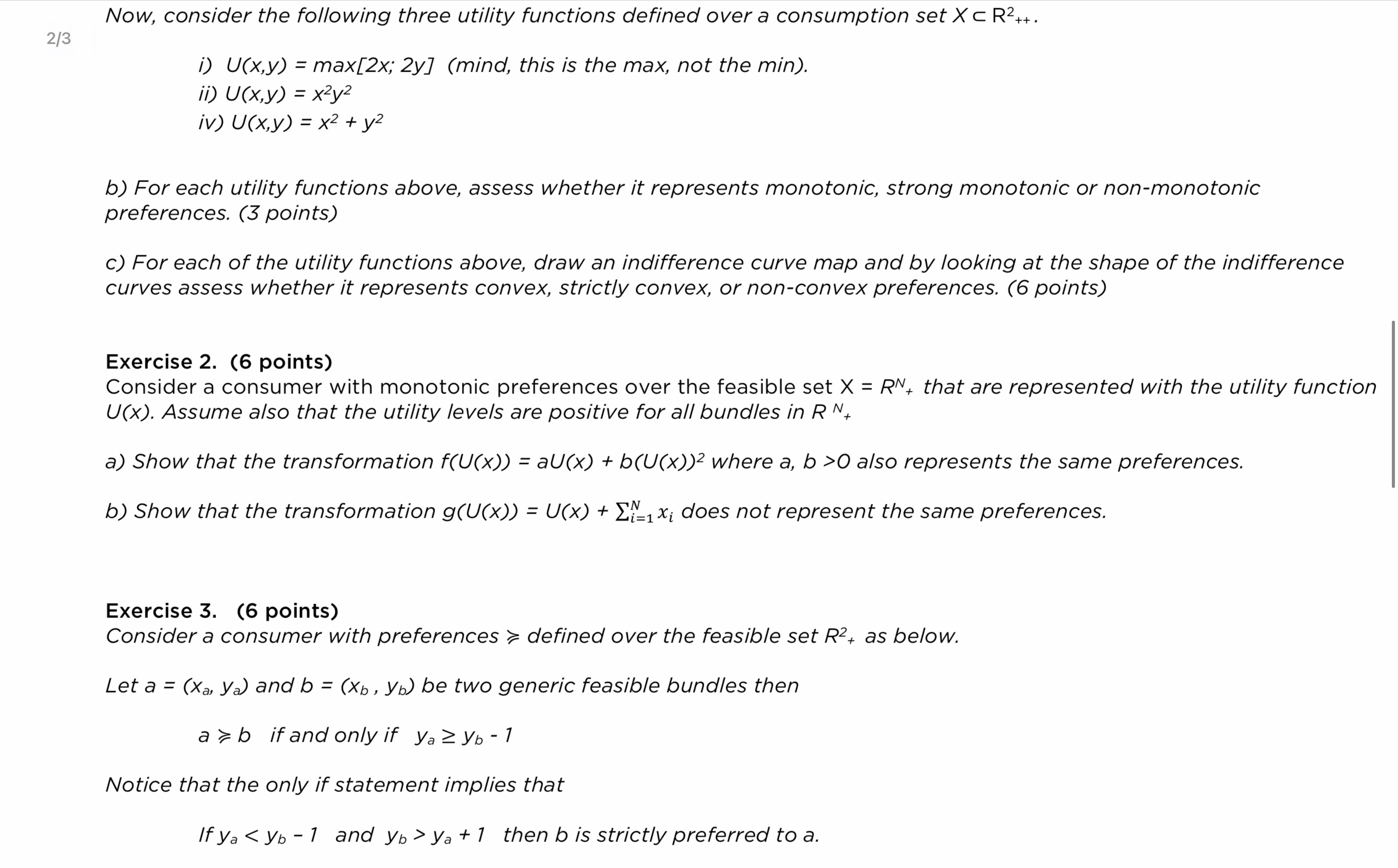
Now, consider the following three utility functions defined over a consumption set X c R2\". 2/3 i) U(x, y) = max[2x,' 2y] (mind, this is the max, not the min). ii) U(X.y) = Xzyz iv) U(X.y) = x2 + y2 b) For each utility functions above, assess whether it represents monotonic, strong monotonic or non-monotonic preferences. (3 points) c) For each of the utility functions above, draw an indifference curve map and by looking at the shape of the indifference curves assess whether it represents convex, strictly convex, or non-con vex preferences. (6 points) Exercise 2. (6 points) Consider a consumer with monotonic preferences over the feasible set X = RM that are represented with the utility function U(x). Assume also that the utility levels are positive for all bundles in R M a) Show that the transformation f(U(x)) = aU(x) + b(U(x))2 where a, b >0 also represents the same preferences. b) Show that the transformation g(U(x)) = U(x) + 29:12:, does not represent the same preferences. Exercise 3. (6 points) Consider a consumer with preferences > dened over the feasible set R2+ as below. Let a = (x5, ya) and b = (xb, yb) be two generic feasible bundles then a k b ifandon/yif ya zyb - 7 Notice that the only if statement implies that If ya ya + 7 then b is strictly preferred to a
Step by Step Solution
There are 3 Steps involved in it

Get step-by-step solutions from verified subject matter experts
 Study Help