







Question: Exercise5.7(1 - 9) Calculas 3 myopenmath.com Question 5 0/1 pt 9 100 99 8 Details Find JJ 6x + by A, where R is the
Exercise5.7(1 - 9)
Calculas 3
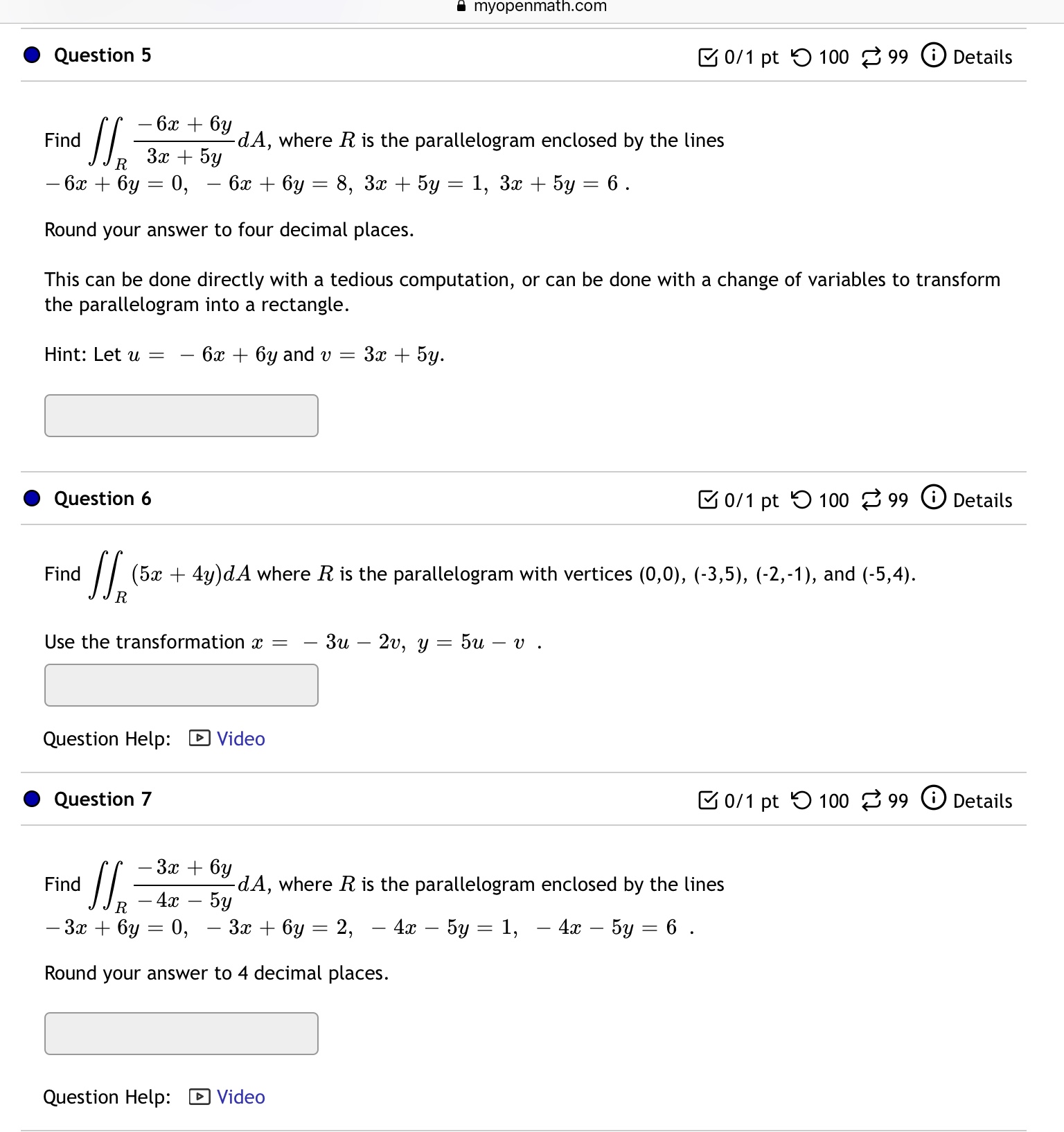
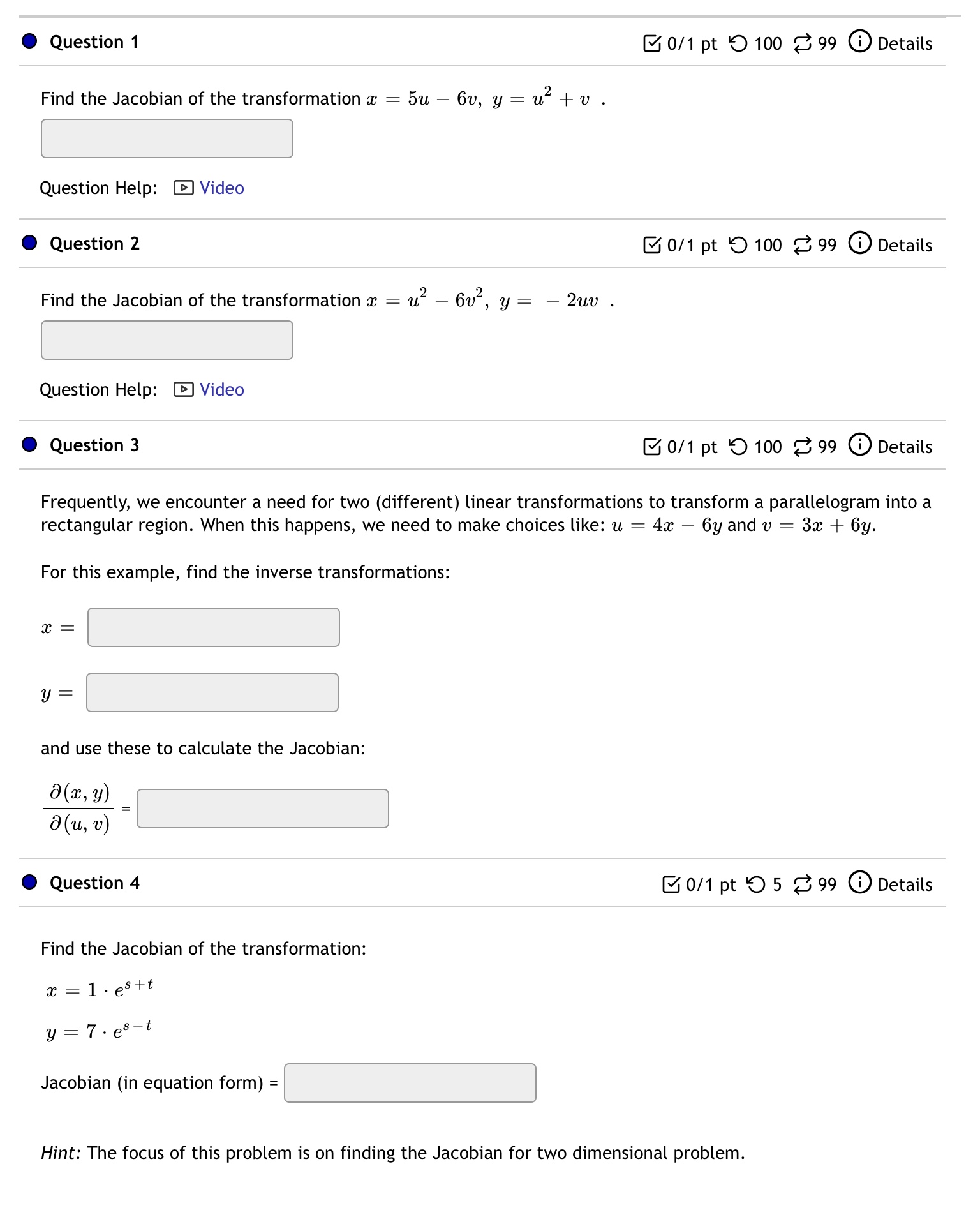
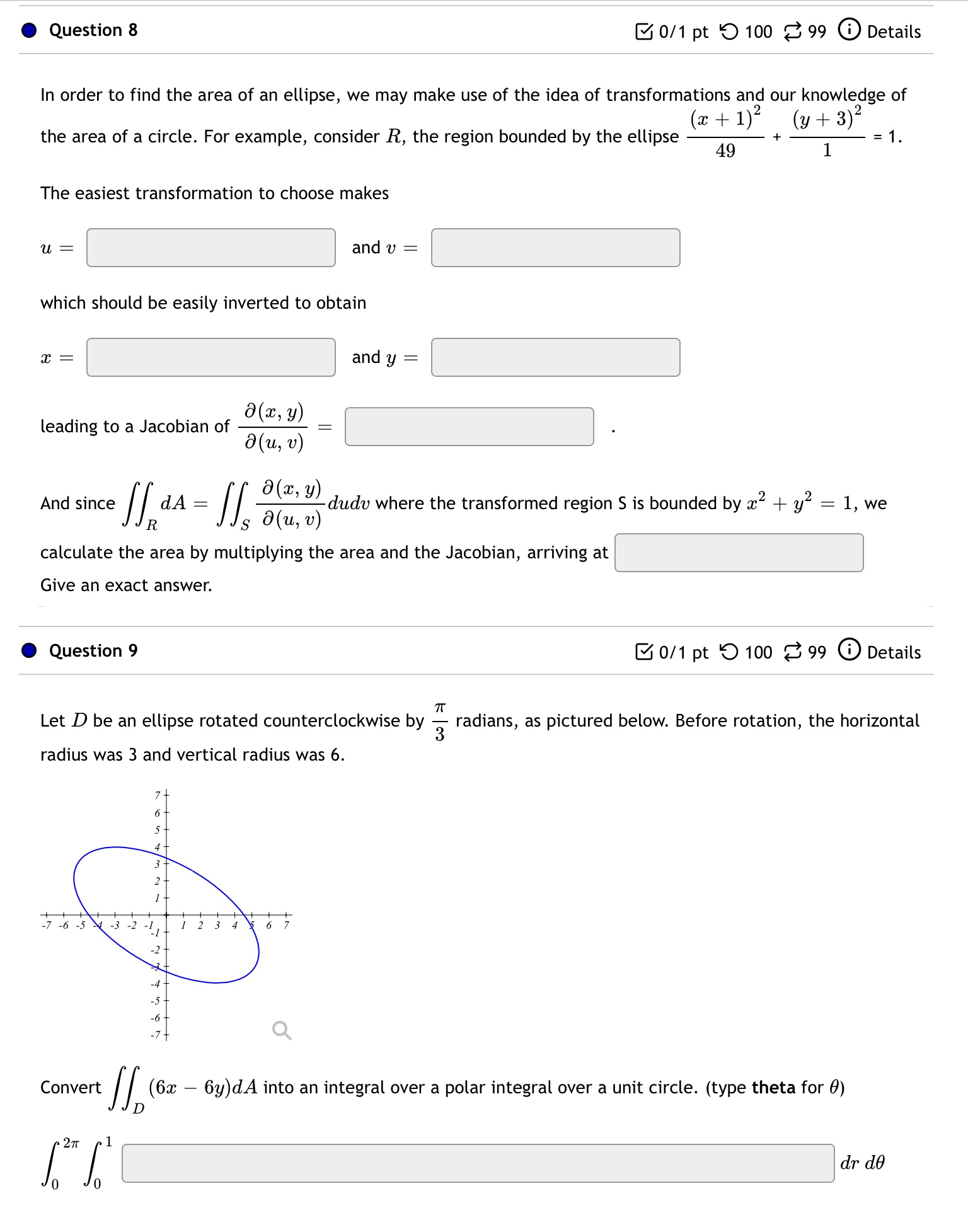
myopenmath.com Question 5 0/1 pt 9 100 99 8 Details Find JJ 6x + by A, where R is the parallelogram enclosed by the lines 3x + 5y -6x + 6y = 0, - 6x + 6y = 8, 3x + 5y = 1, 3x + 5y = 6. Round your answer to four decimal places. This can be done directly with a tedious computation, or can be done with a change of variables to transform the parallelogram into a rectangle. Hint: Let u = - 6x + 6y and v = 3x + 5y. Question 6 0/1 pt 9 100 99 0 Details Find (5x + 4y) d A where R is the parallelogram with vertices (0,0), (-3,5), (-2, -1), and (-5, 4). Use the transformation x = - 3u - 2v, y = 5u - v . Question Help: DVideo Question 7 0/1 pt 100 99 0 Details Find / 3x + by A. where R is the parallelogram enclosed by the lines - 4x - 5y - 3x + 6y = 0, - 3x + 6y = 2, - 4x - 5y = 1, - 4x - 5y = 6 . Round your answer to 4 decimal places. Question Help: DVideo0 Question 1 E 0/1 pt '0 100 8 99 6) Details Find the Jacobian of the transformation :1: = 5a 612, y = 11,2 -l- 'u . Question Help: El Video 0 Question 2 l3 0/1 pt '0 100 Z 99 (D Details Find the Jacobian of the transformation a: = u2 6112, y = Zuv . Question Help: El Video . Question 3 B 0/1 pt '0 100 8 99 6) Details Frequently, we encounter a need for two (different) linear transformations to transform a parallelogram into a rectangular region. When this happens, we need to make choices like: u = 4m By and v = 3$ + 63;. For this example, find the inverse transformations: and use these to calculate the Jacobian: \"9 y) _ 8(u, v) 0 Question 4 [3 0/1 pt '0 5 2 99 (D Details Find the Jacobian of the transformation: Jacobian (in equation form) = Hint: The focus of this problem is on finding the Jacobian for two dimensional problem. 0 Question 8 l3 0/1 pt 0100 2 99 (D Details In order to find the area of an ellipse, we may make use of the idea of transformations and our knowledge of (m + 1)2 (y + 3)2 1 + = the area of a circle. For example, consider R, the region bounded by the ellipse 49 1 The easiest transformation to choose makes andv = 53 II which should be easily inverted to obtain 3 m, 0(u, 'u) 3 3: And since ff dA = ff Mahdi; where the transformed region S is bounded by 3:2 + y2 = 1, we R S 3(1', 1') calculate the area by multiplying the area and the Jacobian, arriving at Give an exact answer. 0 Question 9 B 0/1 pt '0 100 8 99 6) Details 71' Let D be an ellipse rotated counterclockwise by E radians, as pictured below. Before rotation, the horizontal radius was 3 and vertical radius was 6. Convert ff (6:1: 6y)dA into an integral over a polar integral over a unit circle. (type theta for 6) D 2n 1 f fwa 0 0
Step by Step Solution
There are 3 Steps involved in it

Get step-by-step solutions from verified subject matter experts
 Study Help