







Question: Exercises 1 and 9 5.8 CHAPTER 5 EXERCISES sentat D Write down the IEEE double-precision representation fo decimal numbers: (a) 1.5, using round up. (b)
Exercises 1 and 9
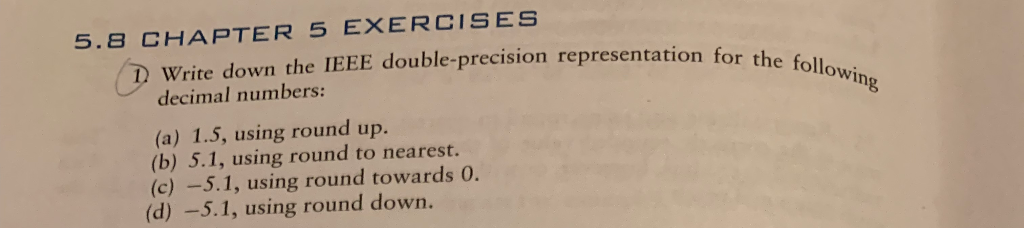
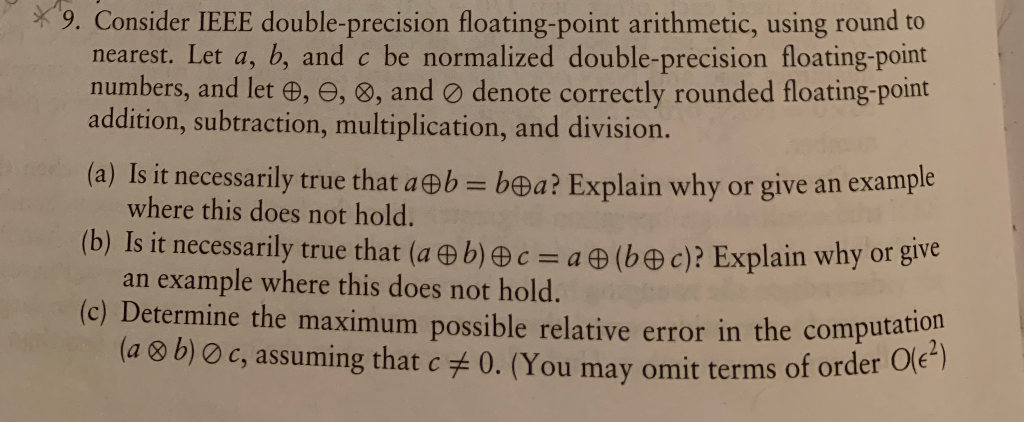

5.8 CHAPTER 5 EXERCISES sentat D Write down the IEEE double-precision representation fo decimal numbers: (a) 1.5, using round up. (b) 5.1, using round to nearest. (c) -5.1, using round towards O (d)-5.1, using round down. 9. Consider IEEE double-precision floating-point arithmetic, using round to nearest. Let a, b, and c be normalized double-precision floating-point numbers, and let e, e, 8, and O denote correctly rounded floating-point addition, subtraction, multiplication, and division. (a) Is it necessarily true that a@b bea? Explain why or give an exa (b) Is it necessarily true that (a ebec-ae(be c)? Explain why or give (c) Determine the maximum possible relative error in the comput where this does not hold. an example where this does not hold. la 8 b)0 c, assuming that c 0. (You may omit terms of order 121 ATING-POINT ARITHMETIC and higher.) Suppose c-0; what are the possible values that (aobloc could be assigned
Step by Step Solution
There are 3 Steps involved in it

Get step-by-step solutions from verified subject matter experts
 Study Help