







Question: Exercises 3.30 ML and Haskell do not have general list structures like Scheme, but require the elements in a list to have all the same
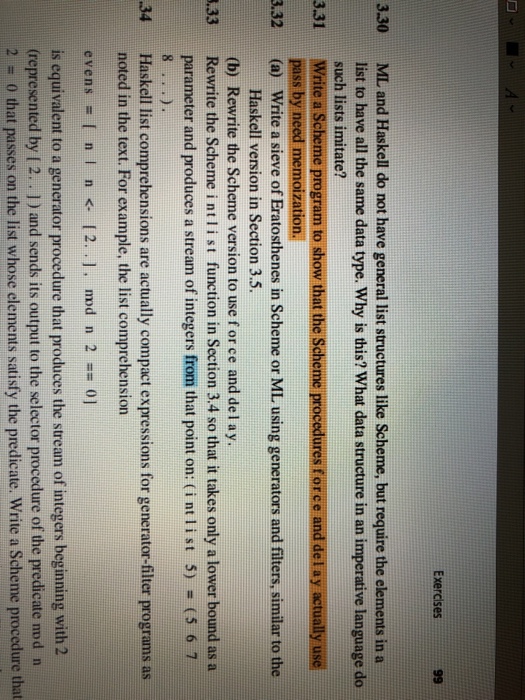
Exercises 3.30 ML and Haskell do not have general list structures like Scheme, but require the elements in a list to have all the same data type. Why is this? What data structure in an imperative language do such lists imitate? Write a Scheme program to show that the Scheme procedures force and de l ay actually use pass by need memoization. (a) 3.31 3.32 Write a sieve of Eratosthenes in Scheme or ML using generators and filters, similar to the Haskell version in Section 3.5 (b) Rewrite the Scheme version to use f or ce and de l ay Rewrite the Scheme intlist function in Section 3.4 so that it takes only a lower bound as a parameter and produces a stream of integers from that point on: ( i nt l i st .33 5) ( 5 6 7 Haskell list comprehensions are actually compact expressions for generator-filter programs as noted in the text. For example, the list comprehension 34 is equivalent to a generator procedure that produces the stream of integers beginning with 2 (represented by { 2) and sends its output to the selector procedure of the predicate mod n 2 # () that passes on the list whose elements satisfy the predicate. Write a Scheme procedure that Exercises 3.30 ML and Haskell do not have general list structures like Scheme, but require the elements in a list to have all the same data type. Why is this? What data structure in an imperative language do such lists imitate? Write a Scheme program to show that the Scheme procedures force and de l ay actually use pass by need memoization. (a) 3.31 3.32 Write a sieve of Eratosthenes in Scheme or ML using generators and filters, similar to the Haskell version in Section 3.5 (b) Rewrite the Scheme version to use f or ce and de l ay Rewrite the Scheme intlist function in Section 3.4 so that it takes only a lower bound as a parameter and produces a stream of integers from that point on: ( i nt l i st .33 5) ( 5 6 7 Haskell list comprehensions are actually compact expressions for generator-filter programs as noted in the text. For example, the list comprehension 34 is equivalent to a generator procedure that produces the stream of integers beginning with 2 (represented by { 2) and sends its output to the selector procedure of the predicate mod n 2 # () that passes on the list whose elements satisfy the predicate. Write a Scheme procedure that
Step by Step Solution
There are 3 Steps involved in it

Get step-by-step solutions from verified subject matter experts
 Study Help