







Question: EXERCISES 9.1 Suppose that it is one year after EBV's investment in Newco (using the CP structure from Exercise 8.2), and Talltree makes a Series
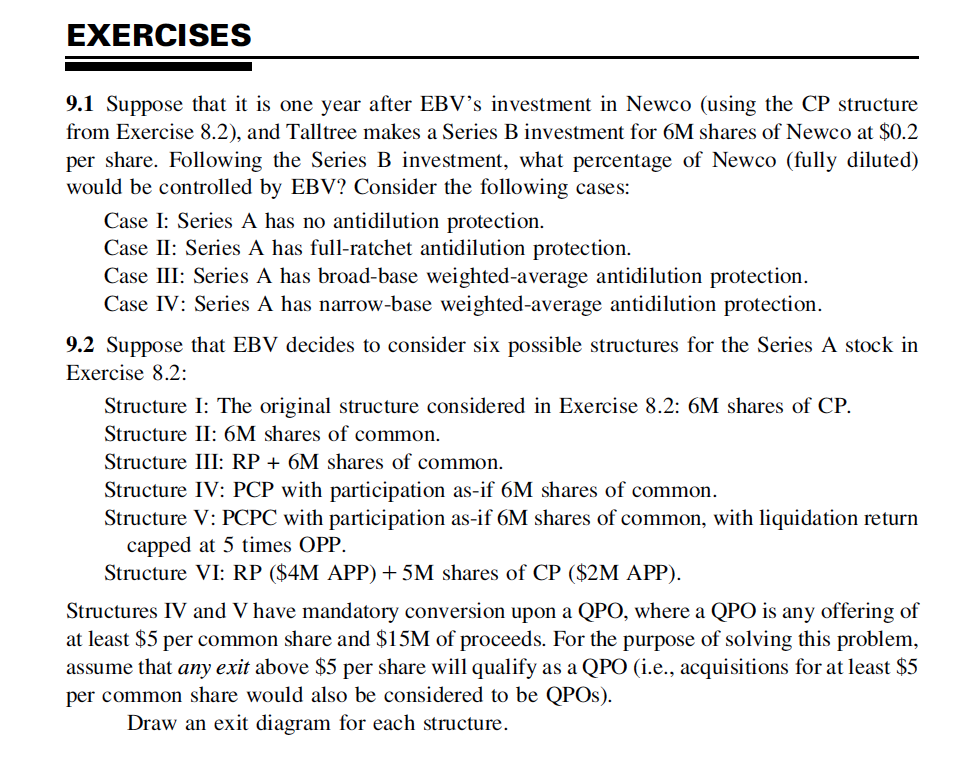
EXERCISES 9.1 Suppose that it is one year after EBV's investment in Newco (using the CP structure from Exercise 8.2), and Talltree makes a Series B investment for 6M shares of Newco at $0.2 per share. Following the Series B investment, what percentage of Newco (fully diluted) would be controlled by EBV? Consider the following cases: Case I: Series A has no antidilution protection. Case II: Series A has full-ratchet antidilution protection. Case III: Series A has broad-base weighted-average antidilution protection. Case IV: Series A has narrow-base weighted-average antidilution protection. 9.2 Suppose that EBV decides to consider six possible structures for the Series A stock in Exercise 8.2: Structure I: The original structure considered in Exercise 8.2: 6M shares of CP. Structure II: 6M shares of common. Structure III: RP + 6M shares of common. Structure IV: PCP with participation as-if 6M shares of common. Structure V: PCPC with participation as-if 6M shares of common, with liquidation return capped at 5 times OPP. Structure VI: RP ($4M APP) + 5M shares of CP ($2M APP). Structures IV and V have mandatory conversion upon a QPO, where a QPO is any offering of at least $5 per common share and $15M of proceeds. For the purpose of solving this problem, assume that any exit above $5 per share will qualify as a QPO (i.e., acquisitions for at least $5 per common share would also be considered to be QPOs). Draw an exit diagram for each structure
Step by Step Solution
There are 3 Steps involved in it

Get step-by-step solutions from verified subject matter experts
 Study Help