







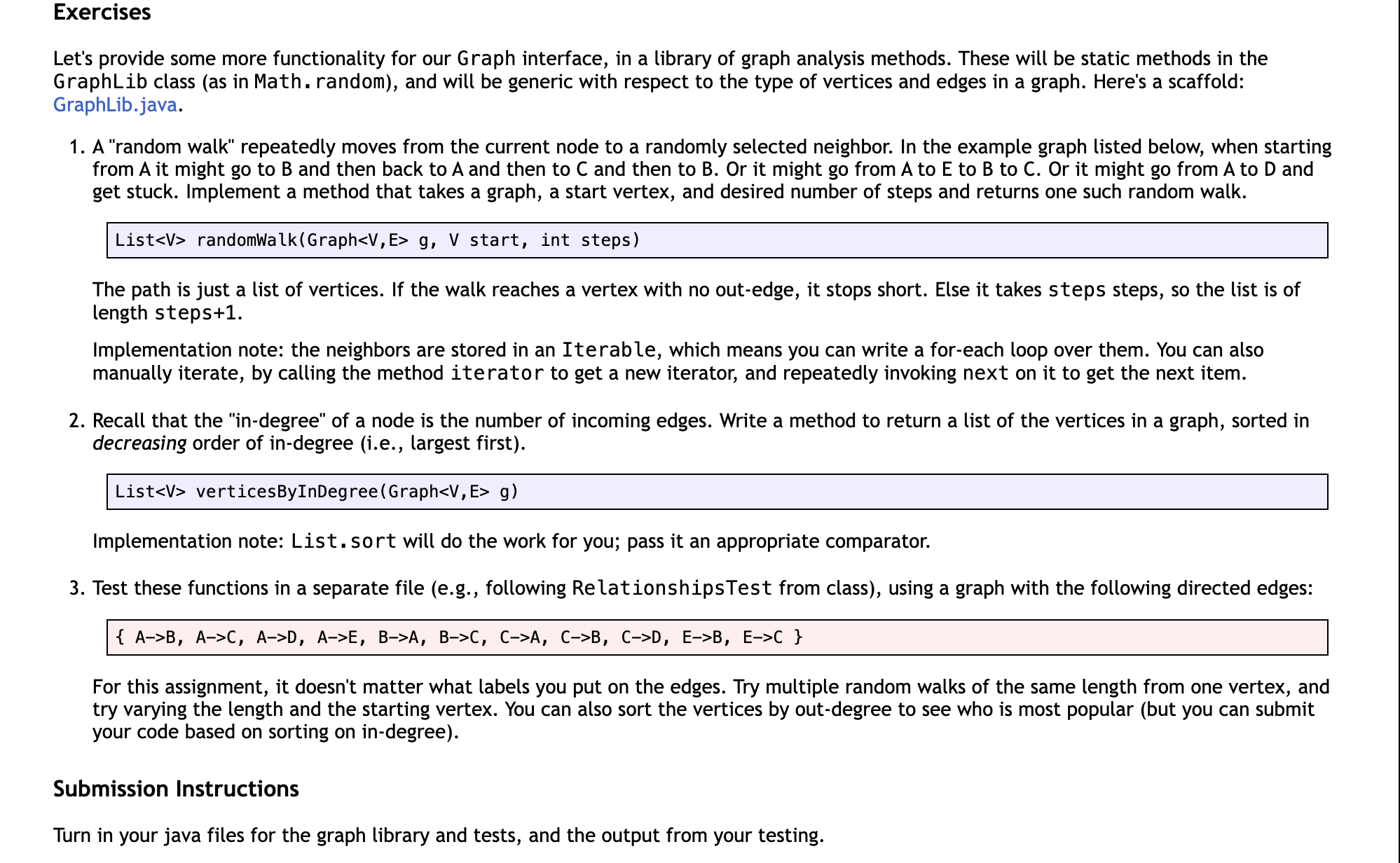
Question: Exercises Let's provide some more functionality for our Graph interface, in a library of graph analysis methods. These will be static methods in the GraphLib
Exercises
Let's provide some more functionality for our Graph interface, in a library of graph analysis methods. These will be static methods in the
GraphLib class as in Math. random and will be generic with respect to the type of vertices and edges in a graph. Here's a scaffold:
GraphLib.java.
A "random walk" repeatedly moves from the current node to a randomly selected neighbor. In the example graph listed below, when starting
from A it might go to B and then back to A and then to C and then to B Or it might go from A to E to B to C Or it might go from A to D and
get stuck. Implement a method that takes a graph, a start vertex, and desired number of steps and returns one such random walk.
List randomWalkGraph g V start, int steps
The path is just a list of vertices. If the walk reaches a vertex with no outedge, it stops short. Else it takes steps steps, so the list is of
length steps
Implementation note: the neighbors are stored in an Iterable, which means you can write a foreach loop over them. You can also
manually iterate, by calling the method iterator to get a new iterator, and repeatedly invoking next on it to get the next item.
Recall that the indegree" of a node is the number of incoming edges. Write a method to return a list of the vertices in a graph, sorted in
decreasing order of indegree ie largest first
List verticesByInDegreeGraph g
Implementation note: List. sort will do the work for you; pass it an appropriate comparator.
Test these functions in a separate file eg following RelationshipsTest from class using a graph with the following directed edges:
A rarr BA rarr CA rarr DA rarr EB rarr AB rarr CC rarr AC rarr BC rarr DE rarr BE rarr C
For this assignment, it doesn't matter what labels you put on the edges. Try multiple random walks of the same length from one vertex, and
try varying the length and the starting vertex. You can also sort the vertices by outdegree to see who is most popular but you can submit
your code based on sorting on indegree
Submission Instructions
Turn in your java files for the graph library and tests, and the output from your testing.
GraphLib.java
public class GraphLib Takes a random walk from a vertex, up to a given number of steps So a step path only includes start, while a step path includes start and one of its outneighbors, and a step path includes start, an outneighbor, and one of the outneighbor's outneighbors Stops earlier if no step can be taken ie reach a vertex with no outedge @param g graph to walk on @param start initial vertex assumed to be in graph @param steps max number of steps @return a list of vertices starting with start, each with an edge to the sequentially next in the list; null if start isn't in graph public static List randomWalkGraph g V start, int steps TODO: your code here Orders vertices in decreasing order by their indegree @param g graph @return list of vertices sorted by indegree, decreasing ie largest at index public static List verticesByInDegreeGraph g TODO: your code here
Step by Step Solution
There are 3 Steps involved in it
1 Expert Approved Answer
Step: 1 Unlock

Question Has Been Solved by an Expert!
Get step-by-step solutions from verified subject matter experts
Step: 2 Unlock
Step: 3 Unlock
 Study Help