







Question: Exo9: let u=(1,2) and v=(2,1). Find a non zero linear combination w and u and v that's perpendicular to u. Draw a picture to illustrate
Exo9: let u=(1,2) and v=(2,1). Find a non zero linear combination w and u and v that's perpendicular to u. Draw a picture to illustrate what the coefficients are measuring. ( hint: you may as well take the linear combination w to be of the form au+v, why is that? Then how would you find a?)
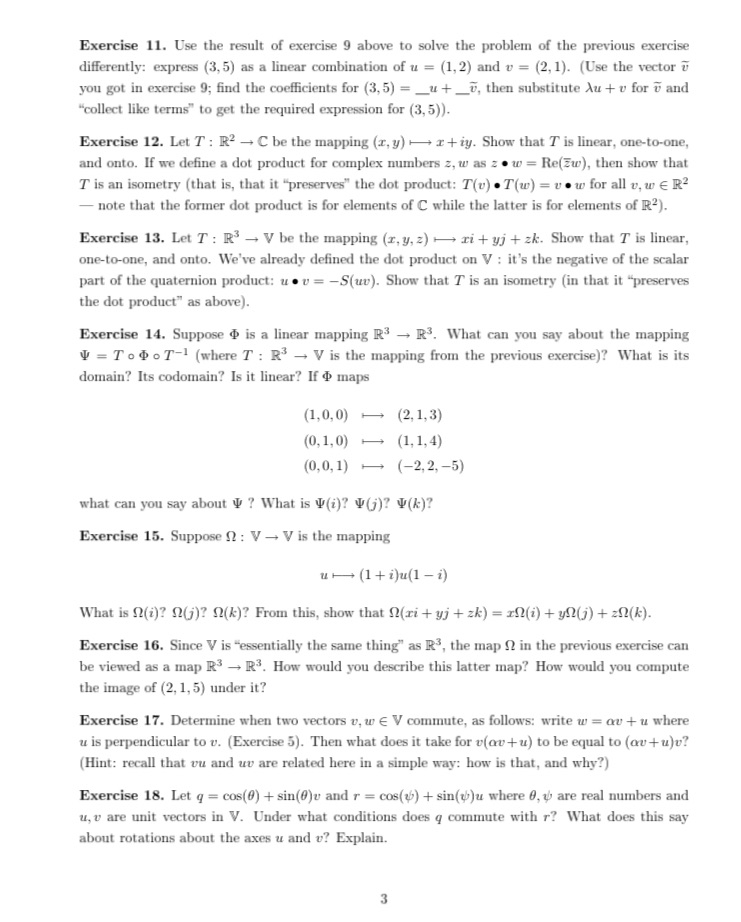 Exercise 11. Use the result of exercise 9 above to solve the problem of the previous exercise differently: express (3,5) as a linear combination of u = (1, 2) and v = (2, 1). (Use the vector you got in exercise 9; find the coefficients for (3,5) = _u + _v, then substitute du + v for v and "collect like terms" to get the required expression for (3, 5)). Exercise 12. Let T : R2 -+ C be the mapping (x, y) - r + iy. Show that T is linear, one-to-one, and onto. If we define a dot product for complex numbers z, w as z . w = Re(Ew), then show that I is an isometry (that is, that it "preserves" the dot product: T(v) . T(w) = v . w for all v, we R? -note that the former dot product is for elements of C while the latter is for elements of R?). Exercise 13. Let 7 : RS -+ V be the mapping (r, y, z) - ri + yj + zk. Show that T is linear, one-to-one, and onto. We've already defined the dot product on V : it's the negative of the scalar part of the quaternion product: u . v = -S(uv). Show that T is an isometry (in that it "preserves the dot product" as above). Exercise 14. Suppose 4 is a linear mapping R3 - R3. What can you say about the mapping V = TodoT-1 (where T : R3 -+ V is the mapping from the previous exercise)? What is its domain? Its codomain? Is it linear? If d maps (1,0,0) - (2, 1,3) (0, 1,0) - (1, 1,4) (0,0, 1) (-2, 2, -5) what can you say about Y ? What is V()? V(j)? V(k)? Exercise 15. Suppose ? : V - V is the mapping un (1 + i)u(1 -i) What is ?(i)? Q(j)? Q(k)? From this, show that ?(ri + yj + zk) = x(i) + y?(j) + 20(k). Exercise 16. Since V is "essentially the same thing" as R3, the map ? in the previous exercise can be viewed as a map R3 -+ R3. How would you describe this latter map? How would you compute the image of (2, 1, 5) under it? Exercise 17. Determine when two vectors v, w E V commute, as follows: write w = au + u where u is perpendicular to v. (Exercise 5). Then what does it take for v(ov + u) to be equal to (au + u)v? (Hint: recall that vu and uv are related here in a simple way: how is that, and why?) Exercise 18. Let q = cos(0) + sin(0)v and r = cos() + sin(t)u where 0, are real numbers and u, v are unit vectors in V. Under what conditions does q commute with r? What does this say about rotations about the axes u and v? Explain
 Step by Step Solution
There are 3 Steps involved in it
1 Expert Approved Answer
Step: 1 Unlock

Question Has Been Solved by an Expert!
Get step-by-step solutions from verified subject matter experts
Step: 2 Unlock
Step: 3 Unlock
 Study Help