







Question: Expected Utility (EU) Problem - Discuss mathematically Question 3. (20 marks) In this question we will consider two decision problems. The Three-Colour Problem. An urn
Expected Utility (EU) Problem - Discuss mathematically
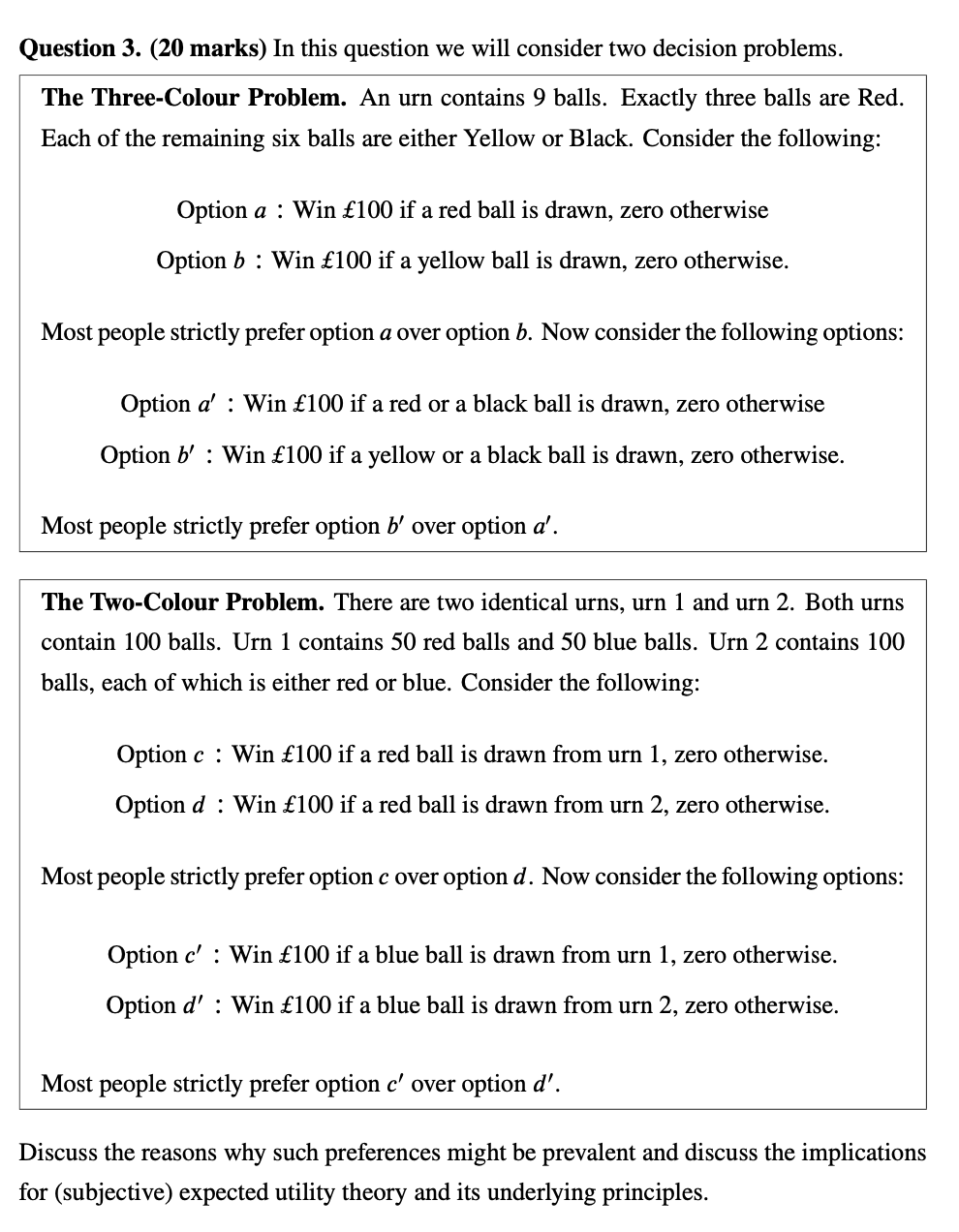
Question 3. (20 marks) In this question we will consider two decision problems. The Three-Colour Problem. An urn contains 9 balls. Exactly three balls are Red. Each of the remaining six balls are either Yellow or Black. Consider the following: Option a : Win 100 if a red ball is drawn, zero otherwise Option 13 : Win 100 if a yellow ball is drawn, zero otherwise. Most people strictly prefer option a over option I). Now consider the following options: Option a' : Win 100 if a red or a black ball is drawn, zero otherwise Option [3' : Win 100 if a yellow or a black ball is drawn, zero otherwise. Most people strictly prefer option If over option a\". The Two-Colour Problem. There are two identical urns, urn l and urn 2. Both urns contain 100 balls. Urn 1 contains 50 red balls and 50 blue balls. Urn 2 contains 100 balls, each of which is either red or blue. Consider the following: Option c : Win 100 if a red ball is drawn from urn 1, zero otherwise. Option :1! : Win :6 100 if a red ball is drawn from urn 2, zero otherwise. Most people strictly prefer option c over option d. Now consider the following options: Option c' : Win 1-? 100 if a blue ball is drawn from urn 1, zero otherwise. Option 11" : Win 100 if a blue ball is drawn from urn 2, zero otherwise. Most people strictly prefer option c' over option a" . Discuss the reasons why such preferences might be prevalent and discuss the implications for (subjective) expected utility theory and its underlying principles
Step by Step Solution
There are 3 Steps involved in it

Get step-by-step solutions from verified subject matter experts
 Study Help