





Question: Expected Value (Realist) Compute the expected value under each action and then pick the action with the largest expected value. This is the only method
Expected Value (Realist) Compute the expected

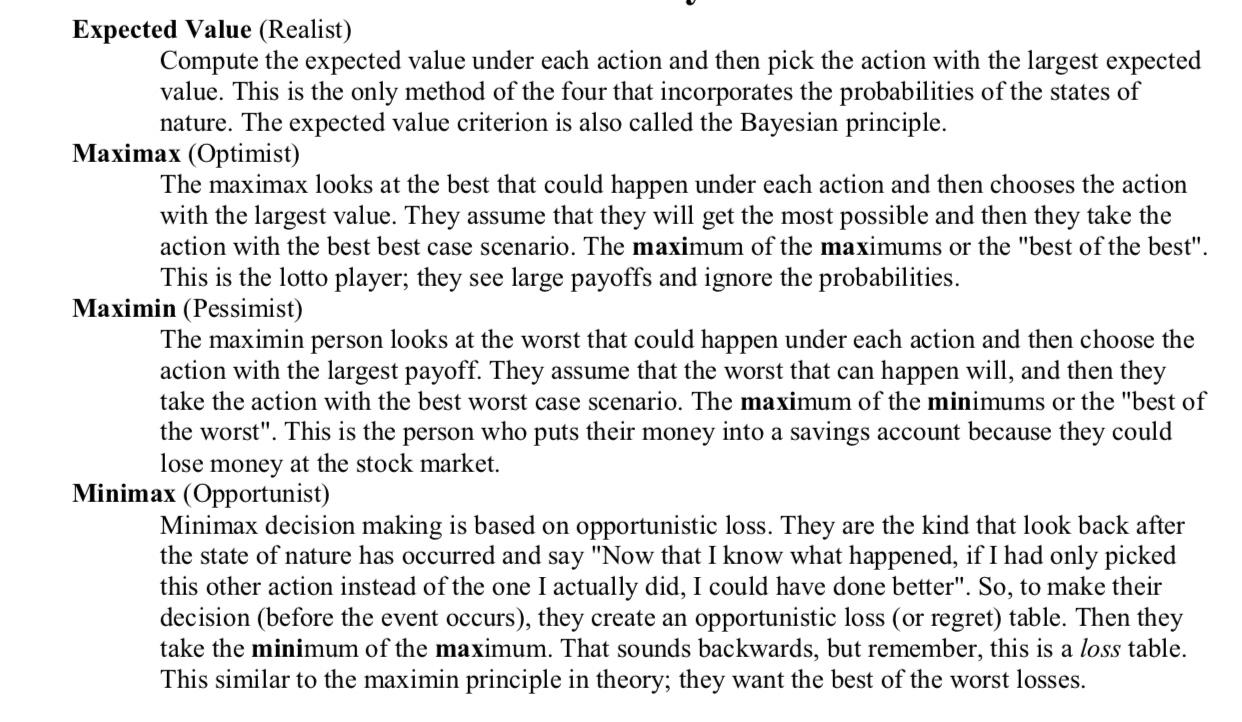
Expected Value (Realist) Compute the expected value under each action and then pick the action with the largest expected value. This is the only method of the four that incorporates the probabilities of the states of nature. The expected value criterion is also called the Bayesian principle. Maximax (Optimist) The maximax looks at the best that could happen under each action and then chooses the action with the largest value. They assume that they will get the most possible and then they take the action with the best best case scenario. The maximum of the maximums or the "best of the best". This is the lotto player; they see large payoffs and ignore the probabilities. Maximin (Pessimist) The maximin person looks at the worst that could happen under each action and then choose the action with the largest payoff. They assume that the worst that can happen will, and then they take the action with the best worst case scenario. The maximum of the minimums or the "best of the worst". This is the person who puts their money into a savings account because they could lose money at the stock market. Minimax (Opportunist) Minimax decision making is based on opportunistic loss. They are the kind that look back after the state of nature has occurred and say "Now that I know what happened, if I had only picked this other action instead of the one I actually did, I could have done better". So, to make their decision (before the event occurs), they create an opportunistic loss (or regret) table. Then they take the minimum of the maximum. That sounds backwards, but remember, this is a loss table. This similar to the maximin principle in theory; they want the best of the worst losses. Expected Value (Realist) Compute the expected value under each action and then pick the action with the largest expected value. This is the only method of the four that incorporates the probabilities of the states of nature. The expected value criterion is also called the Bayesian principle. Maximax (Optimist) The maximax looks at the best that could happen under each action and then chooses the action with the largest value. They assume that they will get the most possible and then they take the action with the best best case scenario. The maximum of the maximums or the "best of the best". This is the lotto player; they see large payoffs and ignore the probabilities. Maximin (Pessimist) The maximin person looks at the worst that could happen under each action and then choose the action with the largest payoff. They assume that the worst that can happen will, and then they take the action with the best worst case scenario. The maximum of the minimums or the "best of the worst". This is the person who puts their money into a savings account because they could lose money at the stock market. Minimax (Opportunist) Minimax decision making is based on opportunistic loss. They are the kind that look back after the state of nature has occurred and say "Now that I know what happened, if I had only picked this other action instead of the one I actually did, I could have done better". So, to make their decision (before the event occurs), they create an opportunistic loss (or regret) table. Then they take the minimum of the maximum. That sounds backwards, but remember, this is a loss table. This similar to the maximin principle in theory; they want the best of the worst losses

Step by Step Solution

There are 3 Steps involved in it

1 Expert Approved Answer
Step: 1 Unlock blur-text-image

Question Has Been Solved by an Expert!

Get step-by-step solutions from verified subject matter experts

Step: 2 Unlock
Step: 3 Unlock

Students Have Also Explored These Related General Management Questions!