







Question: Experiment 2: Using Freezing Point Depression To Find Molecular Weight RESULTS AND CALCULATIONS 1. Calculate The Molality (M) Of Your Solution In Mol/Kg, Using The
Experiment 2: Using Freezing Point Depression To Find Molecular Weight RESULTS AND CALCULATIONS 1. Calculate The Molality (M) Of Your Solution In Mol/Kg, Using The Formula At = Kf X M. The Ks Value For Lauric Acid Is 3.9°C Kg-Mol-?. 2. What Are The Number Of Moles Of Benzoic Acid (The Solute), Using The Molality And The Mass (In Kg) Of The Solvent, Lauric
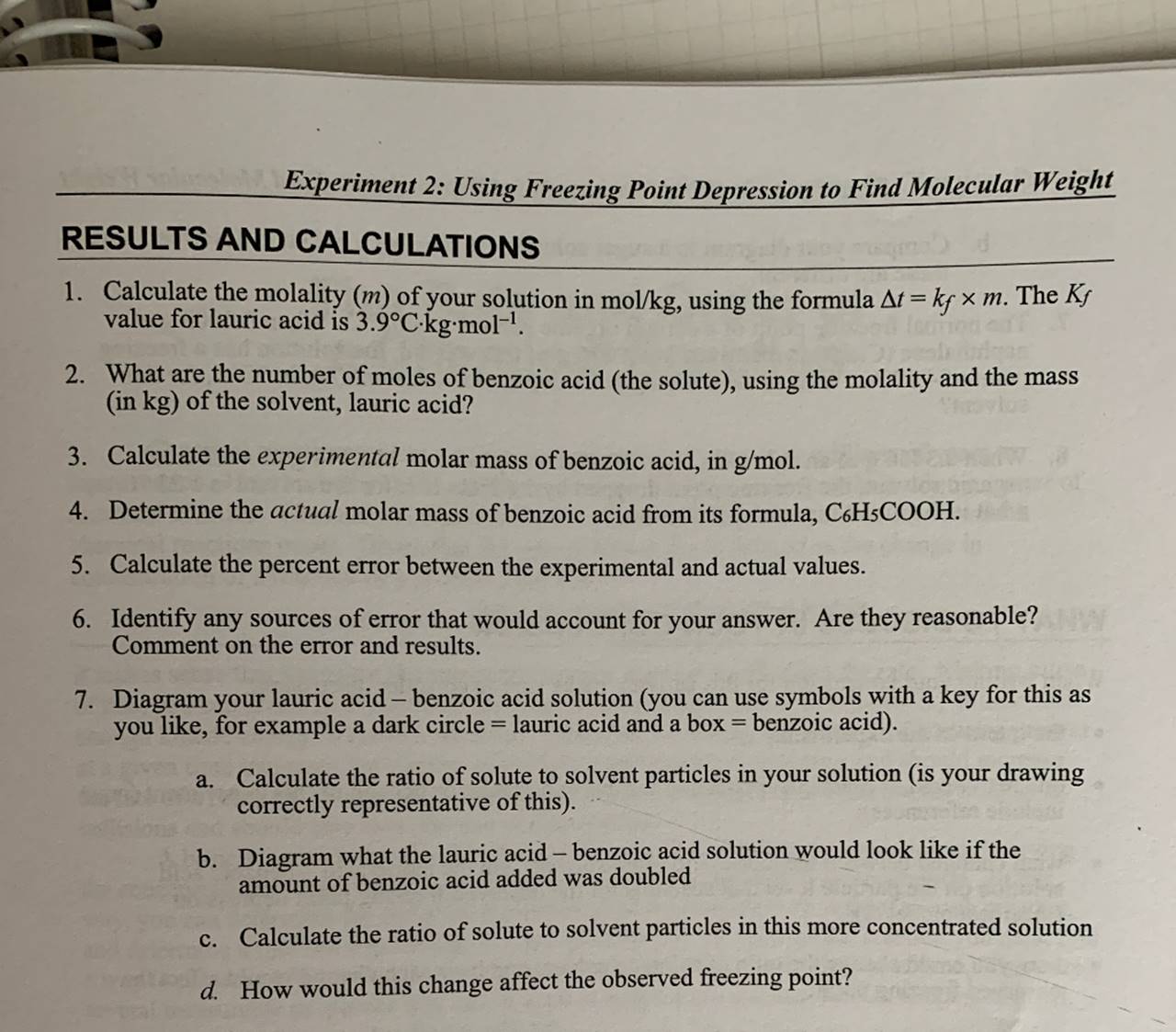
Experiment 2: Using Freezing Point Depression to Find Molecular Weight RESULTS AND CALCULATIONS 1. Calculate the molality (m) of your solution in mol/kg, using the formula At = kfxm. The K value for lauric acid is 3.9C kg.mol-1. 2. What are the number of moles of benzoic acid (the solute), using the molality and the mass (in kg) of the solvent, lauric acid? 3. Calculate the experimental molar mass of benzoic acid, in g/mol. 4. Determine the actual molar mass of benzoic acid from its formula, C6H5COOH. 5. Calculate the percent error between the experimental and actual values. 6. Identify any sources of error that would account for your answer. Are they reasonable? W Comment on the error and results. 7. Diagram your lauric acid - benzoic acid solution (you can use symbols with a key for this as you like, for example a dark circle = lauric acid and a box = benzoic acid). a. Calculate the ratio of solute to solvent particles in your solution (is your drawing correctly representative of this). b. Diagram what the lauric acid - benzoic acid solution would look like if the amount of benzoic acid added was doubled c. Calculate the ratio of solute to solvent particles in this more concentrated solution d. How would this change affect the observed freezing point?
Step by Step Solution
There are 3 Steps involved in it

Get step-by-step solutions from verified subject matter experts
 Study Help