







Question: Experiment: Part 3 How Planets Move in Their Orbits Setup Kepler went on to describe how planets moved along their orbits and made a surprising
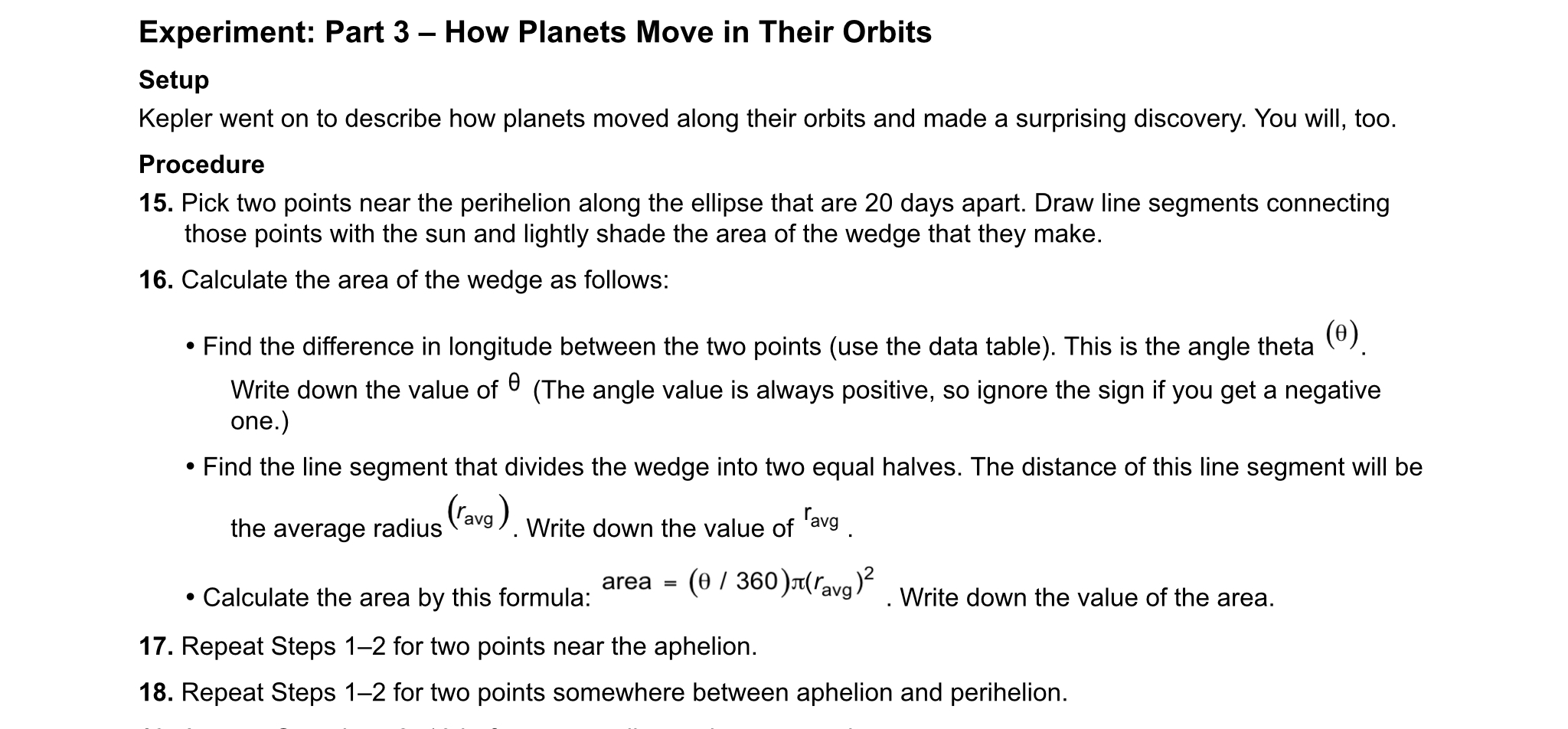
Experiment: Part 3 How Planets Move in Their Orbits Setup Kepler went on to describe how planets moved along their orbits and made a surprising discovery. You will, too. Procedure 15. Pick two points near the perihelion along the ellipse that are 20 days apart. Draw line segments connecting those points with the sun and lightly shade the area of the wedge that they make. 16. Calculate the area of the wedge as follows: - Find the difference in longitude between the two points (use the data table). This is the angle theta (6). Write down the value of 9 (The angle value is always positive, so ignore the sign if you get a negative one.) 0 Find the line segment that divides the wedge into two equal halves. The distance of this line segment will be the average radius (ravg ). Write down the value of raVQ . area = (e / 360)n(ravg)2 - Calculate the area by this formula: . Write down the value of the area. 17. Repeat Steps 12 for two points near the aphelion. 18. Repeat Steps 12 for two points somewhere between aphelion and perihelion
Step by Step Solution
There are 3 Steps involved in it

Get step-by-step solutions from verified subject matter experts
 Study Help