



Question: Experimental Questions: 1. Suppose you had some random error in X1X1 or Y1Y1. Would this error have a same-direction or opposite-direction impact on angles CC
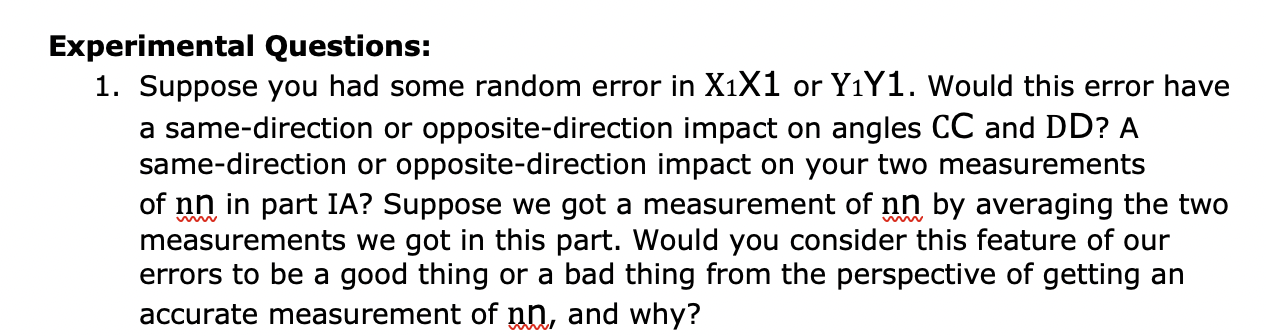
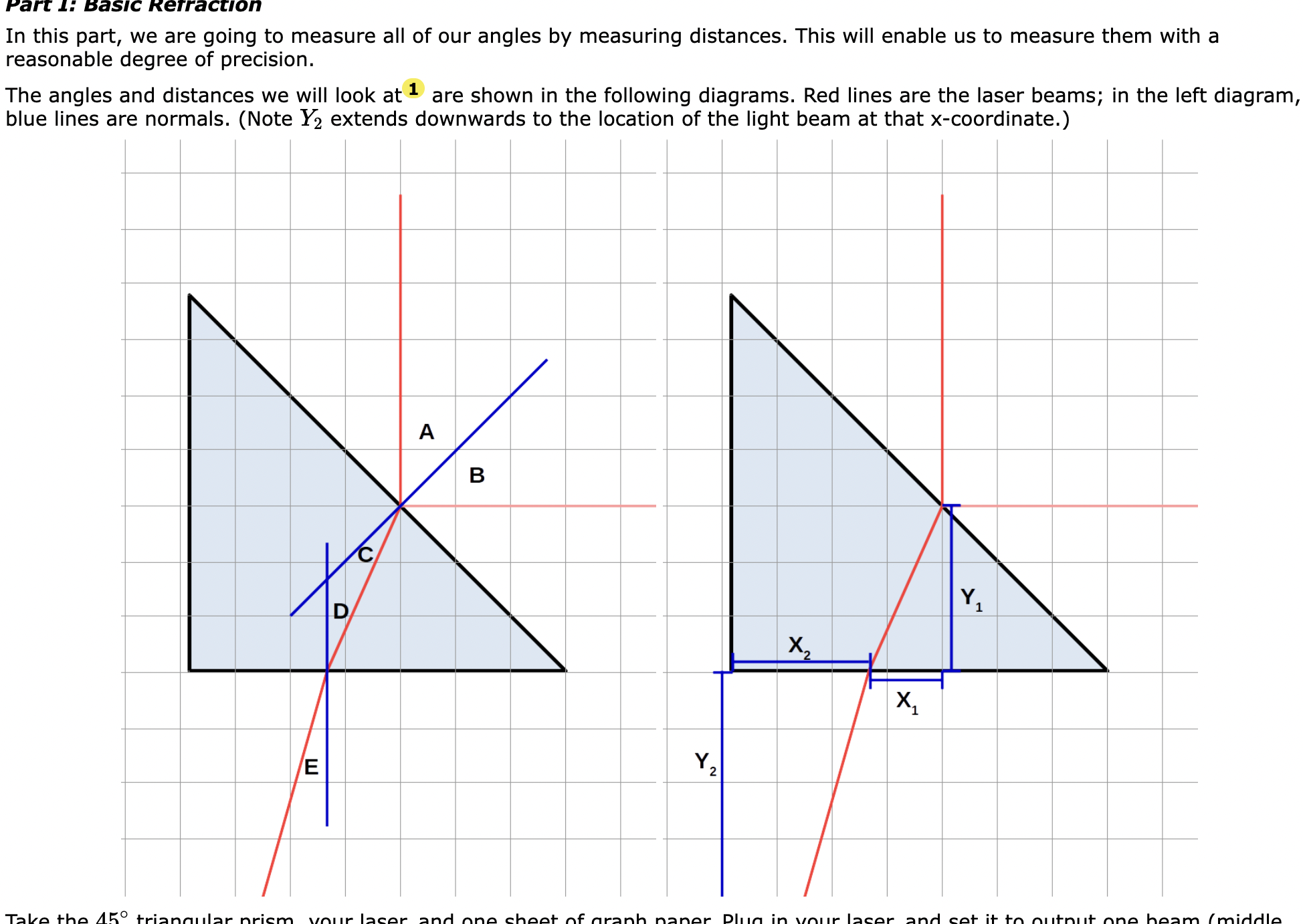
Experimental Questions: 1. Suppose you had some random error in X1X1 or Y1Y1. Would this error have a same-direction or opposite-direction impact on angles CC and DD? A same-direction or opposite-direction impact on your two measurements of gal], in part IA? Suppose we got a measurement of m by averaging the two measurements we got in this part. Would you consider this feature of our errors to be a good thing or a bad thing from the perspective of getting an accurate measurement of rm, and why? Part 1: Basic Refraction In this part, we are going to measure all of our angles by measuring distances. This will enable us to measure them with a reasonable degree of precision. The angles and distances we will look at _ are shown in the following diagrams. Red lines are the laser beams; in the left diagram, blue lines are normals. (Note Y2 extends downwards to the location of the light beam at that x-coordinate.) A B C D Y , X , E Y, 50
Step by Step Solution
There are 3 Steps involved in it

Get step-by-step solutions from verified subject matter experts