







Question: explain how an informal organization may exist in this case. then explain how the informal organization might affect ms. Ratcliffs plans. Leonard-Griggs Primary Care System
explain how an informal organization may exist in this case. then explain how the informal organization might affect ms. Ratcliffs plans. 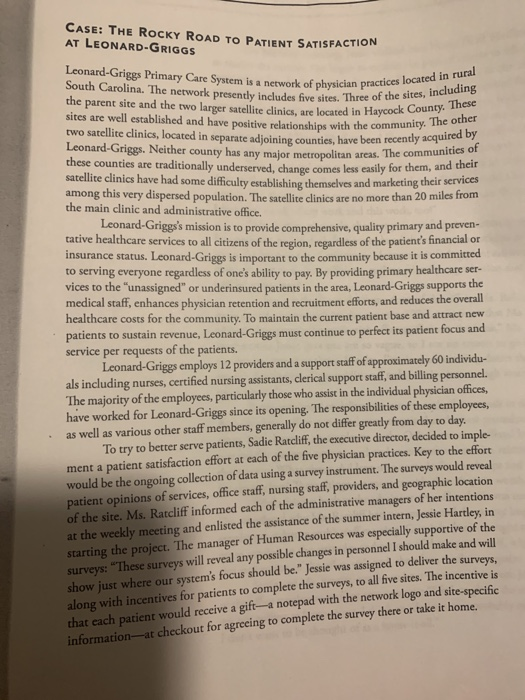
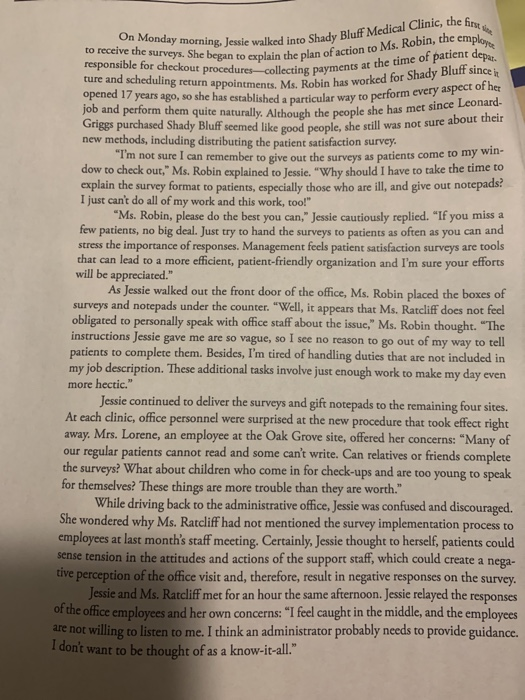
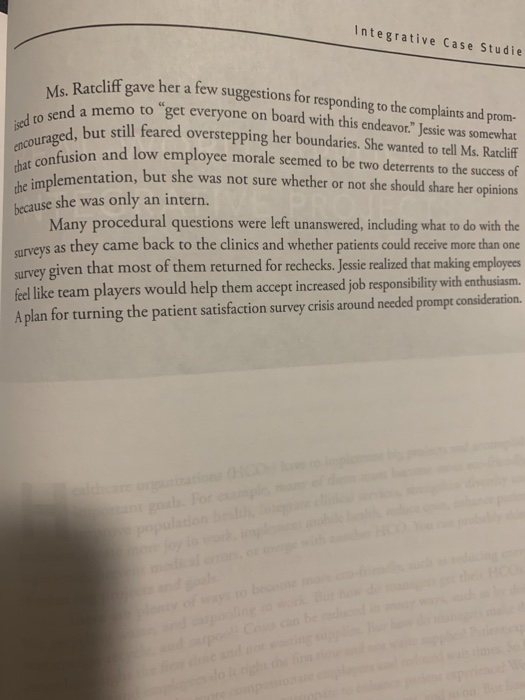
Leonard-Griggs Primary Care System is a network of physician practices located in rural South Carolina. The network presently includes five sites. Three of the sites, including the parent site and the two larger satellite clinics, are located in Haycock County. These CASE: THE ROCKY ROAD TO PATIENT SATISFACTION AT LEONARD-GRIGGS two satellite clinics, located in separate adjoining counties, have been recently acquired by Leonard-Griggs. Neither county has any major metropolitan areas. The communities of these counties are traditionally underserved, change comes less easily for them, and their satellite clinics have had some difficulty establishing themselves and marketing their services among this very dispersed population. The satellite clinics are no more than 20 miles from the main clinic and administrative office. Leonard-Griggs's mission is to provide comprehensive, quality primary and preven- tative healthcare services to all citizens of the region, regardless of the patient's financial or insurance status. Leonard-Griggs is important to the community because it is committed to serving everyone regardless of one's ability to pay. By providing primary healthcare ser- vices to the "unassigned" or underinsured patients in the area, Leonard-Griggs supports the medical staff, enhances physician retention and recruitment efforts, and reduces the overall healthcare costs for the community. To maintain the current patient base and attract new patients to sustain revenue, Leonard-Griggs must continue to perfect its patient focus and service per requests of the patients. Leonard-Griggs employs 12 providers and a support staff of approximately 60 individu- als including nurses, certified nursing assistants, clerical support staff, and billing personnel. The majority of the employees, particularly those who assist in the individual physician offices, have worked for Leonard-Griggs since its opening. The responsibilities of these employees, as well as various other staff members, generally do not differ greatly from day to day. To try to better serve patients, Sadie Ratcliff, the executive director, decided to imple- ment a patient satisfaction effort at each of the five physician practices. Key to the effort would be the ongoing collection of data using a survey instrument. The surveys would reveal patient opinions of services, office staff, nursing staff, providers, and geographic location of the site. Ms. Ratcliff informed each of the administrative managers of her intentions at the weekly meeting and enlisted the assistance of the summer intern, Jessie Hartley, in starting the project. The manager of Human Resources was especially supportive of the will reveal any possible changes in personnel I should make and will "These surveys surveys: the surveys show just where our system's focus should be." Jessie was assigned to deliver along with incentives for patients to complete the surveys, to all five sites. The incentive is that each patient would receive a gifta notepad with the network logo and site-specific information-at checkout for agreeing to complete the survey there or take it home. On Monday morning. Jessie walked into Shady Bluff Medical Clinic, the first to receive the surveys. She began to explain the plan of action to Ms. Robin, the employee responsible for checkout procedures collecting payments at the time of patient depar. ture and scheduling return appointments. Ms. Robin has worked for Shady Bluff since opened 17 years ago, so she has established a particular way to perform every aspect of her Griges purchased Shady Bluff seemed like good people, she still was not sure about their new methods, including distributing the patient satisfaction survey. I'm not sure I can remember to give out the surveys as patients come to my win- dow to check out," Ms. Robin explained to Jessie. "Why should I have to take the time to explain the survey format to patients, especially those who are ill, and give out notepads? I just can't do all of my work and this work, too!" "Ms. Robin, please do the best you can," Jessie cautiously replied. "If you miss a few patients, no big deal. Just try to hand the surveys to patients as often as you can and stress the importance of responses. Management feels patient satisfaction surveys are tools that can lead to a more efficient, patient-friendly organization and I'm sure your efforts will be appreciated." As Jessie walked out the front door of the office, Ms. Robin placed the boxes of surveys and notepads under the counter. "Well, it appears that Ms. Rateliff does not feel obligated to personally speak with office staff about the issue," Ms. Robin thought. "The instructions Jessie gave me are so vague, so I see no reason to go out of my way to tell patients to complete them. Besides, I'm tired of handling duties that are not included in my job description. These additional tasks involve just enough work to make my day even more hectic." Jessie continued to deliver the surveys and gift notepads to the remaining four sites. At each clinic, office personnel were surprised at the new procedure that took effect right away. Mrs. Lorene, an employee at the Oak Grove site, offered her concerns: "Many of our regular patients cannot read and some can't write. Can relatives or friends complete the surveys? What about children who come in for check-ups and are too young to speak for themselves? These things are more trouble than they are worth." While driving back to the administrative office, Jessie was confused and discouraged. She wondered why Ms. Ratcliff had not mentioned the survey implementation process to employees at last month's staff meeting. Certainly, Jessie thought to herself, patients could sense tension in the attitudes and actions of the support staff, which could create a nega- tive perception of the office visit and, therefore, result in negative responses on the survey. Jessie and Ms. Ratcliff met for an hour the same afternoon. Jessie relayed the responses of the office employees and her own concerns: I feel caught in the middle, and the employees are not willing to listen to me. I think an administrator probably needs to provide guidance. I don't want to be thought of as a know-it-all." Ms. Ratcliff gave her a few suggestions for responding to the complaints and prom- encouraged, but still feared overstepping her boundaries. She wanted to tell Ms. Ratcliff Integrative Case Studie a ha confusion and low employee morale seemed to be two deterrents to the success of the implementation, but she was not sure whether or not she should share her opinions because she was only an intern. Many procedural questions were left unanswered, including what to do with the surveys as they came back to the clinics and whether patients could receive more than one survey given that most of them returned for rechecks. Jessie realized that making employees feel like team players would help them accept increased job responsibility with enthusiasm. A plan for turning the patient satisfaction survey crisis around needed prompt consideration
Step by Step Solution
There are 3 Steps involved in it
1 Expert Approved Answer
Step: 1 Unlock

Question Has Been Solved by an Expert!
Get step-by-step solutions from verified subject matter experts
Step: 2 Unlock
Step: 3 Unlock
 Study Help