







Question: Explain in words Suppose I have a std: : vector> A. This vector has only values in the range of 0 to A.size(), inclusive. For
Explain in words
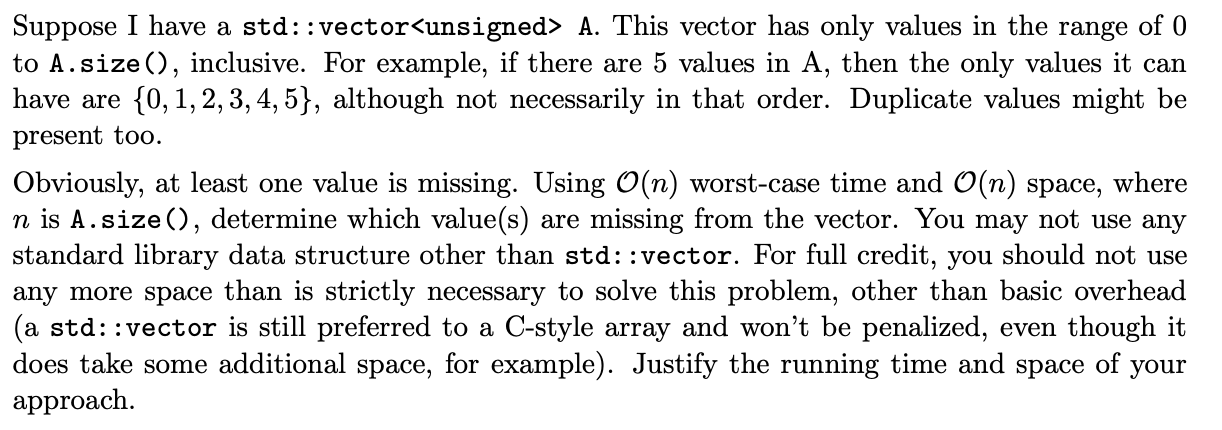
Suppose I have a std: : vector> A. This vector has only values in the range of 0 to A.size(), inclusive. For example, if there are 5 values in A, then the only values it can have are {0,1,2,3,4,5}, although not necessarily in that order. Duplicate values might be present too. Obviously, at least one value is missing. Using O(n) worst-case time and O(n) space, where n is A.size(), determine which value(s) are missing from the vector. You may not use any standard library data structure other than std: : vector. For full credit, you should not use any more space than is strictly necessary to solve this problem, other than basic overhead (a std: :vector is still preferred to a C-style array and won't be penalized, even though it does take some additional space, for example). Justify the running time and space of your approach
Step by Step Solution
There are 3 Steps involved in it

Get step-by-step solutions from verified subject matter experts
 Study Help