







Question: explain problem 6 ELEC 221, 2024 Winter Term 2 Bennett Galamaga ELEC 221, 2024 Winter Term 2 Bennett Galamaga b ) Problem 6. Let r(t)
explain problem 6
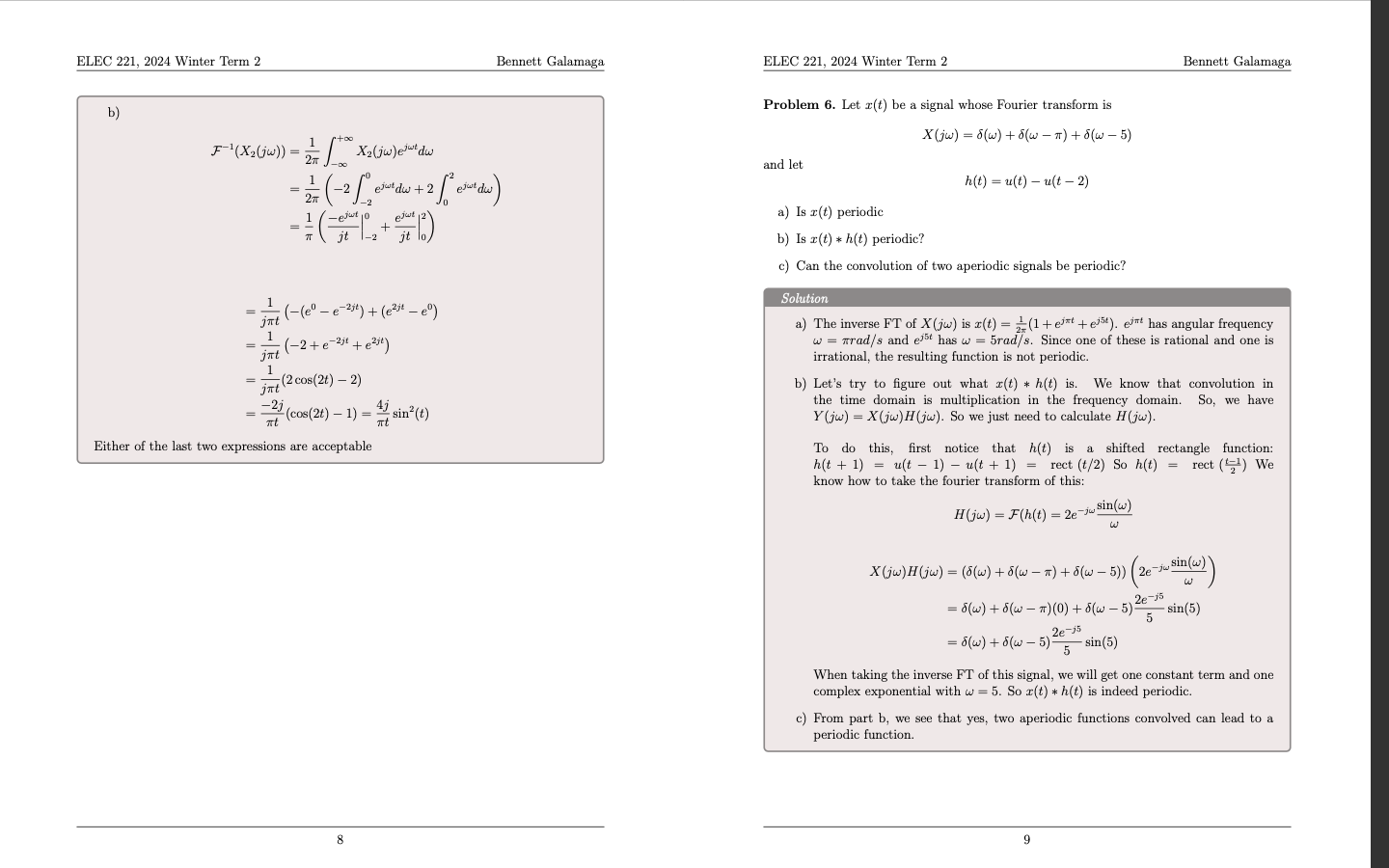 ELEC 221, 2024 Winter Term 2 Bennett Galamaga ELEC 221, 2024 Winter Term 2 Bennett Galamaga b ) Problem 6. Let r(t) be a signal whose Fourier transform is X(jw) = 8(w) + 8(w -7) + 8(w-5) F -1 ( X z (jw)) = 2x Xz(jw)ejust dw and let 27 ( - 2 / eutaw + 2 ( " eswlaw ) h(t) = u(t) - u(t - 2) a) Is r(t) periodic b) Is r(t) * h(t) periodic? c) Can the convolution of two aperiodic signals be periodic? Solution a) The inverse FT of X(jw) is x(t) = 2. (1 + ext + ejst). eit has angular frequency 1 jut ( - 2 +e- 2 31 + @ 2 it ) w = mrad/s and ejst has w = 5rad/s. Since one of these is rational and one is irrational, the resulting function is not periodic. jort (2 cos(2t) - 2) b) Let's try to figure out what r(t) * h(t) is. We know that convolution in -21 (cos(2t) - 1) = = sin (t) the time domain is multiplication in the frequency domain. So, we have Y(jw) = X(jw) H (jw). So we just need to calculate H(jw). Either of the last two expressions are acceptable To do this, first notice that h(t) is a shifted rectangle function: h(t + 1) = u(t - 1) - u(t + 1) = rect (t/2) So h(t) = rect ($1) We know how to take the fourier transform of this: H(jw) = F(h(t) = 2e-ju sin(w) X ( jw) H (jw) = (8( w) + 5( w - ) +(w- 5)) (2e -ju sin(w) w = 8(w) + 8(w - 7) (0 ) + 8 (w - 5) 2e-35 5 sin(5) = 8 ( w) + 8 (w - 5)- 2e-15 5 sin(5) When taking the inverse FT of this signal, we will get one constant term and one complex exponential with w =5. So r(t) * h(t) is indeed periodic. c) From part b, we see that yes, two aperiodic functions convolved can lead to a periodic function. 8
Step by Step Solution
There are 3 Steps involved in it
1 Expert Approved Answer
Step: 1 Unlock

Question Has Been Solved by an Expert!
Get step-by-step solutions from verified subject matter experts
Step: 2 Unlock
Step: 3 Unlock
 Study Help