







Question: Explain steps in mathmatica PART 3. Algorithm complexity Computer scientists work hard to find efficient algorithms for problems. Some well-known algorithms run in logarithmic or
Explain steps in mathmatica
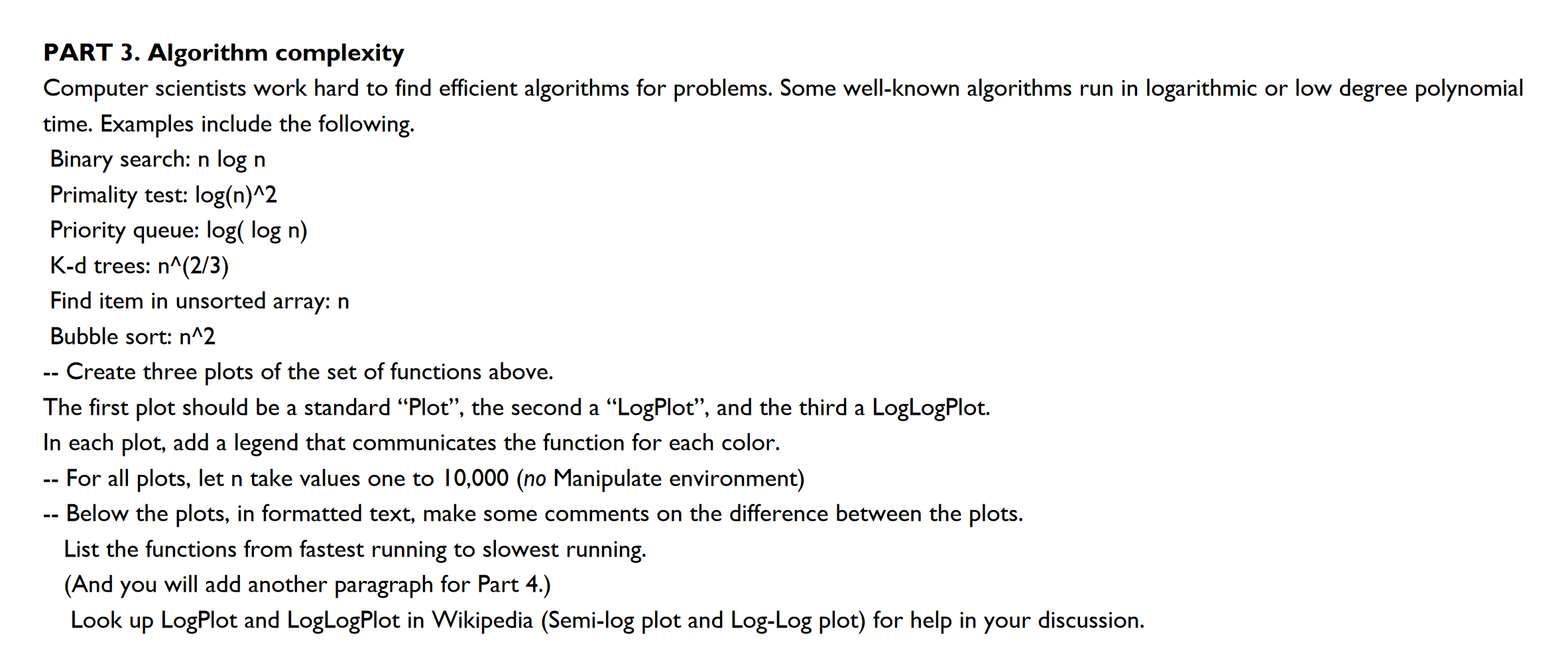
PART 3. Algorithm complexity Computer scientists work hard to find efficient algorithms for problems. Some well-known algorithms run in logarithmic or low degree polynomial time. Examples include the following. Binary search: nlogn Primality test: log(n)2 Priority queue: log(logn) K-d trees: n(2/3) Find item in unsorted array: n Bubble sort: n2 -- Create three plots of the set of functions above. The first plot should be a standard "Plot", the second a "LogPlot", and the third a LogLogPlot. In each plot, add a legend that communicates the function for each color. -- For all plots, let n take values one to 10,000 (no Manipulate environment) -- Below the plots, in formatted text, make some comments on the difference between the plots. List the functions from fastest running to slowest running. (And you will add another paragraph for Part 4.) Look up LogPlot and LogLogPlot in Wikipedia (Semi-log plot and Log-Log plot) for help in your discussion
Step by Step Solution
There are 3 Steps involved in it

Get step-by-step solutions from verified subject matter experts
 Study Help