



Question: explain the answer for Q90 EXPECTATION DAMAGES 325 W an plaintiff contractor, who sues for lost profits on a job that was terminated before its
explain the answer for Q90
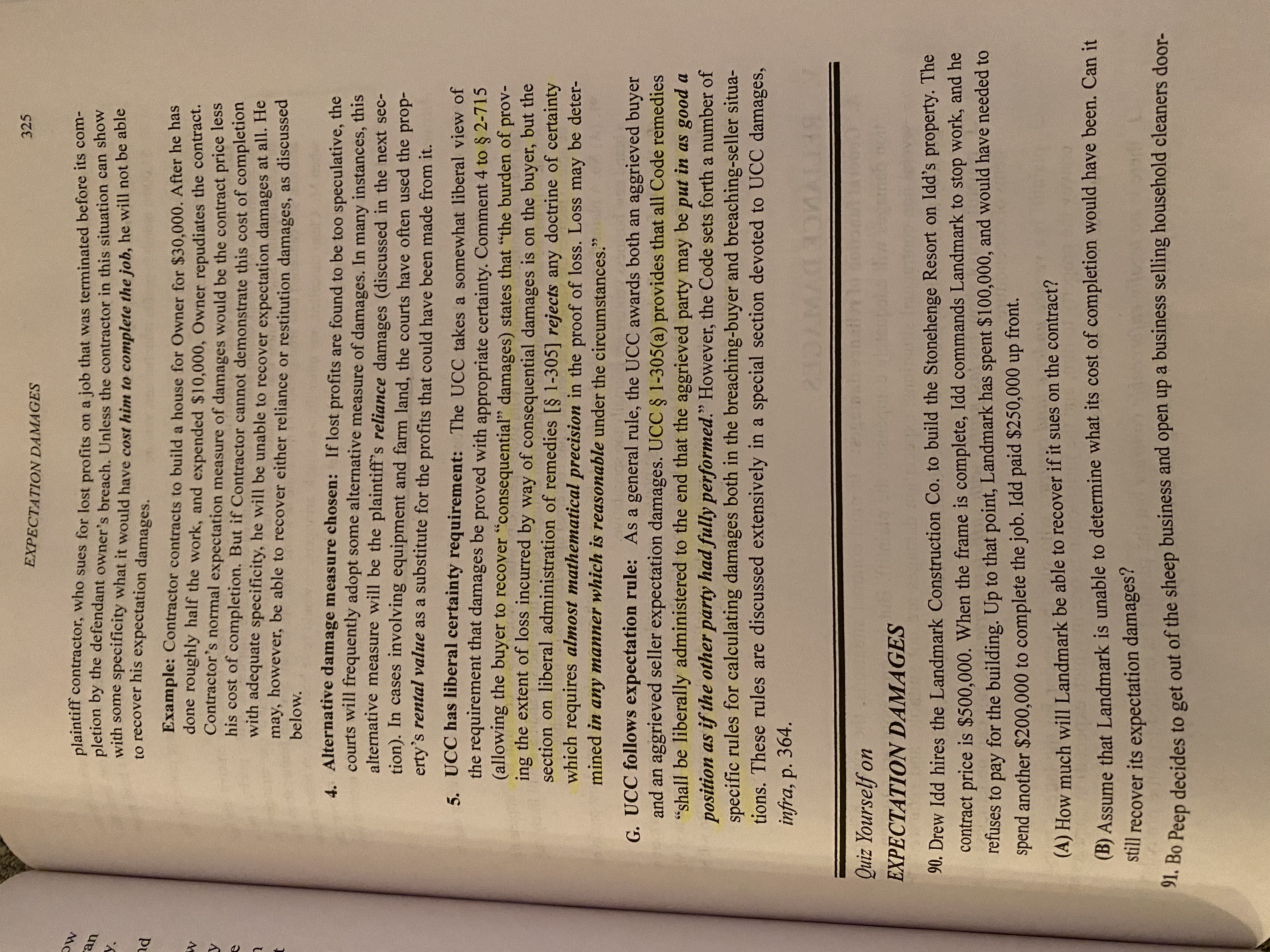
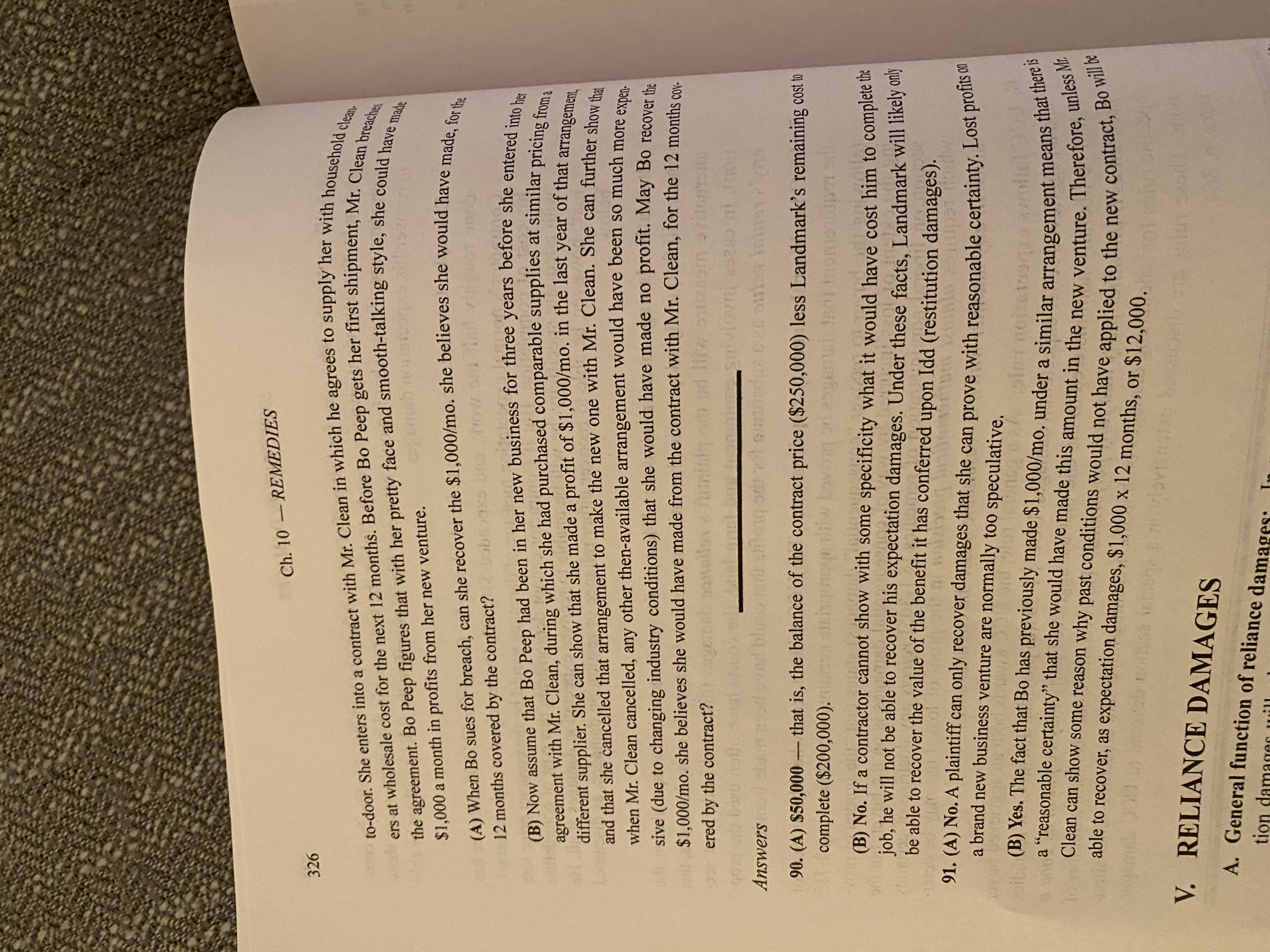
EXPECTATION DAMAGES 325 W an plaintiff contractor, who sues for lost profits on a job that was terminated before its com- pletion by the defendant owner's breach. Unless the contractor in this situation can show with some specificity what it would have cost him to complete the job, he will not be able ld to recover his expectation damages. Example: Contractor contracts to build a house for Owner for $30,000. After he has done roughly half the work, and expended $10,000, Owner repudiates the contract. Contractor's normal expectation measure of damages would be the contract price less his cost of completion. But if Contractor cannot demonstrate this cost of completion with adequate specificity, he will be unable to recover expectation damages at all. He may, however, be able to recover either reliance or restitution damages, as discussed below. 4. Alternative damage measure chosen: If lost profits are found to be too speculative, the courts will frequently adopt some alternative measure of damages. In many instances, this alternative measure will be the plaintiff's reliance damages (discussed in the next sec- tion). In cases involving equipment and farm land, the courts have often used the prop- erty's rental value as a substitute for the profits that could have been made from it. 5. UCC has liberal certainty requirement: The UCC takes a somewhat liberal view of the requirement that damages be proved with appropriate certainty. Comment 4 to $ 2-715 (allowing the buyer to recover "consequential" damages) states that "the burden of prov- ing the extent of loss incurred by way of consequential damages is on the buyer, but the section on liberal administration of remedies [$ 1-305] rejects any doctrine of certainty which requires almost mathematical precision in the proof of loss. Loss may be deter- mined in any manner which is reasonable under the circumstances." G. UCC follows expectation rule: As a general rule, the UCC awards both an aggrieved buyer and an aggrieved seller expectation damages. UCC $ 1-305(a) provides that all Code remedies "shall be liberally administered to the end that the aggrieved party may be put in as good a position as if the other party had fully performed." However, the Code sets forth a number of specific rules for calculating damages both in the breaching-buyer and breaching-seller situa- tions. These rules are discussed extensively in a special section devoted to UCC damages, infra, p. 364. Quiz Yourself on EXPECTATION DAMAGES 90. Drew Idd hires the Landmark Construction Co. to build the Stonehenge Resort on Idd's property. The contract price is $500,000. When the frame is complete, Idd commands Landmark to stop work, and he refuses to pay for the building. Up to that point, Landmark has spent $100,000, and would have needed to spend another $200,000 to complete the job. Idd paid $250,000 up front. (A) How much will Landmark be able to recover if it sues on the contract? (B) Assume that Landmark is unable to determine what its cost of completion would have been. Can it still recover its expectation damages? 1. Bo Peep decides to get out of the sheep business and open up a business selling household cleaners door-Ch. 10 - REMEDIES 326 to-door. She enters into a contract with Mr. Clean in which he agrees to supply her with household clear ers at wholesale cost for the next 12 months. Before Bo Peep gets her first shipment, Mr. Clean breach the agreement. Bo Peep figures that with her pretty face and smooth-talking style, she could have mas $1,000 a month in profits from her new venture. (A) When Bo sues for breach, can she recover the $1,000/mo. she believes she would have made, for the 12 months covered by the contract? (B) Now assume that Bo Peep had been in her new business for three years before she entered into her agreement with Mr. Clean, during which she had purchased comparable supplies at similar pricing from a different supplier. She can show that she made a profit of $1,000/mo. in the last year of that arrangement, and that she cancelled that arrangement to make the new one with Mr. Clean. She can further show that when Mr. Clean cancelled, any other then-available arrangement would have been so much more expen- sive (due to changing industry conditions) that she would have made no profit. May Bo recover the $1,000/mo. she believes she would have made from the contract with Mr. Clean, for the 12 months cov- ered by the contract? Answers 90. (A) $50,000 - that is, the balance of the contract price ($250,000) less Landmark's remaining cost to complete ($200,000). (B) No. If a contractor cannot show with some specificity what it would have cost him to complete the job, he will not be able to recover his expectation damages. Under these facts, Landmark will likely only be able to recover the value of the benefit it has conferred upon Idd (restitution damages). 91. (A) No. A plaintiff can only recover damages that she can prove with reasonable certainty. Lost profits of a brand new business venture are normally too speculative. (B) Yes. The fact that Bo has previously made $1,000/mo. under a similar arrangement means that there a "reasonable certainty" that she would have made this amount in the new venture. Therefore, unless Me Clean can show some reason why past conditions would not have applied to the new contract, Bo will able to recover, as expectation damages, $1,000 x 12 months, or $12,000. V. RELIANCE DAMAGES A. General function of reliance damages tion dama
Step by Step Solution
There are 3 Steps involved in it

Get step-by-step solutions from verified subject matter experts