







Question: Many elementary mechanics problems deal with the physics of objects moving or flying through the air, but they almost always ignore friction and air
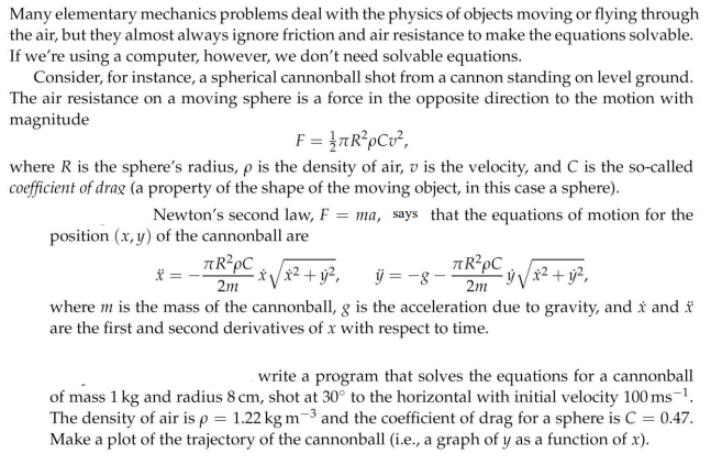
Many elementary mechanics problems deal with the physics of objects moving or flying through the air, but they almost always ignore friction and air resistance to make the equations solvable. If we're using a computer, however, we don't need solvable equations. Consider, for instance, a spherical cannonball shot from a cannon standing on level ground. The air resistance on a moving sphere is a force in the opposite direction to the motion with magnitude F = RpCv, where R is the sphere's radius, p is the density of air, v is the velocity, and C is the so-called coefficient of drag (a property of the shape of the moving object, in this case a sphere). Newton's second law, F = ma, says that the equations of motion for the position (x, y) of the cannonball are RpC xx + y, 2m where m is the mass of the cannonball, g is the acceleration due to gravity, and * and are the first and second derivatives of x with respect to time. R pCyx + y, 2m write a program that solves the equations for a cannonball of mass 1 kg and radius 8 cm, shot at 30 to the horizontal with initial velocity 100 ms-. The density of air is p = 1.22 kg m-3 and the coefficient of drag for a sphere is C = 0.47. Make a plot of the trajectory of the cannonball (i.e., a graph of y as a function of x).
Step by Step Solution
3.54 Rating (157 Votes )
There are 3 Steps involved in it
Answer for the above problem is This program is going to use the RangeKutta method to transform the ... View full answer

Get step-by-step solutions from verified subject matter experts
 Study Help