







Question: explain this case study using diagram INCENTIVES, INCOME EFFECTS, AND SUBSTITUTION EFFECTS Economists focus on incentives because they want to understand how choices are made.
explain this case study using diagram
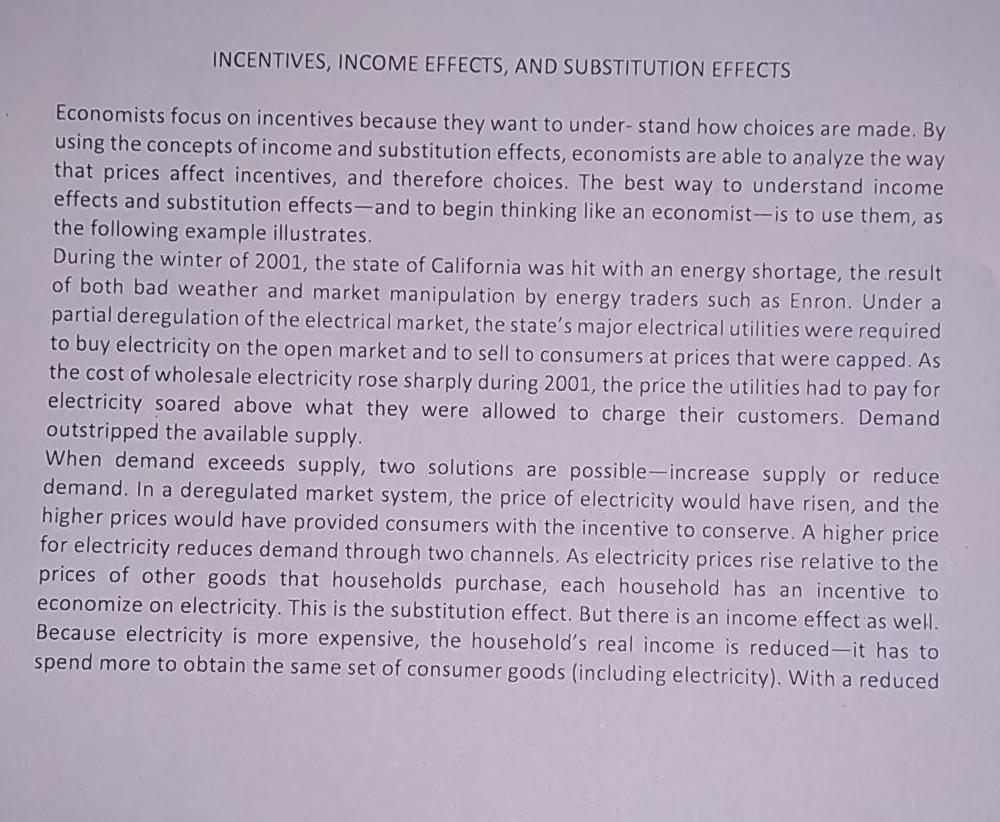
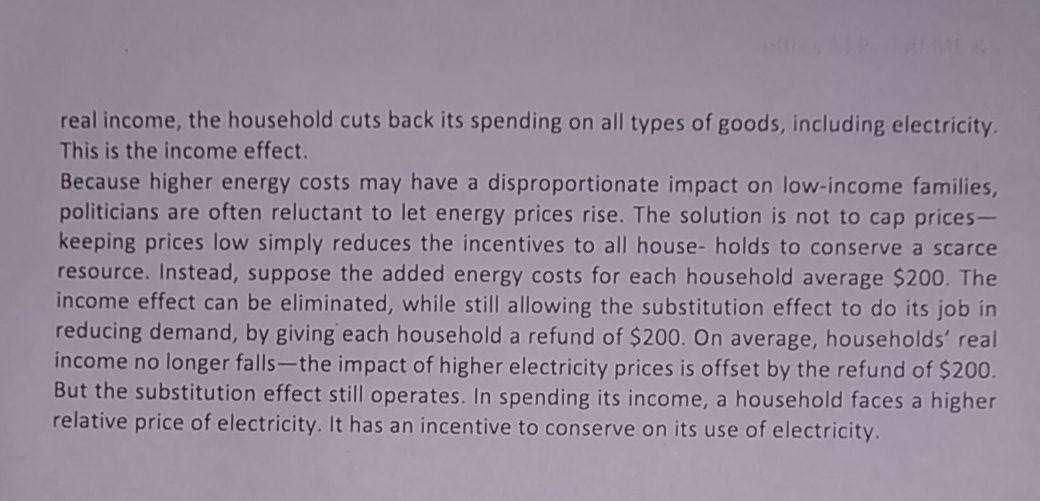
INCENTIVES, INCOME EFFECTS, AND SUBSTITUTION EFFECTS Economists focus on incentives because they want to understand how choices are made. By using the concepts of income and substitution effects, economists are able to analyze the way that prices affect incentives, and therefore choices. The best way to understand income effects and substitution effects-and to begin thinking like an economist-is to use them, as the following example illustrates. During the winter of 2001, the state of California was hit with an energy shortage, the result of both bad weather and market manipulation by energy traders such as Enron. Under a partial deregulation of the electrical market, the state's major electrical utilities were required to buy electricity on the open market and to sell to consumers at prices that were capped. As the cost of wholesale electricity rose sharply during 2001, the price the utilities had to pay for electricity soared above what they were allowed to charge their customers. Demand outstripped the available supply. When demand exceeds supply, two solutions are possible--increase supply or reduce demand. In a deregulated market system, the price of electricity would have risen, and the higher prices would have provided consumers with the incentive to conserve. A higher price for electricity reduces demand through two channels. As electricity prices rise relative to the prices of other goods that households purchase, each household has an incentive to economize on electricity. This is the substitution effect. But there is an income effect as well. Because electricity is more expensive, the household's real income is reduced-it has to spend more to obtain the same set of consumer goods (including electricity). With a reduced real income, the household cuts back its spending on all types of goods, including electricity. This is the income effect. Because higher energy costs may have a disproportionate impact on low-income families, politicians are often reluctant to let energy prices rise. The solution is not to cap prices- keeping prices low simply reduces the incentives to all households to conserve a scarce resource. Instead, suppose the added energy costs for each household average $200. The income effect can be eliminated, while still allowing the substitution effect to do its job in reducing demand, by giving each household a refund of $200. On average, households' real income no longer falls-the impact of higher electricity prices is offset by the refund of $200. But the substitution effect still operates. In spending its income, a household faces a higher relative price of electricity. It has an incentive to conserve on its use of electricity
Step by Step Solution
There are 3 Steps involved in it

Get step-by-step solutions from verified subject matter experts
 Study Help