





Question: Explain When Java was designed by James Gosling (then of Sun Microsystems), he took a great deal of inspiration from C and C++. For this

Explain
Explain When Java was designed by James Gosling (then of Sun Microsystems),

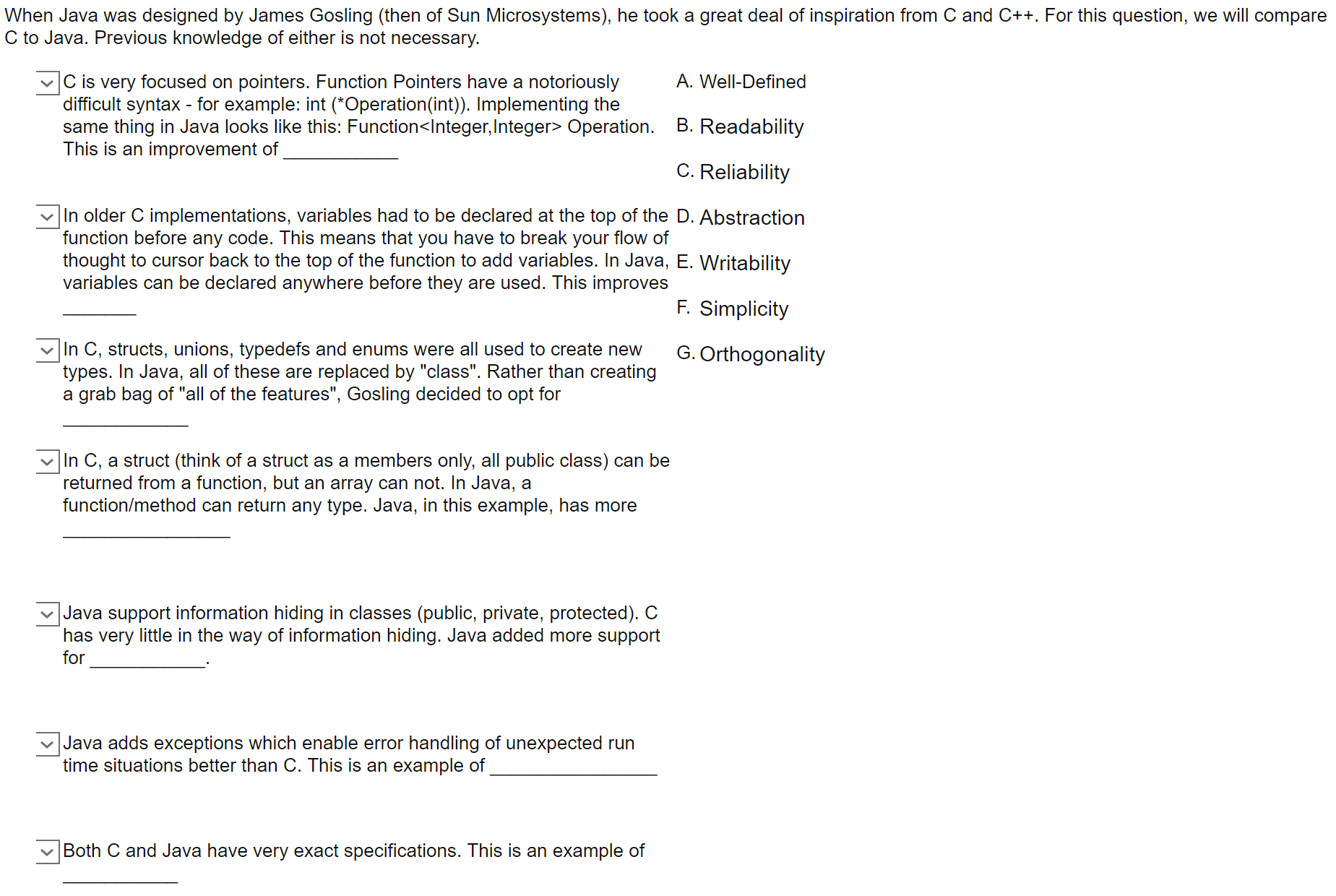
When Java was designed by James Gosling (then of Sun Microsystems), he took a great deal of inspiration from C and C++. For this question, we will compare C to Java. Previous knowledge of either is not necessary. C is very focused on pointers. Function Pointers have a notoriously difficult syntax - for example: int (*Operation(int)). Implementing the same thing in Java looks like this: Function Operation. This is an improvement of_____ In older C implementations, variables had to be declared at the top of the function before any code. This means that you have to break your flow of thought to cursor back to the top of the function to add variables. In Java, variables can be declared anywhere before they are used. This improves _____ In C, structs, unions, typedefs and enums were all used to create new types. In Java, all of these are replaced by "class". Rather than creating a grab bag of "all of the features", Gosling decided to opt for _____ In C, a struct (think of a struct as a members only, all public class) can be returned from a function, but an array cannot. In Java, a function/method can return any type. Java, in this example, has more _____ Java support information hiding in classes (public, private, protected). C has very little in the way of information hiding. Java added more support for_____ Java adds exceptions which enable error handling of unexpected run time situations better than C. This is an example of_____ Both C and Java have very exact specifications. This is an example of _____ A. Well-Defined B. Readability C. Reliability D. Abstraction E. Writability F. Simplicity G. Orthogonality

Step by Step Solution

There are 3 Steps involved in it

1 Expert Approved Answer
Step: 1 Unlock blur-text-image
Question Has Been Solved by an Expert!

Get step-by-step solutions from verified subject matter experts

Step: 2 Unlock
Step: 3 Unlock

Students Have Also Explored These Related Databases Questions!