







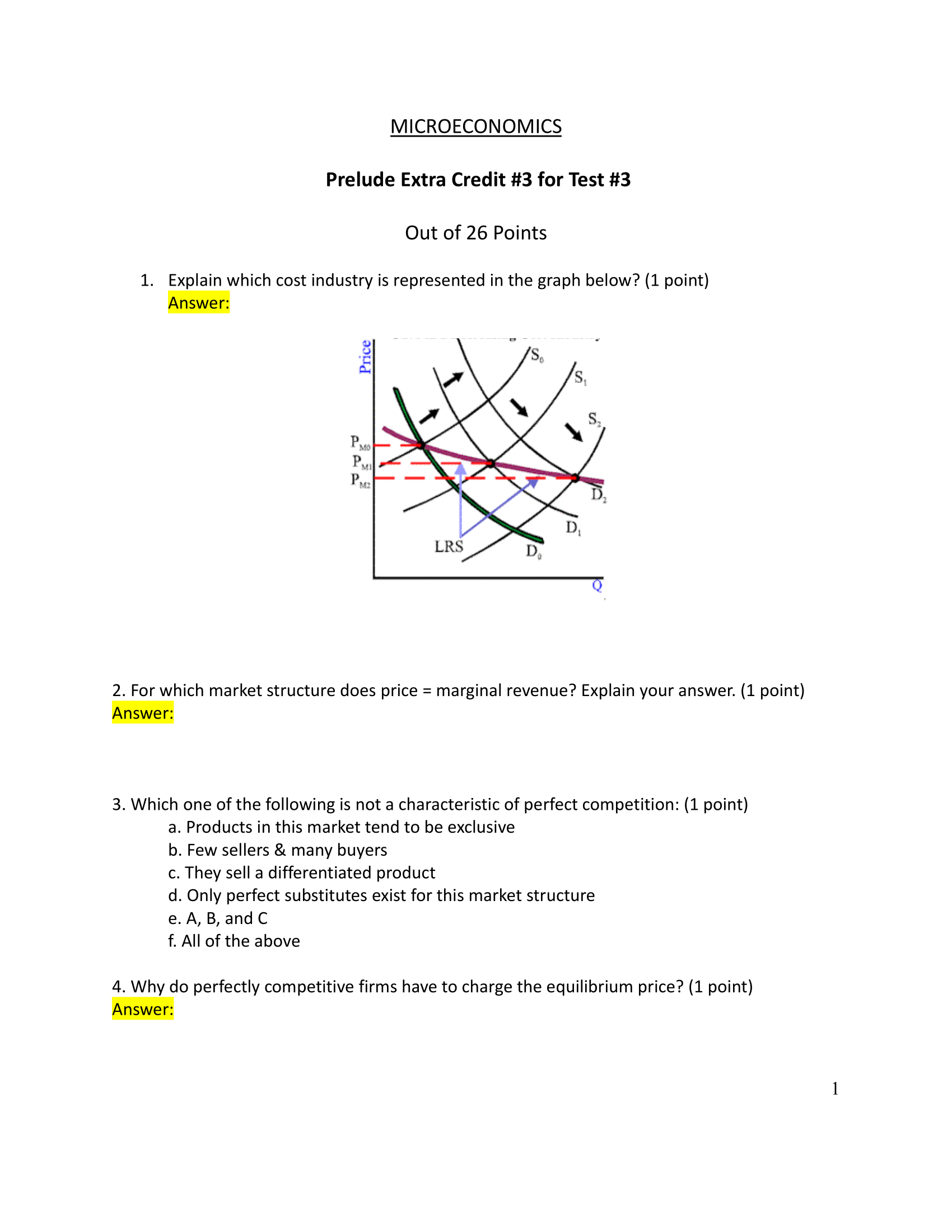
Question: Explain which cost industry is represented in the graph below? (1 point) Answer: 2. For which market structure does price = marginal revenue? Explain your
- Explain which cost industry is represented in the graph below? (1 point)
Answer:
2. For which market structure does price = marginal revenue? Explain your answer. (1 point)
Answer:
3. Which one of the following is not a characteristic of perfect competition: (1 point)
a. Products in this market tend to be exclusive
b. Few sellers & many buyers
c. They sell a differentiated product
d. Only perfect substitutes exist for this market structure
e. A, B, and C
f. All of the above
4. Why do perfectly competitive firms have to charge the equilibrium price? (1 point)
Answer:
5. Explicit costs are out-of-pocket costs, such as expenses on labor, raw materials, and rent. (T/F) Explain your choice. (1 point)
Answer:
6. Implicit costs are costs a business incurs without actually spending money. (T/F) Explain your choice. (1 point)
Answer:
7. What is a market monopoly? (1 point)
Answer:
8. Which of following depicts a reason for why oligopolies are mutually interdependent? (1 point)
a. They possess inelastic demand due to limited competition
b. The sellers can't keep track with each other
c. Profit margins are small
d. The sellers can form a cartel
9. What is the goal of rent seeking? AndB) which market structures practice it? (2 points)
Answer:
10. Which type of price discrimination enhances economies of scale the most? (1 point)
Answer:
11. Why are economies of scale a barrier to entry? (1point)
Answer:
12. There are three primary reasons behind the pricing of a product. Meaning, three particular concepts we learned together determine collectively what the final price for a product will be. What are they? (3 points)
Answer:
13. Give an example of a company unable to price discriminate. Explain your answer. (1 point)
Answer:
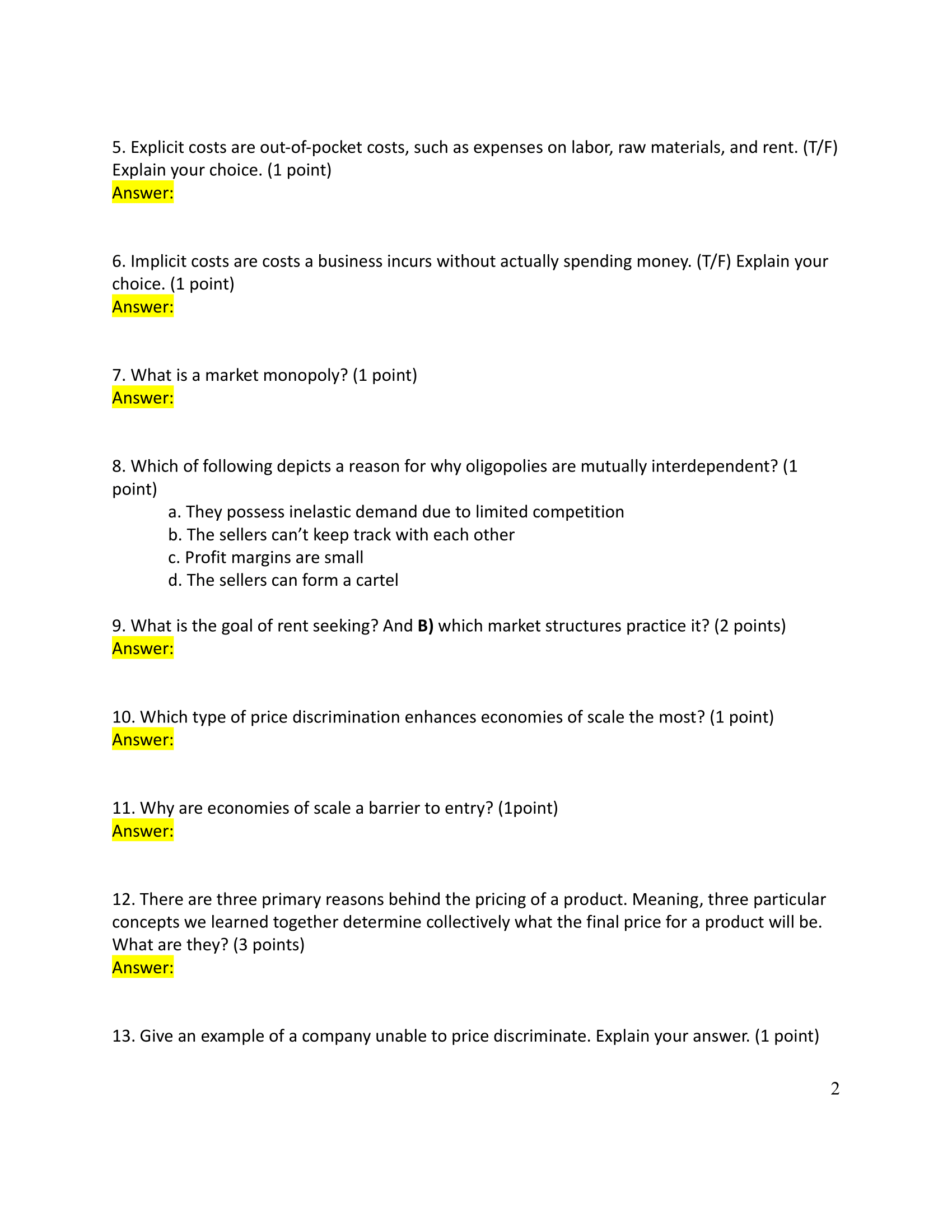
14. Which market structure does the graph below represent, andb) is this company at a profit maximization or loss minimization point? Explain thoroughly. (2 points)
Answer:
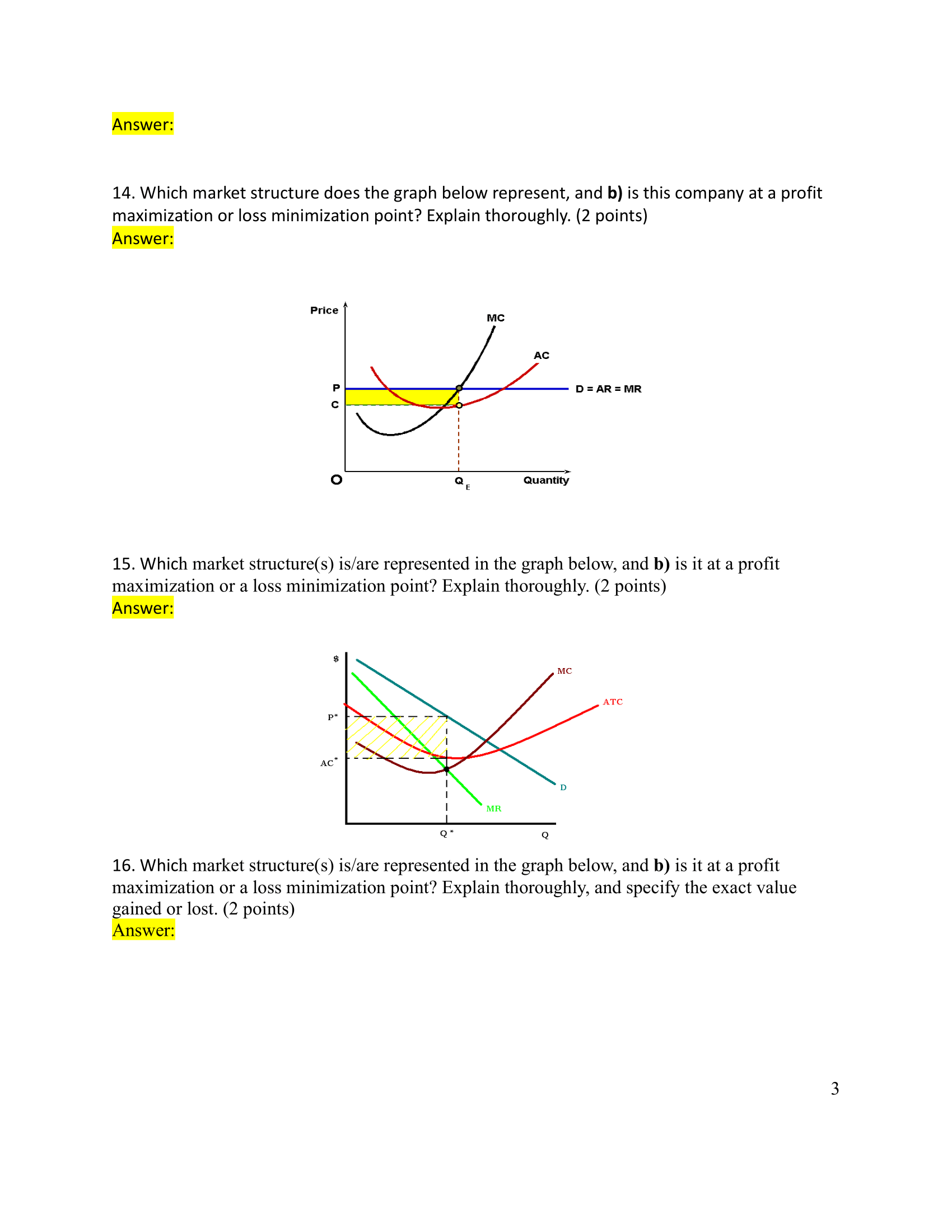
15. Which market structure(s) is/are represented in the graph below, andb) is it at a profit maximization or a loss minimization point? Explain thoroughly. (2 points)
Answer:
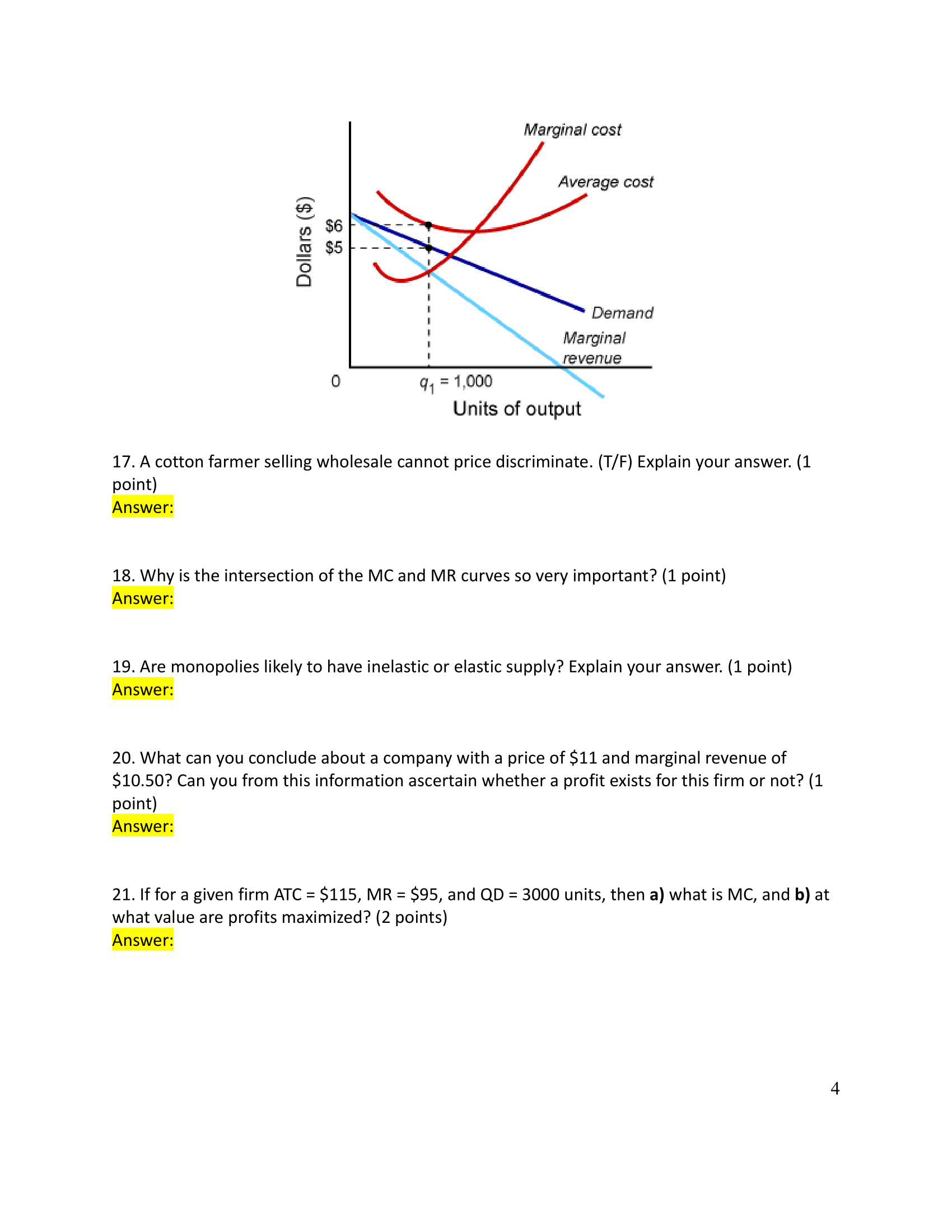
16. Which market structure(s) is/are represented in the graph below, andb) is it at a profit maximization or a loss minimization point? Explain thoroughly, and specify the exact value gained or lost. (2 points)
Answer:
17. A cotton farmer selling wholesale cannot price discriminate. (T/F) Explain your answer. (1 point)
Answer:
18. Why is the intersection of the MC and MR curves so very important? (1 point)
Answer:
19. Are monopolies likely to have inelastic or elastic supply? Explain your answer. (1 point)
Answer:
20. What can you conclude about a company with a price of $11 and marginal revenue of $10.50? Can you from this information ascertain whether a profit exists for this firm or not? (1 point)
Answer:
21. If for a given firm ATC = $115, MR = $95, and QD = 3000 units, thena) what is MC, andb) at what value are profits maximized? (2 points)
Answer:
MICROECONOMICS Prelude Extra Credit #3 for Test #3 Out of 26 Points 1. Explain which cost industry is represented in the graph below? (1 point) Answer: Price 2. For which market structure does price = marginal revenue? Explain your answer. (1 point) Answer: 3. Which one of the following is not a characteristic of perfect competition: (1 point) a. Products in this market tend to be exclusive b. Few sellers & many buyers c. They sell a differentiated product d. Only perfect substitutes exist for this market structure e. A, B, and C f. All of the above 4. Why do perfectly competitive firms have to charge the equilibrium price? (1 point) Answer: 5. Explicit costs are out-of-pocket costs, such as expenses on labor, raw materials, and rent. (T/F) Explain your choice. (1 point) Answer: 6. Implicit costs are costs a business incurs without actually spending money. {T/F) Explain your choice. (1 point) Answer: 7. What is a market monopoly? (1 point) Answer: 8. Which of following depicts a reason for why oligopolies are mutually interdependent? (1 point) a. They possess inelastic demand due to limited competition b. The sellers can't keep track with each other c. Profit margins are small d. The sellers can form a cartel 9. What is the goal of rent seeking? And B) which market structures practice it? (2 points) Answer: 10. Which type of price discrimination enhances economies of scale the most? (1 point) Answer: 11. Why are economies of scale a barrier to entry? (1point) Answer: 12. There are three primary reasons behind the pricing of a product. Meaning, three particular concepts we learned together determine collectively what the final price for a product will be. What are they? (3 points) Answer: 13. Give an example of a company unable to price discriminate. Explain your answer. (1 point) Answer: 14. Which market structure does the graph below represent, and b) is this company at a profit maximization or loss minimization point? Explain thoroughly. (2 points) Answer: Prlce M c AC D=AR=IVIR I i O a Quant; 15. Which market structure(s) is/are represented in the graph below, and b) is it at a prot maximization or a loss minimization point? Explain thoroughly. (2 points) Answer: ATC 16. Which market structure(s) is/are represented in the graph below, and b) is it at a prot maximization or a loss minimization point? Explain thoroughly, and specify the exact value gained or lost, (2 points) Answer: Marginal cost Average cost Dollars ($) 3 33 qt = 1,000 Units of output 17. A cotton farmer selling wholesale cannot price discriminate. (T/F) Explain your answer. (1 point) Answer: 18. Why is the intersection of the MC and MR curves so very important? (1 point) Answer: 19. Are monopolies likely to have inelastic or elastic supply? Explain your answer. (1 point) Answer: 20. What can you conclude about a company with a price of $11 and marginal revenue of $10.50? Can you from this information ascertain whether a profit exists for this firm or not? (1 point) Answer: 21. If for a given firm ATC = $115, MR = $95, and OD = 3000 units, then a) what is MC, and b) at what value are profits maximized? (2 points)
Step by Step Solution
There are 3 Steps involved in it

Get step-by-step solutions from verified subject matter experts
 Study Help