







Question: Explain why decisions about acceptable audit risk, inherent risk, the preliminary judgement about materiality, and performance materiality should be made early in the audit during

Explain why decisions about acceptable audit risk, inherent risk, the preliminary judgement about materiality, and performance materiality should be made early in the audit during the planning phase?


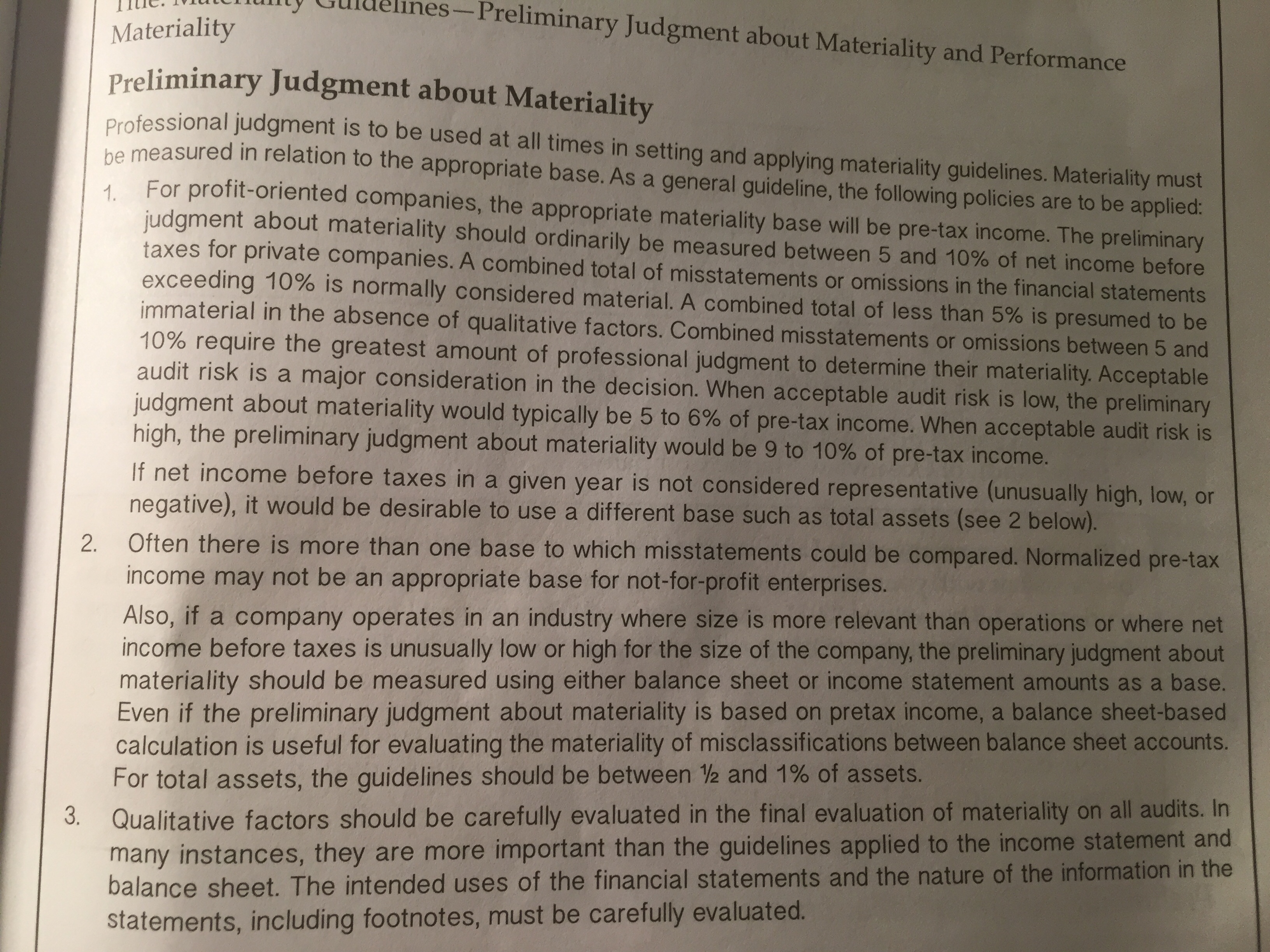
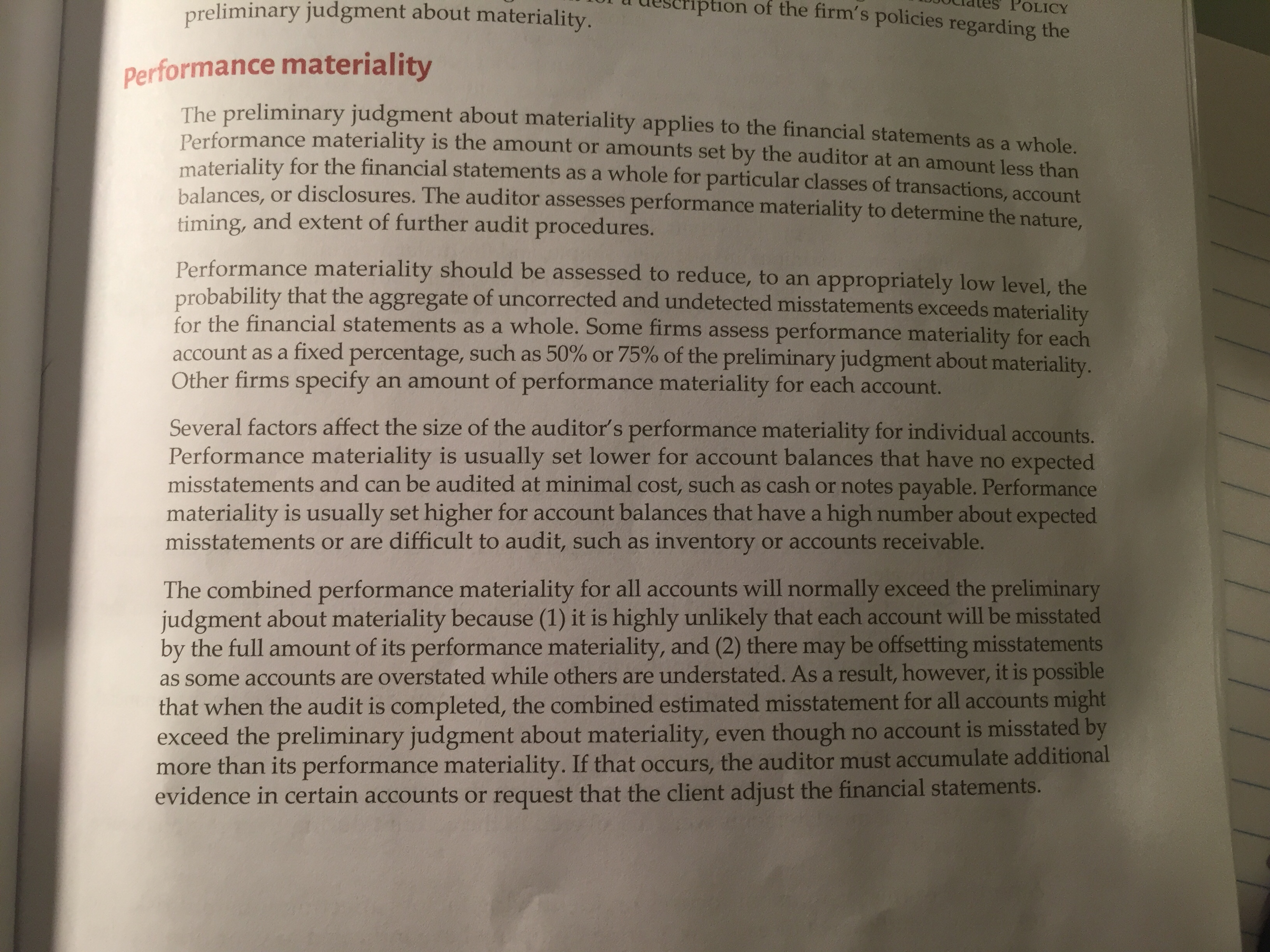
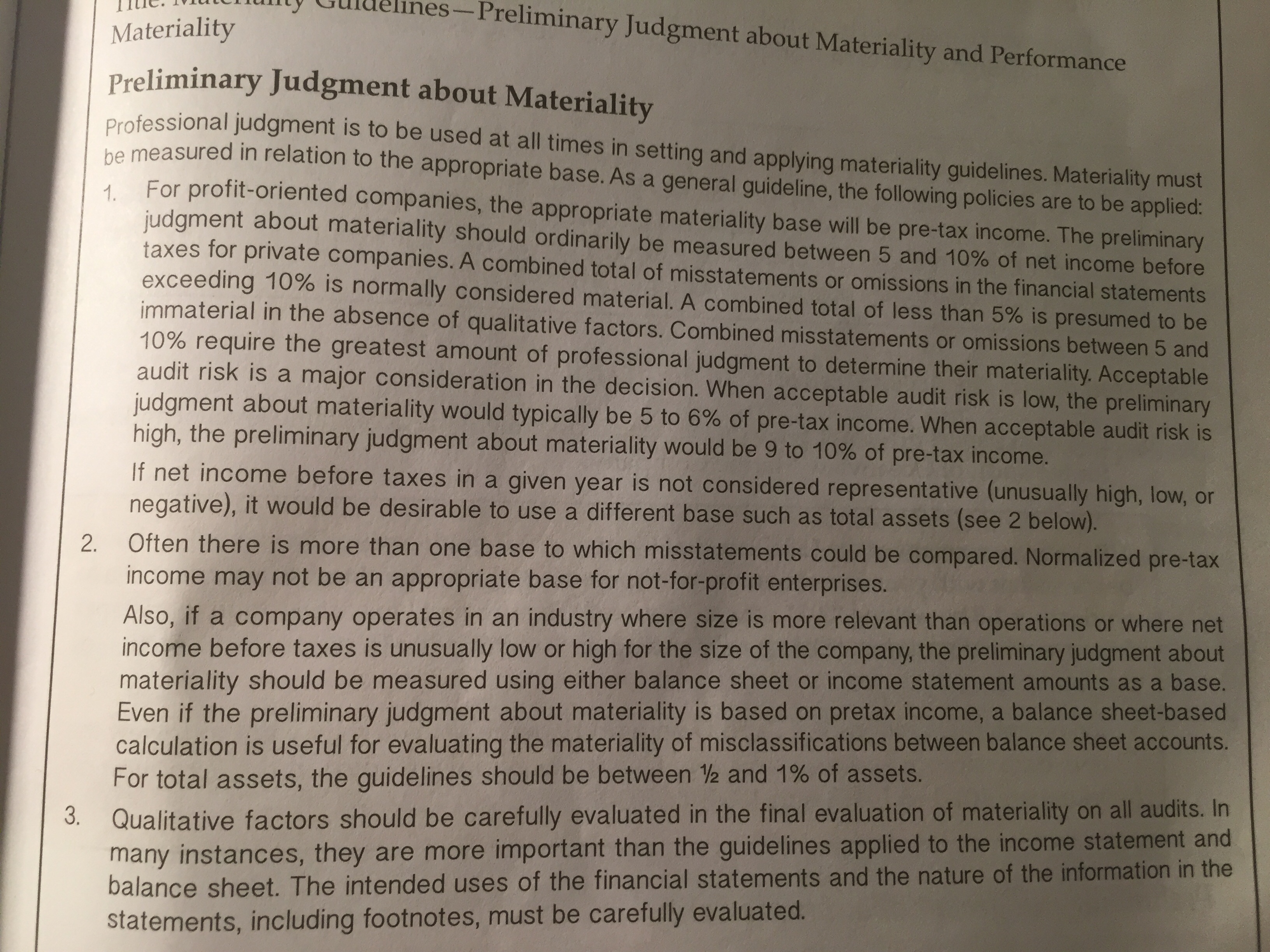
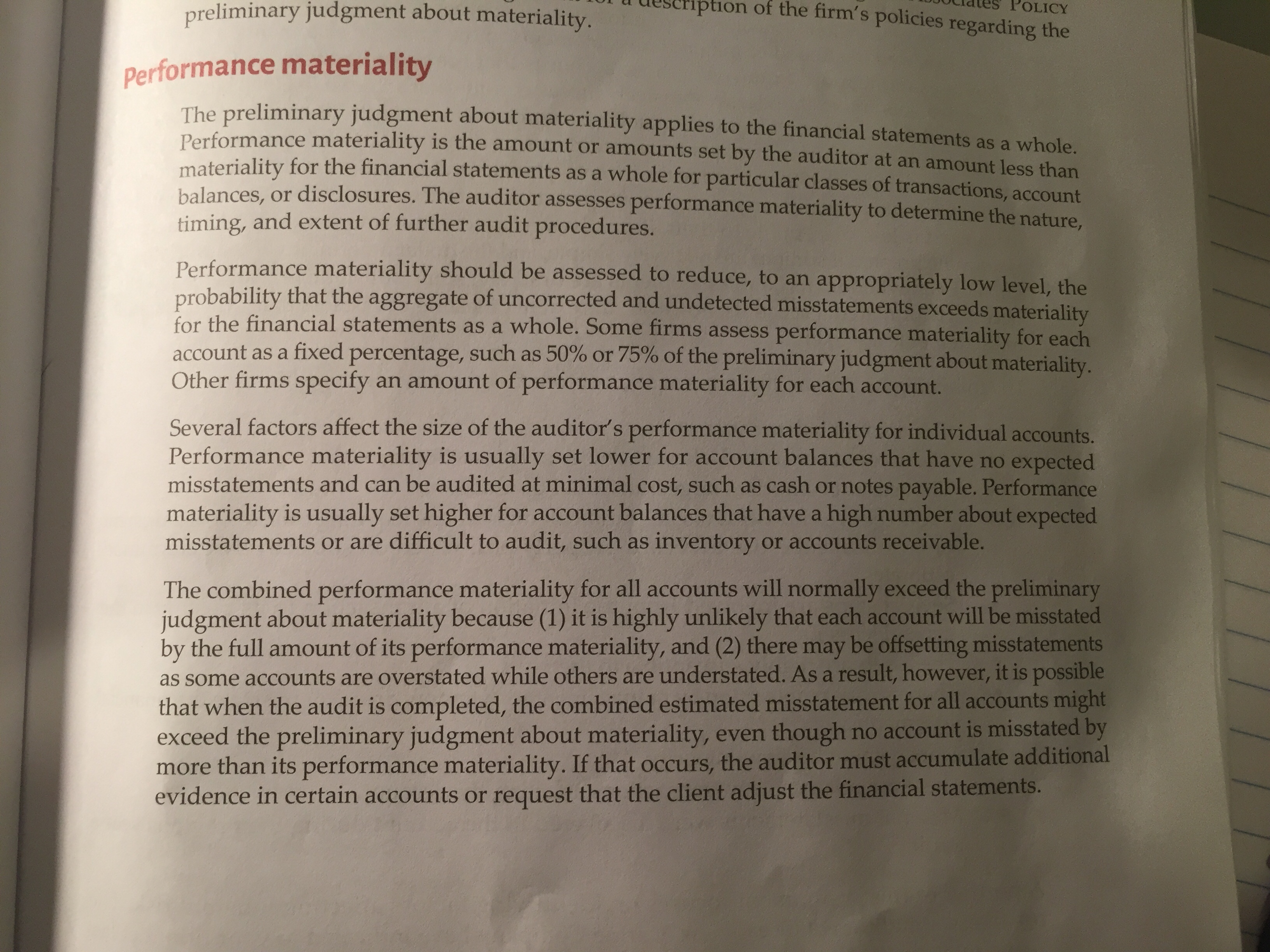
Inherent risk Inherent risk is the risk of a material misstatement in an account before considering the effectiveness of internal control. Inherent risk is assessed for each relevant assertion. The combined assessment of inherent risk and control risk is the risk of material misstatement in the financial statements and consists of: risk related to the nature of the account or transaction (inherent risk) risk related to the client's internal control (control risk) Early in the audit, the auditor assesses inherent risk and control risk. The purpose of assessing risk early is to help the auditor plan the audit by deciding which parts of the audit to emphasize and deciding the extent of testing. In developing these assessments of risk, the auditor considers the nature of the client's business and industry and whether client business risk is associated with increased likelihood of material misstatements in the financial statements. The auditor should examine more extensively those accounts that are most likely to contain material misstatements and examine less extensively those accounts that are least likely to be materially misstated. For example, inventory usually is associated with high inherent risk because it is susceptible to theft, numerous transactions affect inventory in each period, numerous calculations are needed to determine the inventory's year-end valuation, and the dollar amount of the account is usually large. In contrast, prepaid insurance usually has less inherent risk because it is less susceptible to theft, it involves relatively few transactions, calculations to determine prepaid insurance are relatively simple, and the dollar amount involved is relatively small. Even when material misstatements are unlikely, some substantive testing is usually necessary for material accounts; however, the extent of testing can be less than when material misstatements are likely.\fMateriality lelines-Preliminary Judgment about Materiality and Performance Preliminary Judgment about Materiality Professional judgment is to be used at all times in setting and applying materiality guidelines. Materiality must be measured in relation to the appropriate base. As a general guideline, the following policies are to be applied: 1. For profit-oriented companies, the appropriate materiality base will be pre-tax income. The preliminary judgment about materiality should ordinarily be measured between 5 and 10% of net income before taxes for private companies. A combined total of misstatements or omissions in the financial statements exceeding 10% is normally considered material. A combined total of less than 5% is presumed to be immaterial in the absence of qualitative factors. Combined misstatements or omissions between 5 and 10% require the greatest amount of professional judgment to determine their materiality. Acceptable audit risk is a major consideration in the decision. When acceptable audit risk is low, the preliminary judgment about materiality would typically be 5 to 6% of pre-tax income. When acceptable audit risk is high, the preliminary judgment about materiality would be 9 to 10% of pre-tax income. If net income before taxes in a given year is not considered representative (unusually high, low, or negative), it would be desirable to use a different base such as total assets (see 2 below). 2. Often there is more than one base to which misstatements could be compared. Normalized pre-tax income may not be an appropriate base for not-for-profit enterprises. Also, if a company operates in an industry where size is more relevant than operations or where net income before taxes is unusually low or high for the size of the company, the preliminary judgment about materiality should be measured using either balance sheet or income statement amounts as a base. Even if the preliminary judgment about materiality is based on pretax income, a balance sheet-based calculation is useful for evaluating the materiality of misclassifications between balance sheet accounts. For total assets, the guidelines should be between 1/2 and 1% of assets. 3. Qualitative factors should be carefully evaluated in the final evaluation of materiality on all audits. In many instances, they are more important than the guidelines applied to the income statement and balance sheet. The intended uses of the financial statements and the nature of the information in the statements, including footnotes, must be carefully evaluated.preliminary judgment about materiality. scription of the firm's policies regarding the POLICY Performance materiality The preliminary judgment about materiality applies to the financial statements as a whole. Performance materiality is the amount or amounts set by the auditor at an amount less than materiality for the financial statements as a whole for particular classes of transactions, account balances, or disclosures. The auditor assesses performance materiality to determine the nature, timing, and extent of further audit procedures. Performance materiality should be assessed to reduce, to an appropriately low level, the probability that the aggregate of uncorrected and undetected misstatements exceeds materiality for the financial statements as a whole. Some firms assess performance materiality for each account as a fixed percentage, such as 50% or 75% of the preliminary judgment about materiality. Other firms specify an amount of performance materiality for each account. Several factors affect the size of the auditor's performance materiality for individual accounts. Performance materiality is usually set lower for account balances that have no expected misstatements and can be audited at minimal cost, such as cash or notes payable. Performance materiality is usually set higher for account balances that have a high number about expected misstatements or are difficult to audit, such as inventory or accounts receivable. The combined performance materiality for all accounts will normally exceed the preliminary judgment about materiality because (1) it is highly unlikely that each account will be misstated by the full amount of its performance materiality, and (2) there may be offsetting misstatements as some accounts are overstated while others are understated. As a result, however, it is possible that when the audit is completed, the combined estimated misstatement for all accounts might exceed the preliminary judgment about materiality, even though no account is misstated by more than its performance materiality. If that occurs, the auditor must accumulate additional evidence in certain accounts or request that the client adjust the financial statements
Step by Step Solution
There are 3 Steps involved in it

Get step-by-step solutions from verified subject matter experts
 Study Help