



Question: Bob (look up homework 1 if you don't remember who he is) now has another dataset and wants to split it for training/testing again.
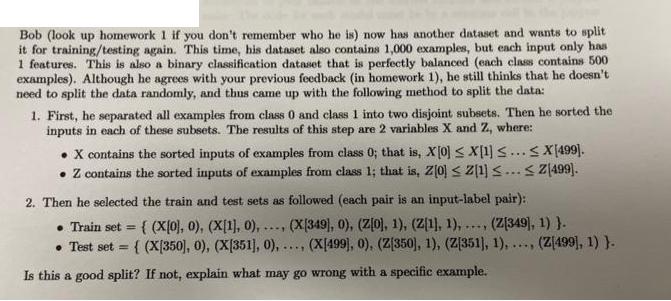
Bob (look up homework 1 if you don't remember who he is) now has another dataset and wants to split it for training/testing again. This time, his dataset also contains 1,000 examples, but each input only has 1 features. This is also a binary classification dataset that is perfectly balanced (each class contains 500 examples). Although he agrees with your previous feedback (in homework 1), he still thinks that he doesn't need to split the data randomly, and thus came up with the following method to split the data: 1. First, he separated all examples from class 0 and class 1 into two disjoint subsets. Then he sorted the inputs in each of these subsets. The results of this step are 2 variables X and Z, where: X contains the sorted inputs of examples from class 0; that is, X[0] < X[1] S... X[499]. Z contains the sorted inputs of examples from class 1; that is, Z[0] < Z[1] S...
Step by Step Solution
There are 3 Steps involved in it

Get step-by-step solutions from verified subject matter experts