







Question: Exploring Relationships among Financial Statements using Excel's SUM and Basic Math Functions Marta Communications, Inc. has provided incomplete financial statements for the month ended
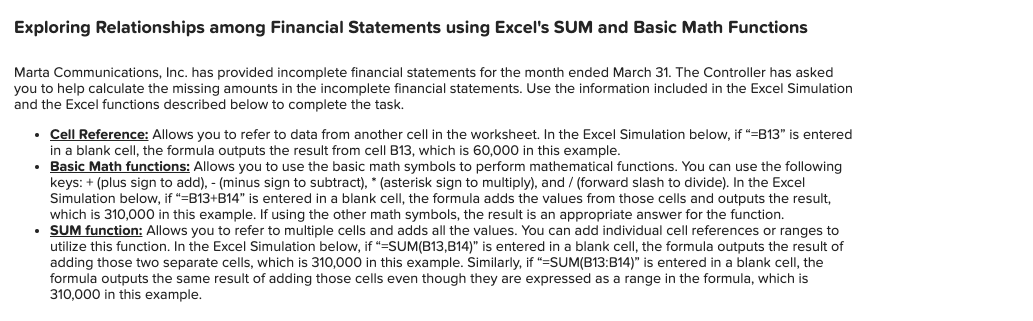

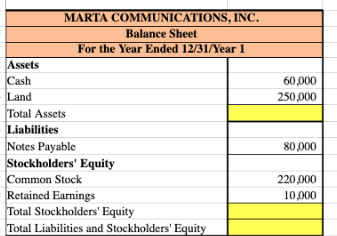
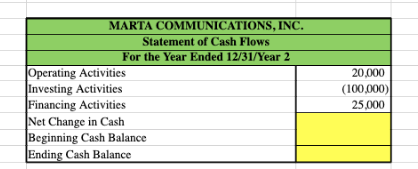
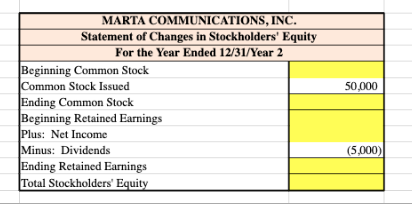
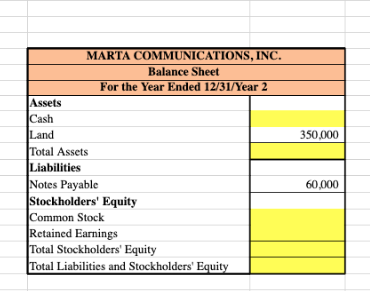
Exploring Relationships among Financial Statements using Excel's SUM and Basic Math Functions Marta Communications, Inc. has provided incomplete financial statements for the month ended March 31. The Controller has asked you to help calculate the missing amounts in the incomplete financial statements. Use the information included in the Excel Simulation and the Excel functions described below to complete the task. Cell Reference: Allows you to refer to data from another cell in the worksheet. In the Excel Simulation below, if "-B13" is entered in a blank cell, the formula outputs the result from cell B13, which is 60,000 in this example. Basic Math functions: Allows you to use the basic math symbols to perform mathematical functions. You can use the following keys: +(plus sign to add), - (minus sign to subtract), *(asterisk sign to multiply), and (forward slash to divide). In the Excel Simulation below, if "-B13+B14" is entered in a blank cell, the formula adds the values from those cells and outputs the result, which is 310,000 in this example. If using the other math symbols, the result is an appropriate answer for the function. SUM function: Allows you to refer to multiple cells and adds all the values. You can add individual cell references or ranges to utilize this function. In the Excel Simulation below, if "=SUM(B13,B14)" is entered in a blank cell, the formula outputs the result of adding those two separate cells, which is 310,000 in this example. Similarly, if "=SUM(B13:B14)" is entered in a blank cell, the formula outputs the same result of adding those cells even though they are expressed as a range in the formula, which is 310,000 in this example.
Step by Step Solution
There are 3 Steps involved in it

Get step-by-step solutions from verified subject matter experts
 Study Help