







Question: Expressions with bitwise AND (&) can be represented in the reverse polish no- tation (suffix notation). For example, the infix expression a&a is represented by
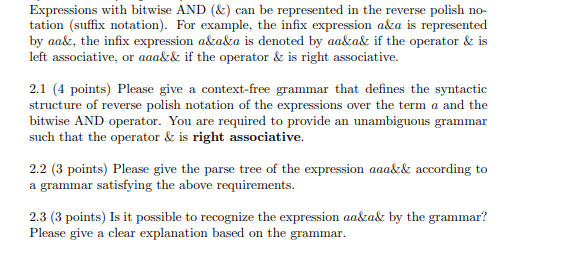
Expressions with bitwise AND (&) can be represented in the reverse polish no- tation (suffix notation). For example, the infix expression a&a is represented by aa&, the infix expression a&a&a is denoted by aa&a& if the operator & is left associative, or aaa&& if the operator & is right associative. 2.1 (4 points) Please give a context-free grammar that defines the syntactic structure of reverse polish notation of the expressions over the term a and the bitwise AND operator. You are required to provide an unambiguous grammar such that the operator & is right associative. 2.2 (3 points) Please give the parse tree of the expression gaa&& according to a grammar satisfying the above requirements. 2.3 (3 points) Is it possible to recognize the expression aa&a& by the grammar? Please give a clear explanation based on the grammar. Expressions with bitwise AND (&) can be represented in the reverse polish no- tation (suffix notation). For example, the infix expression a&a is represented by aa&, the infix expression a&a&a is denoted by aa&a& if the operator & is left associative, or aaa&& if the operator & is right associative. 2.1 (4 points) Please give a context-free grammar that defines the syntactic structure of reverse polish notation of the expressions over the term a and the bitwise AND operator. You are required to provide an unambiguous grammar such that the operator & is right associative. 2.2 (3 points) Please give the parse tree of the expression gaa&& according to a grammar satisfying the above requirements. 2.3 (3 points) Is it possible to recognize the expression aa&a& by the grammar? Please give a clear explanation based on the grammar
Step by Step Solution
There are 3 Steps involved in it

Get step-by-step solutions from verified subject matter experts
 Study Help