







Question: Extended Case Analysis: Case # 9 : Purdue's Dilemma to Increase Sales For the larger midterm and final case study assignments, your submission should be
Extended Case Analysis:
Case #: Purdue's Dilemma to Increase Sales
For the larger midterm and final case study assignments, your submission should be done in a professional manner, and constructed as if you are a consultant providing a solution to the situation. The expected length of your submission is three to five pages, double spaced, using margins. This does not include a cover page or reference list if used
Your submission in these larger cases should follow this format:
Introduction
Present an overview of the key problems and issues in the case.
Provide a thesis statement that summarizes your analysis in one or two sentences.
Background, key facts, and issues
Provide background information, relevant facts, and the most important issues.
Tie to class materials.
Alternatives
Outline two to five possible alternatives certainly not all of them
Discuss the critical constraints.
Explain the strengths and weaknesses of the alternatives.
Proposed solution or Recommend one solution.
Explain why this solution was chosen.
Support this solution with facts and class materials.
Provide personal experiences, if applicable.
Recommendations
Determine and discuss the specific strategies needed to accomplish the proposed solution.
If applicable, define what further information is needed.
For all submissions, remember this is business, so be concise, complete, persuasive, and support your responses.
Note: The following case is based on the sources cited. It is intended for case study purposes only and does not imply acceptance of any statement as fact.
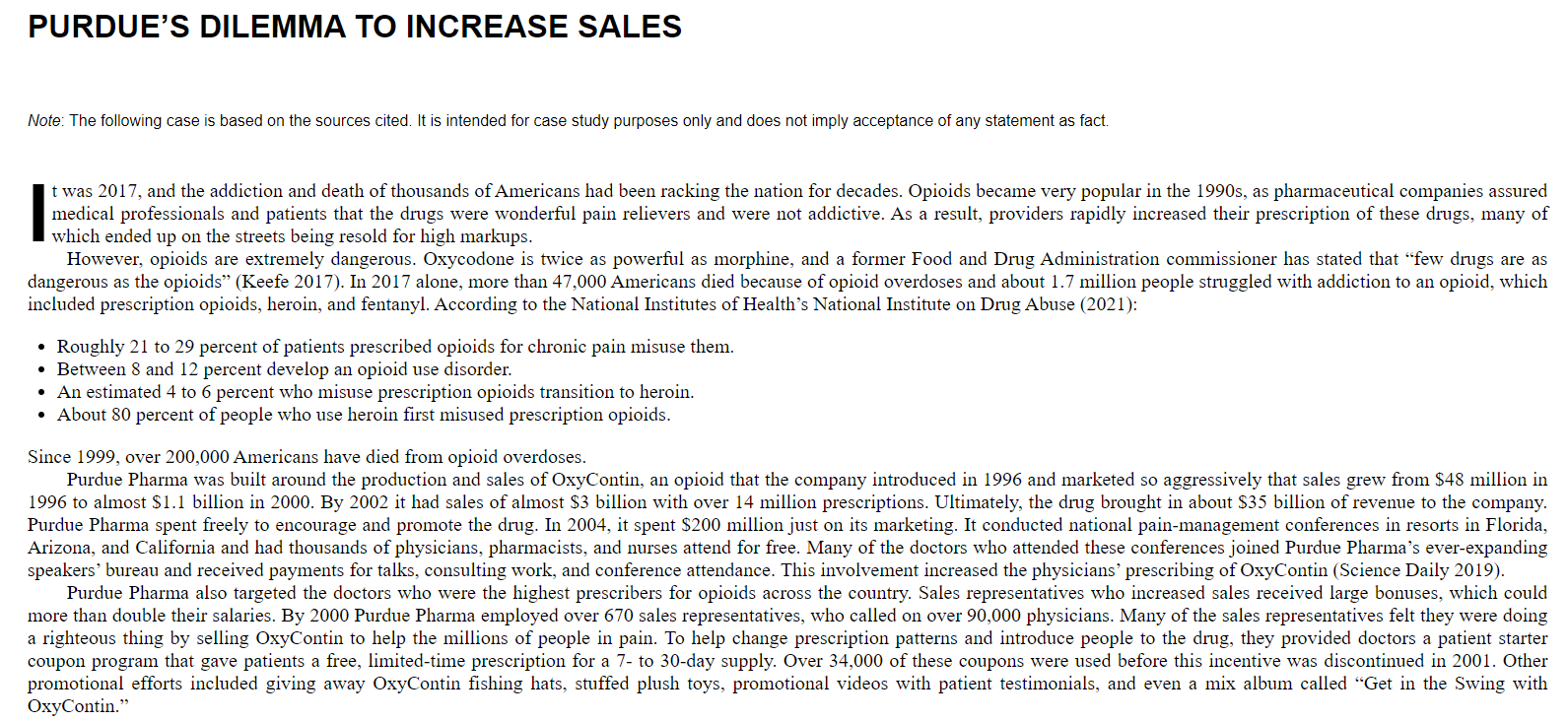
t was and the addiction and death of thousands of Americans had been racking the nation for decades. Opioids became very popular in the s as pharmaceutical companies assured medical professionals and patients that the drugs were wonderful pain relievers and were not addictive. As a result, providers rapidly increased their prescription of these drugs, many of which ended up on the streets being resold for high markups.
However, opioids are extremely dangerous. Oxycodone is twice as powerful as morphine, and a former Food and Drug Administration commissioner has stated that "few drugs are as dangerous as the opioids" Keefe In alone, more than Americans died because of opioid overdoses and about million people struggled with addiction to an opioid, which included prescription opioids, heroin, and fentanyl. According to the National Institutes of Health's National Institute on Drug Abuse :
Roughly to percent of patients prescribed opioids for chronic pain misuse them.
Between and percent develop an opioid use disorder.
An estimated to percent who misuse prescription opioids transition to heroin.
About percent of people who use heroin first misused prescription opioids.
Since over Americans have died from opioid overdoses.
Purdue Pharma was built around the production and sales of OxyContin, an opioid that the company introduced in and marketed so aggressively that sales grew from $ million in to almost $ billion in By it had sales of almost $ billion with over million prescriptions. Ultimately, the drug brought in about $ billion of revenue to the company. Purdue Pharma spent freely to encourage and promote the drug. In it spent $ million just on its marketing. It conducted national painmanagement conferences in resorts in Florida, Arizona, and California and had thousands of physicians, pharmacists, and nurses attend for free. Many of the doctors who attended these conferences joined Purdue Pharma's everexpanding speakers' bureau and received payments for talks, consulting work, and conference attendance. This involvement increased the physicians' prescribing of OxyContin Science Daily
Purdue Pharma also targeted the doctors who were the highest prescribers for opioids across the country. Sales representatives who increased sales received large bonuses, which could more than double their salaries. By Purdue Pharma employed over sales representatives, who called on over physicians. Many of the sales representatives felt they were doing a righteous thing by selling OxyContin to help the millions of people in pain. To help change prescription patterns and introduce people to the drug, they provided doctors a patient starter coupon program that gave patients a free, limitedtime prescription for a to day supply. Over of these coupons were used before this incentive was discontinued in Other promotional efforts included giving away OxyContin fishing hats, stuffed plush toys, promotional videos with patient testimonials, and even a mix album called "Get in the Swing with OxyContin." Sales representatives were trained to overcome objections and concerns from clinicians. If asked about addiction, they were to state that the slowrelease system of the drug reduced the abuse liability of the drug, which was not true. Basically, they
Step by Step Solution
There are 3 Steps involved in it
1 Expert Approved Answer
Step: 1 Unlock

Question Has Been Solved by an Expert!
Get step-by-step solutions from verified subject matter experts
Step: 2 Unlock
Step: 3 Unlock
 Study Help