Question: External pressures often challenge organizations to make difficult changes. Skilled change managers can help leaders develop creative solutions when they understand the variety of internal
External pressures often challenge organizations to make difficult changes. Skilled change managers can help leaders develop creative solutions when they understand the variety of internal and external pressures that commonly cause change. Change management approaches, such as the action research approach, can help ensure all stakeholders needs are considered, which will improve the likelihood of them getting on board with the changes.
Review the following case study from Ch. 3, Why Change? Contemporary Pressures and Drivers, of Managing Organizational Change: A Multiple Perspectives Approach: Case Analysis: The Sunderland City Story
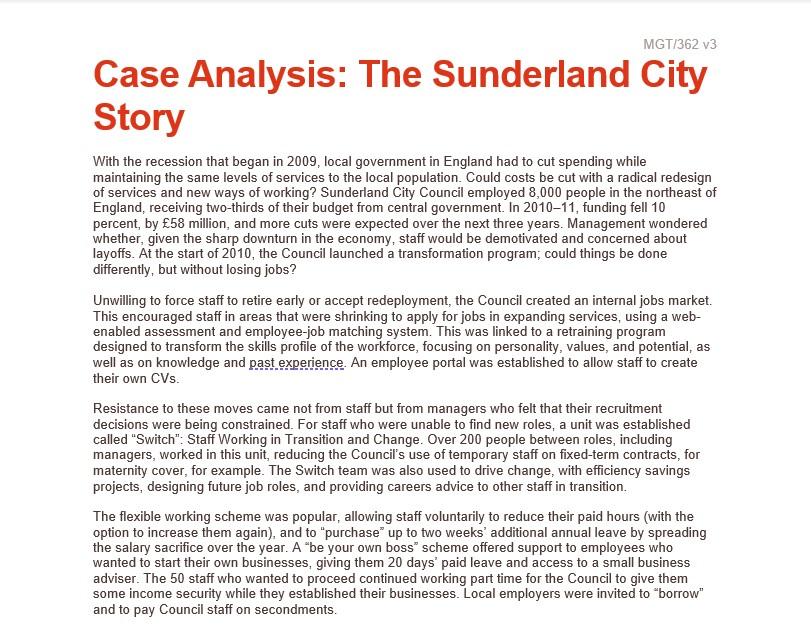
Imagine you are in a managerial role in a company experiencing a similar situation as Sunderland. Funding is to be cut due to the recent recession, and leadership would like to go with an OD approach. Analyze the situation at Sunderland through the OD lens to provide insight to company leadership about upcoming change management decisions they will need to make soon.
- Describe how the 8-step OD Practitioner action research approach may have been used to understand and address the concerns of these managers. Focus on 2-3 key steps where these managers should have played a greater role. Note: The case indicates that the changes were popular among staff, but resistance came from, managers who felt that their recruitment decisions were being constrained.
MGT/362 v3 Case Analysis: The Sunderland City Story With the recession that began in 2009, local government in England had to cut spending while maintaining the same levels of services to the local population. Could costs be cut with a radical redesign of services and new ways of working? Sunderland City Council employed 8,000 people in the northeast of England, receiving two-thirds of their budget from central government. In 2010-11, funding fell 10 percent, by 58 million, and more cuts were expected over the next three years. Management wondered whether, given the sharp downturn in the economy, staff would be demotivated and concerned about layoffs. At the start of 2010, the Council launched a transformation program, could things be done differently, but without losing jobs? Unwilling to force staff to retire early or accept redeployment, the Council created an internal jobs market. This encouraged staff in areas that were shrinking to apply for jobs in expanding services, using a web- enabled assessment and employee-job matching system. This was linked to a retraining program designed to transform the skills profile of the workforce, focusing on personality, values, and potential, as well as on knowledge and past experience. An employee portal was established to allow staff to create their own CVs. Resistance to these moves came not from staff but from managers who felt that their recruitment decisions were being constrained. For staff who were unable to find new roles, a unit was established called "Switch": Staff Working in Transition and Change. Over 200 people between roles, including managers, worked in this unit, reducing the Council's use of temporary staff on fixed-term contracts, for maternity cover, for example. The Switch team was also used to drive change, with efficiency savings projects, designing future job roles, and providing careers advice to other staff in transition. The flexible working scheme was popular, allowing staff voluntarily to reduce their paid hours (with the option to increase them again), and to "purchase up to two weeks' additional annual leave by spreading the salary sacrifice over the year. A "be your own boss" scheme offered support to employees who wanted to start their own businesses, giving them 20 days' paid leave and access to a small business adviser. The 50 staff who wanted to proceed continued working part time for the Council to give them some income security while they established their businesses. Local employers were invited to "borrow" and to pay Council staff on secondments









 Study Help