







Question: External temperature, day : 12 External temperature, night : 3 Number of floors: 18 Width of the building: 24 Length of the building: 38 INSULATION
External temperature, day : 12
External temperature, night : 3
Number of floors: 18
Width of the building: 24
Length of the building: 38
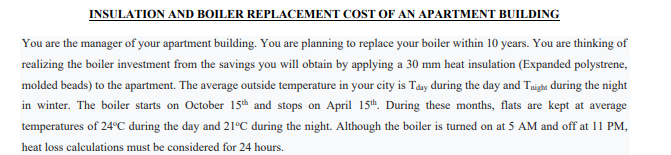
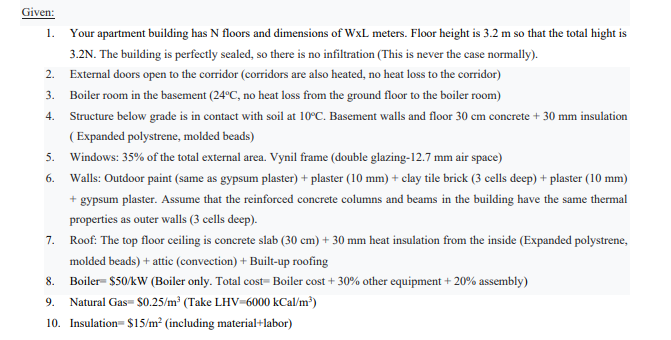
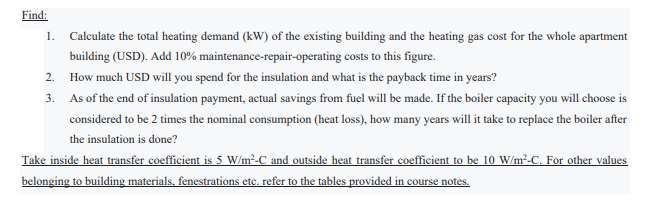
INSULATION AND BOILER REPLACEMENT COST OF AN APARTMENT BUILDING You are the manager of your apartment building. You are planning to replace your boiler within 10 years. You are thinking of realizing the boiler investment from the savings you will obtain by applying a 30 mm heat insulation (Expanded polystrene, molded beads) to the apartment. The average outside temperature in your city is Tay during the day and Tmight during the night in winter. The boiler starts on October 15th and stops on April 15th. During these months, flats are kept at average temperatures of 24C during the day and 21C during the night. Although the boiler is turned on at 5 AM and off at 11 PM, heat loss calculations must be considered for 24 hours. Given: 1. Your apartment building has N floors and dimensions of WxL meters. Floor height is 3.2 m so that the total hight is 3.2N. The building is perfectly sealed, so there is no infiltration (This is never the case normally). 2. External doors open to the corridor (corridors are also heated, no heat loss to the corridor) 3. Boiler room in the basement (24C, no heat loss from the ground floor to the boiler room) 4. Structure below grade is in contact with soil at 10C. Basement walls and floor 30 cm concrete + 30 mm insulation (Expanded polystrene, molded beads) 5. Windows: 35% of the total external area. Vynil frame (double glazing-12.7 mm air space) 6. Walls: Outdoor paint (same as gypsum plaster) + plaster (10 mm) + clay tile brick (3 cells deep) + plaster (10 mm) + gypsum plaster. Assume that the reinforced concrete columns and beams in the building have the same thermal properties as outer walls (3 cells deep). 7. Roof: The top floor ceiling is concrete slab (30 cm) + 30 mm heat insulation from the inside (Expanded polystrene, molded beads) + attic (convection) + Built-up roofing 8. Boiler= $50/kW (Boiler only. Total cost-Boiler cost +30% other equipment + 20% assembly) Natural Gas=$0.25/m2 (Take LHV-6000 kcal/m) 10. Insulation $15/m (including material+labor) 9. Find: 1. Calculate the total heating demand (kW) of the existing building and the heating gas cost for the whole apartment building (USD). Add 10% maintenance-repair-operating costs to this figure. 2. How much USD will you spend for the insulation and what is the payback time in years? 3. As of the end of insulation payment, actual savings from fuel will be made. If the boiler capacity you will choose is considered to be 2 times the nominal consumption (heat loss), how many years will it take to replace the boiler after the insulation is done? Take inside heat transfer coefficient is 5 W/m-C and outside heat transfer coefficient to be 10 W/m-C. For other values belonging to building materials, fenestrations etc. refer to the tables provided in course notes. INSULATION AND BOILER REPLACEMENT COST OF AN APARTMENT BUILDING You are the manager of your apartment building. You are planning to replace your boiler within 10 years. You are thinking of realizing the boiler investment from the savings you will obtain by applying a 30 mm heat insulation (Expanded polystrene, molded beads) to the apartment. The average outside temperature in your city is Tay during the day and Tmight during the night in winter. The boiler starts on October 15th and stops on April 15th. During these months, flats are kept at average temperatures of 24C during the day and 21C during the night. Although the boiler is turned on at 5 AM and off at 11 PM, heat loss calculations must be considered for 24 hours. Given: 1. Your apartment building has N floors and dimensions of WxL meters. Floor height is 3.2 m so that the total hight is 3.2N. The building is perfectly sealed, so there is no infiltration (This is never the case normally). 2. External doors open to the corridor (corridors are also heated, no heat loss to the corridor) 3. Boiler room in the basement (24C, no heat loss from the ground floor to the boiler room) 4. Structure below grade is in contact with soil at 10C. Basement walls and floor 30 cm concrete + 30 mm insulation (Expanded polystrene, molded beads) 5. Windows: 35% of the total external area. Vynil frame (double glazing-12.7 mm air space) 6. Walls: Outdoor paint (same as gypsum plaster) + plaster (10 mm) + clay tile brick (3 cells deep) + plaster (10 mm) + gypsum plaster. Assume that the reinforced concrete columns and beams in the building have the same thermal properties as outer walls (3 cells deep). 7. Roof: The top floor ceiling is concrete slab (30 cm) + 30 mm heat insulation from the inside (Expanded polystrene, molded beads) + attic (convection) + Built-up roofing 8. Boiler= $50/kW (Boiler only. Total cost-Boiler cost +30% other equipment + 20% assembly) Natural Gas=$0.25/m2 (Take LHV-6000 kcal/m) 10. Insulation $15/m (including material+labor) 9. Find: 1. Calculate the total heating demand (kW) of the existing building and the heating gas cost for the whole apartment building (USD). Add 10% maintenance-repair-operating costs to this figure. 2. How much USD will you spend for the insulation and what is the payback time in years? 3. As of the end of insulation payment, actual savings from fuel will be made. If the boiler capacity you will choose is considered to be 2 times the nominal consumption (heat loss), how many years will it take to replace the boiler after the insulation is done? Take inside heat transfer coefficient is 5 W/m-C and outside heat transfer coefficient to be 10 W/m-C. For other values belonging to building materials, fenestrations etc. refer to the tables provided in course notes
Step by Step Solution
There are 3 Steps involved in it

Get step-by-step solutions from verified subject matter experts
 Study Help