Question: Extra Suppose we are playing a typical finite bargaining game of length T (pie vanishing if no agreement after round T), size of pie 1,
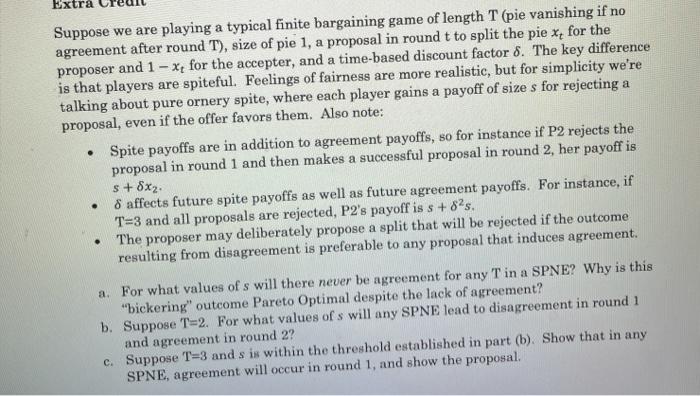
Extra Suppose we are playing a typical finite bargaining game of length T (pie vanishing if no agreement after round T), size of pie 1, a proposal in round t to split the pie xfor the proposer and 1 X, for the accepter, and a time-based discount factor 8. The key difference is that players are spiteful. Feelings of fairness are more realistic, but for simplicity we're talking about pure ornery spite, where each player gains a payoff of sizes for rejecting a proposal, even if the offer favors them. Also note: Spite payoffs are in addition to agreement payoffs, so for instance if P2 rejects the proposal in round 1 and then makes a successful proposal in round 2, her payoff is s +8x2. 8 affects future spite payoffs as well as future agreement payoffs. For instance, if T=3 and all proposals are rejected, P2's payoff is s + 8s. The proposer may deliberately propose a split that will be rejected if the outcome resulting from disagreement is preferable to any proposal that induces agreement. . a. For what values of s will there never be agreement for any T in a SPNE? Why is this "bickering" outcome Pareto Optimal despite the lack of agreement? b. Suppose T=2. For what values of s will any SPNE lead to disagreement in round 1 and agreement in round 2? c. Suppose T=3 and s is within the threshold established in part (b). Show that in any SPNE, agreement will occur in round 1, and show the proposal. Extra Suppose we are playing a typical finite bargaining game of length T (pie vanishing if no agreement after round T), size of pie 1, a proposal in round t to split the pie xfor the proposer and 1 X, for the accepter, and a time-based discount factor 8. The key difference is that players are spiteful. Feelings of fairness are more realistic, but for simplicity we're talking about pure ornery spite, where each player gains a payoff of sizes for rejecting a proposal, even if the offer favors them. Also note: Spite payoffs are in addition to agreement payoffs, so for instance if P2 rejects the proposal in round 1 and then makes a successful proposal in round 2, her payoff is s +8x2. 8 affects future spite payoffs as well as future agreement payoffs. For instance, if T=3 and all proposals are rejected, P2's payoff is s + 8s. The proposer may deliberately propose a split that will be rejected if the outcome resulting from disagreement is preferable to any proposal that induces agreement. . a. For what values of s will there never be agreement for any T in a SPNE? Why is this "bickering" outcome Pareto Optimal despite the lack of agreement? b. Suppose T=2. For what values of s will any SPNE lead to disagreement in round 1 and agreement in round 2? c. Suppose T=3 and s is within the threshold established in part (b). Show that in any SPNE, agreement will occur in round 1, and show the proposal