







Question: . Extrapolate the initial slope of the output pulse until the line intersects 1v. Measure the time between the start of the pulse and the
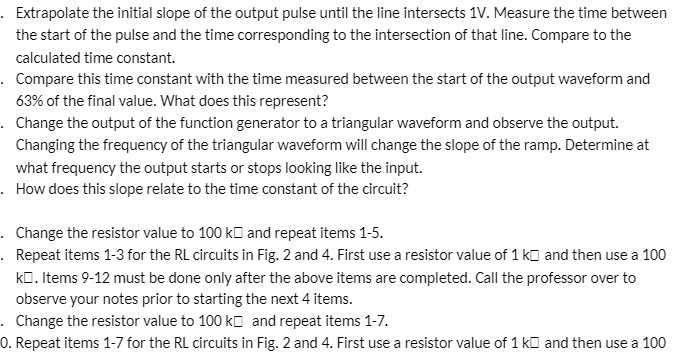
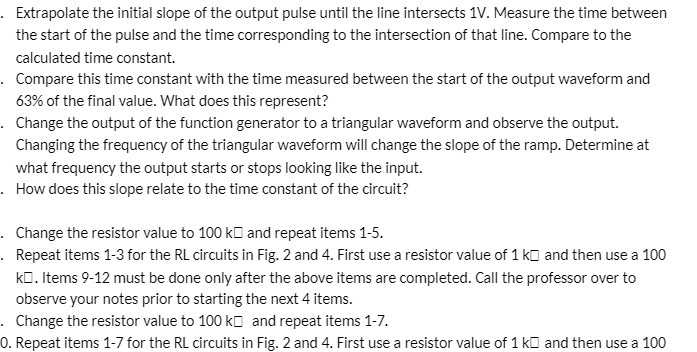
. Extrapolate the initial slope of the output pulse until the line intersects 1v. Measure the time between the start of the pulse and the time corresponding to the intersection of that line. Compare to the calculated time constant. . Compare this time constant with the time measured between the start of the output waveform and 63% of the final value. What does this represent? . Change the output of the function generator to a triangular waveform and observe the output. Changing the frequencv of the triangular waveform will change the slope ofthe ramp. Determine at what freouencv the output starts or stops looking like the input. . How does this slope relate to the time constant of the circuit? . Change the resistor value to 1131] k: and repeat items 1-5. . Repeat items 1-3 for the RL circuits in Fig. 2 and 4. First use a resistor value of 1 k: and then use a 100 iii. Items 9-12 must be done onlyr after the above items are completed. |Call the professor over to observe 1vour notes prior to starting the next 4 items. . Change the resistor value to 1GB k: and repeat items 1-1 II}. Repeat items 1-? for the RL circuits in Fig. 2 and 4. First use a resistor value of 1 k: and then use a 100
Step by Step Solution
There are 3 Steps involved in it

Get step-by-step solutions from verified subject matter experts
 Study Help