







Question: I. (30 marks total) Consider a modification of the search and matching model of the labour market from LN2. In that model, we as;umed
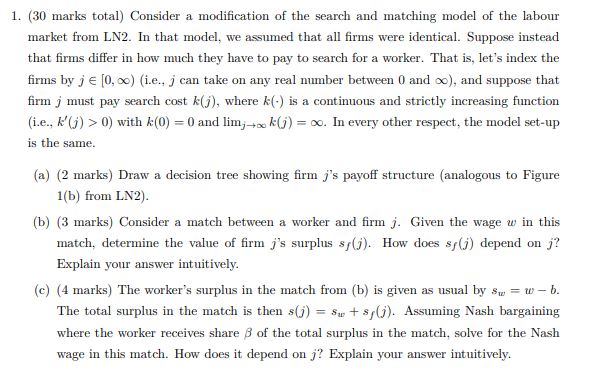
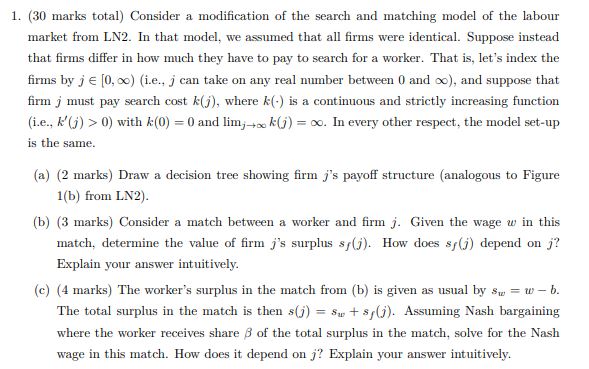
I. (30 marks total) Consider a modification of the search and matching model of the labour market from LN2. In that model, we as;umed that all firms were identical. Suppose instead that firms differ in how much they have to pay to search for a worker. That is, let's index the firms by j E [O, m) (i.e., j can take on any real number between O and m), and suppose that firm j must pay search cost k(j), where k() is a continuous and strictly increasing function (i.e V (j) > O) with k(O) O and k(j) x. In every other respect, the model set-up is the same. (a) (2 marks) Draw a decision tree showing firm j's payoff structure (analogous to Figure I(b) from LN2). (b) (3 marks) Consider a match between a worker and firm j. Given the wage w in this match, determine the value of firm j's surplus Sf(j). How dews depend on j? Explain your answer intuitively. (c) (4 marks) The worker's surplus in the match from (b) is given as usual by sw b. The total surplus in the match is then s(j) + Sf(j). Assuming Nash bargaining where the worker receives share of the total surplus in the match, solve for the Nash wage in this match. How does it depend on j? Explain your answer intuitively.
Step by Step Solution
There are 3 Steps involved in it

Get step-by-step solutions from verified subject matter experts
 Study Help